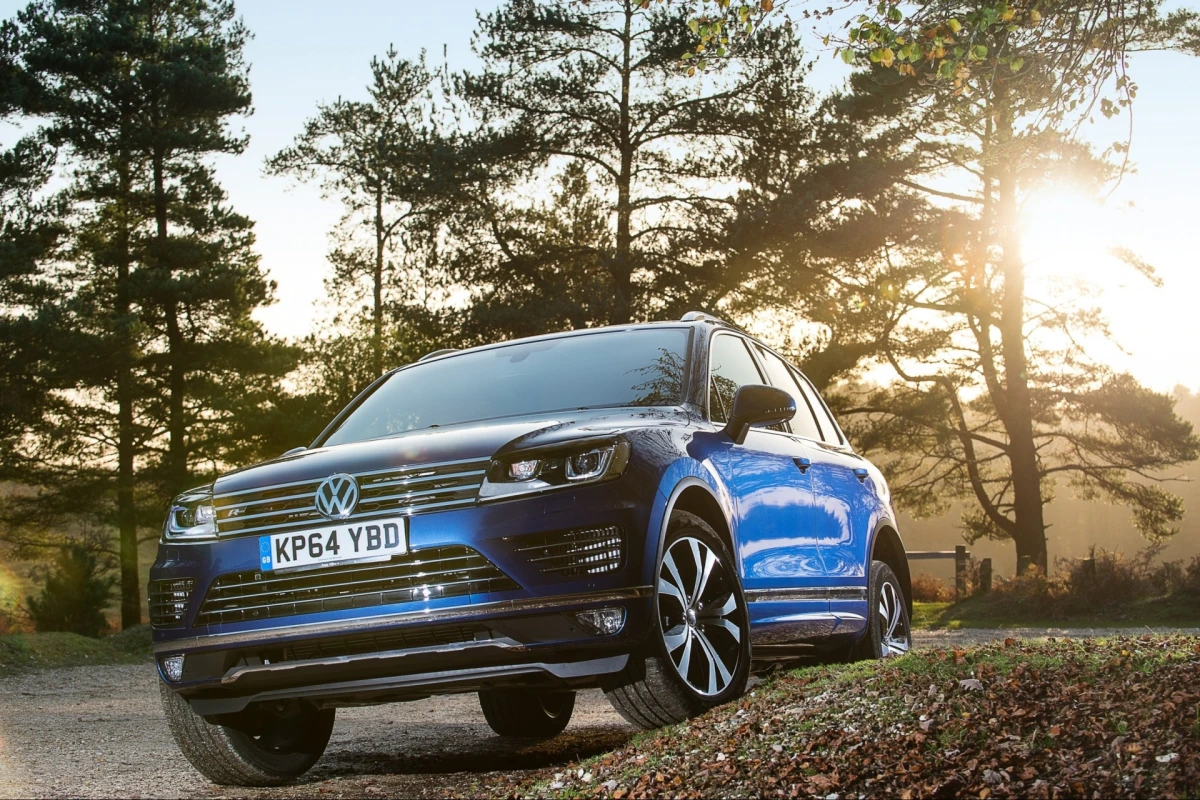



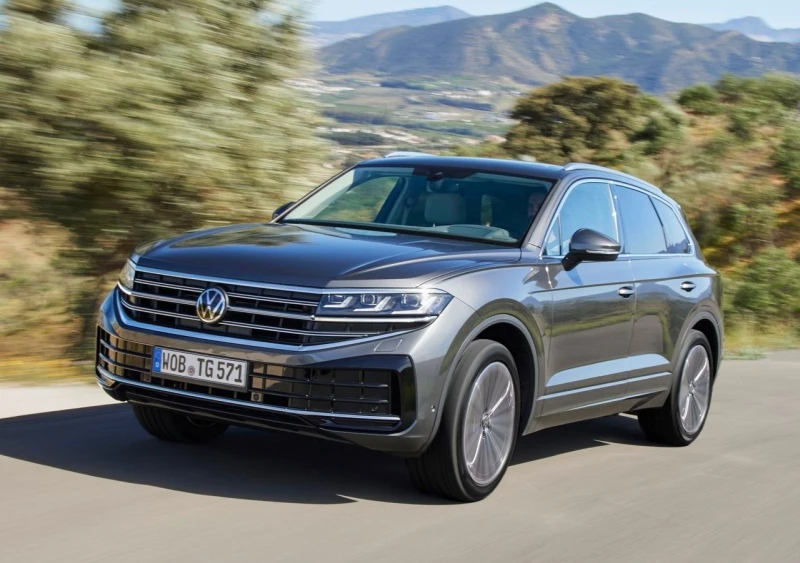
The CR-generation Touareg uses the MLB Evo platform, with a longitudinally mounted engine, permanent 4MOTION all-wheel drive, and an eight-speed Tiptronic automatic transmission. That layout places it alongside the Volkswagen Group’s larger vehicles engineered for substantial torque, high gross vehicle weights, and heavy towing. Volkswagen never officially offered this generation in the United States; the specifications below cover overseas versions, not a U.S. model lineup.
The platform provides a useful starting point for understanding the third-generation Volkswagen Touareg. It grew longer and wider than its predecessor, adopted a body combining aluminum with high-strength steel, and gained a more complex electronic architecture. Available chassis equipment included air suspension, rear-wheel steering, and active anti-roll bars. Across most versions, however, the basic formula remained consistent: a V6 engine, eight forward gears, and power delivered to both axles.
This article focuses on powertrains, dimensions, and ownership considerations for those overseas models. Styling, interior features, and trim-level differences are covered elsewhere in the Volkswagen Touareg III series. These specifications should not be applied to the earlier Touareg generations sold in the United States.
One Drivetrain Layout, Several Engine Personalities
In Europe, the CR lineup included two V6 diesels and a gasoline V6, along with a 4.0-liter V8 TDI, an eHybrid plug-in hybrid, and the more powerful Touareg R at different points in its production run. None formed part of an official U.S. third-generation lineup. The table summarizes those overseas powertrains across multiple model years, rather than presenting them as simultaneously available new vehicles. Horsepower figures are approximate conversions from the original metric PS ratings, not U.S. SAE-certified ratings.
| Engine | Displacement | Output | Transmission | Drive |
| V6 TDI turbodiesel | 3.0 liters | 228 hp, 369 lb-ft | 8-speed Tiptronic automatic | Permanent 4MOTION AWD |
| V6 TDI turbodiesel | 3.0 liters | 282 hp, 443 lb-ft | 8-speed Tiptronic automatic | Permanent 4MOTION AWD |
| V6 TSI turbocharged gasoline | 3.0 liters | 335 hp, 332 lb-ft | 8-speed Tiptronic automatic | Permanent 4MOTION AWD |
| V8 TDI turbodiesel | 4.0 liters | 415 hp, 664 lb-ft | 8-speed Tiptronic automatic | Permanent 4MOTION AWD |
| V6 TSI with electric motor, eHybrid | 3.0 liters | 376 hp, 443 lb-ft combined | 8-speed automatic with integrated electric motor | Permanent 4MOTION AWD |
| V6 TSI with electric motor, Touareg R eHybrid | 3.0 liters | 456 hp, 516 lb-ft combined | 8-speed automatic with integrated electric motor | Permanent 4MOTION AWD |
The 228-hp diesel is a different calibration of the 3.0-liter V6 TDI, rather than a smaller engine with a separate basic design. Its 369 lb-ft arrives low in the rev range, providing sufficient pulling power for everyday driving, highway trips, and a full load of passengers and luggage. The 282-hp version raises torque to 443 lb-ft and offers stronger passing performance. Both belong to the overseas lineup.
The gasoline 3.0-liter V6 produces less peak torque but sustains it across a broader engine-speed range. The overseas specifications cited here give it a 0–62 mph time of approximately 6.1 seconds, compared with about 7.7 and 6.4 seconds for the lower- and higher-output V6 diesels, respectively. These are conversions of 0–100 km/h figures, not 0–60 mph test results. Listed top speeds are approximately 138 mph for the 228-hp TDI, 147 mph for the 282-hp TDI, and 155 mph for the gasoline V6.
Why Tiptronic Matters More Than the Gear Count
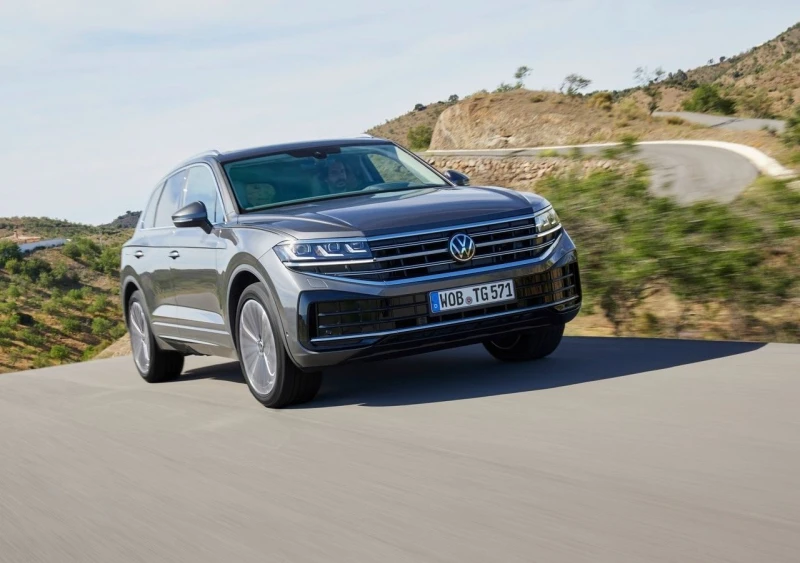
The eight-speed transmission is designed to handle substantial torque and uses a conventional automatic layout, unlike the DSG dual-clutch transmissions found in many smaller Volkswagens. It works with a transfer case and a self-locking center differential. Depending on available traction, the system can direct up to 70% of torque to the front axle or up to 80% to the rear.
There is no front-wheel-drive alternative or manual-transmission option within the lineup covered here. For an owner evaluating one of these vehicles overseas, transmission-fluid condition, smooth operation both cold and warm, transfer-case behavior, and consistent wear across all four tires matter more than the odometer reading alone. Different tire rolling diameters place additional strain on the AWD system, making a set with substantially uneven wear undesirable.
Dimensions Changed Less Than the Catalog Descriptions
The 2023 update retained the basic body architecture, but revised bumpers increased overall length to approximately 193.0 inches in the Ukrainian-market specifications used for the updated models below. Width remained 78.1 inches without mirrors and 86.3 inches with them. Height varies with suspension type, air-suspension setting, wheels, and equipment. These are overseas measurements; there is no corresponding U.S.-specification CR model.
| Configuration | Length / width / height | Wheelbase | Listed curb weight | Gross vehicle weight rating | Transmission / drive |
| Updated 3.0 TDI, Ukrainian specification | 193.0 / 78.1 / 66.1–67.4 in | 114.3 in | Approx. 4,680 lb | 6,280 lb | 8-speed automatic / 4MOTION |
| Updated 3.0-liter gasoline V6, Ukrainian specification | 193.0 / 78.1 / 66.1–67.4 in | 114.3 in | Approx. 4,540 lb | 6,190 lb | 8-speed automatic / 4MOTION |
| Pre-update non-hybrid versions, overseas specifications | Approx. 192.0 / 78.1 / 67.0–67.6 in | Approx. 114.3 in | Approx. 4,400–4,740 lb | Varies by version | 8-speed automatic / 4MOTION |
| Pre-update Touareg eHybrid, overseas specification | Approx. 192.0 / 78.1 / up to 67.6 in | 114.3 in | Approx. 5,200 lb | 6,640 lb | 8-speed automatic / 4MOTION |
| Pre-update Touareg R eHybrid, overseas specification | Approx. 192.0 / 78.1 / up to 67.6 in | 114.3 in | Up to approx. 5,580 lb | 6,640 lb | 8-speed automatic / 4MOTION |
Engine choice accounts for only part of the weight variation. Air suspension, active roll control, rear-wheel steering, a panoramic roof, larger wheels, and other equipment can add substantial weight. The hybrids stand out: their traction battery reduces standard cargo capacity from approximately 28.6 to 23.5 cubic feet and takes curb weight beyond 5,000 pounds. Folding the rear seats provides up to approximately 63.6 cubic feet in conventional versions and 59.2 cubic feet in the PHEVs. These cargo figures are direct conversions of overseas ratings, not measurements under a U.S. cargo-volume standard; overseas curb-weight definitions may also differ.
The Ukrainian specifications cited here list standard ground clearance at approximately 7.9 inches, with an air-suspension range of roughly 7.3–10.2 inches. Air suspension also increases the stated wading depth from approximately 19.3 to 22.4 inches. Those figures do not make the Touareg CR a utilitarian off-roader: low exterior trim, substantial weight, and road-oriented tires still limit how effectively its clearance can be used.
The Update Refined the Chassis, Not the Basic Powertrains
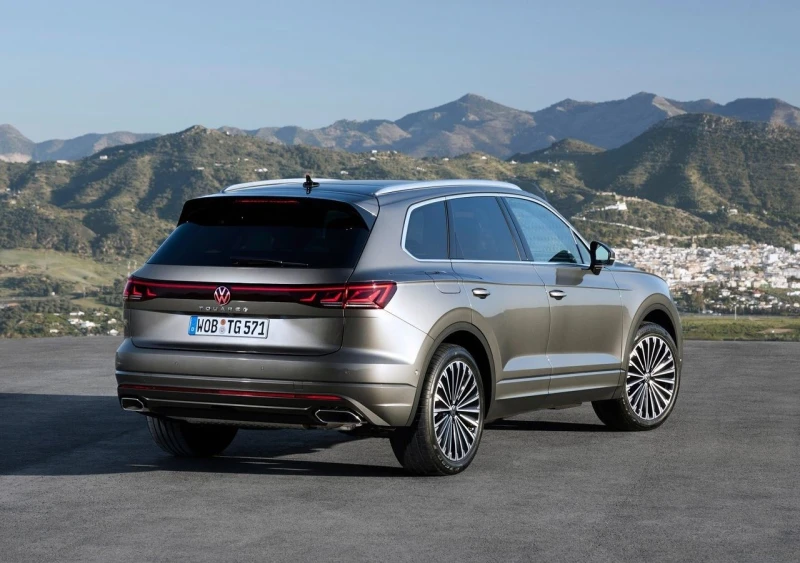
The 2023 update retained the European lineup’s core engines: the two 3.0-liter TDIs rated at approximately 228 and 282 hp, the 335-hp gasoline V6, the 376-hp eHybrid, and the 456-hp Touareg R eHybrid. All continued with an eight-speed automatic and 4MOTION. The uncommon V8 TDI had already left the lineup by then. These figures describe the European range at the time of the update, not a U.S. offering or a guarantee of availability in every subsequent model year.
Development work focused on the chassis and electronics. Volkswagen revised both the steel-spring and air-suspension tuning and added a roof-load sensor connected to the stability-control system. With a roof box fitted, the electronics account for the higher center of gravity; without a roof load, the systems governing lateral dynamics can use different settings. Matrix headlights and infotainment were also updated, with those changes covered in greater detail in the equipment-focused articles.
The generation’s later production plans and special editions concern overseas markets. The Ukrainian source describes a FINAL EDITION based on R-Line Platinum, with orders opening on March 16, 2026, and Ukrainian-market production planned into 2027. Those statements are specific to Ukraine and do not indicate a U.S. launch. The CR generation has no official American trim lineup, dealer ordering program, or new-vehicle price list.
Fuel Economy and Maintenance Reflect the Touareg’s Size
Published consumption figures vary with model year and test procedure. Converted to U.S. mpg, the Ukrainian catalog figures cited in the source range from approximately 34.1 mpg combined for an early higher-output V6 TDI to 27.0 mpg in a later specification; the lower-output diesel is listed at approximately 26.7 mpg. The gasoline V6 figure converts to about 19.9 mpg. Listed city consumption converts to approximately 18.7–18.8 mpg for the diesels and 14.2 mpg for the gasoline version. These are overseas catalog values, not EPA ratings or independent road-test results. The source does not identify a consistent test cycle across them, so the differences should not be treated as a like-for-like comparison. Actual consumption varies with temperature, route, wheels, load, and trip length.
What Matters When Assessing the Engines
For overseas use, the 3.0-liter TDI is best suited to higher annual mileage and regular highway driving. Its fuel-injection system, turbocharger, exhaust-gas recirculation system, diesel particulate filter, and SCR system with AdBlue require thorough diagnosis, particularly after prolonged use on short urban trips. High mileage alone is not necessarily the deciding issue: oil-change history, cooling-system condition, unusual noises during a cold start, and correct emissions-system operation are more informative.
The gasoline 3.0-liter V6 avoids the TDI’s diesel-specific particulate filter and SCR hardware, but it still has direct injection, turbocharging, a complex cooling system, and numerous supporting components. It can be the more practical overseas choice for moderate annual mileage or frequent short trips, although higher fuel consumption offsets some of the potential savings on diesel-specific repairs. Its emissions equipment should still be checked against the exact model year and original market.
The plug-in hybrids require additional checks of high-voltage battery health, the onboard charger, electrical-system cooling, and insulation-fault records. Their low published fuel-consumption figures depend on regular charging. Once the usable plug-in charge is depleted, the heavy PHEV relies mainly on its gasoline engine while retaining the weight of the hybrid hardware.
U.S. owners should not assume that parts and service support for an earlier American-market Touareg extend to the CR generation. Availability of model-specific components requires separate confirmation. Even where the CR was officially sold, its maintenance costs should not be judged by Tiguan standards: brakes, air-suspension components, lighting, cameras, and active-chassis hardware belong to a more expensive vehicle class. Some components are shared with other MLB Evo models, but that does not establish full interchangeability. Complex repairs require suitable equipment, factory diagnostic access, and experience with the platform’s larger vehicles.
Which Configuration Offers the Best Balance?
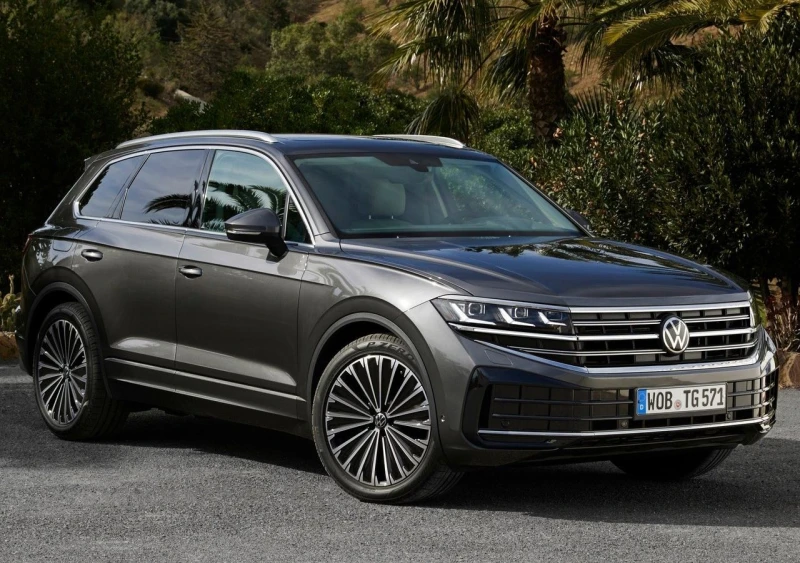
In overseas markets where the diesel lineup was established, the 3.0-liter TDI offers a straightforward match for the Touareg’s size and long-distance role. The 228-hp version suits drivers who do not need the strongest acceleration, while the 282-hp version adds useful passing power. Choosing steel springs or air suspension is less about declaring one universally reliable than deciding whether adjustable ride height and different ride characteristics justify more complex maintenance. Neither diesel is an official U.S.-market CR option.
The gasoline V6 makes more sense for overseas drivers covering fewer miles, taking frequent short trips, or avoiding a modern diesel. The eHybrid and Touareg R are most relevant when regular charging is available and the high-voltage system has a documented history, but they warrant a more detailed inspection. The V8 TDI remains an unusual engineering highlight of the generation, with distinct considerations for repair costs and engine-specific parts availability.
For an American reader, the essential distinction is that the third-generation Touareg is an overseas model, not a newer version of the Touareg available through the U.S. dealer network. Its range spans V6 diesels, a gasoline V6, plug-in hybrids, and a discontinued V8 diesel, all built around a sophisticated longitudinal-engine platform. Where these vehicles are sold used, transmission, AWD, suspension, and emissions-system condition matter more than an engine’s position in the original lineup. For a U.S. purchase, specifications and buying advice must instead match the actual generation and original market of the vehicle being considered.