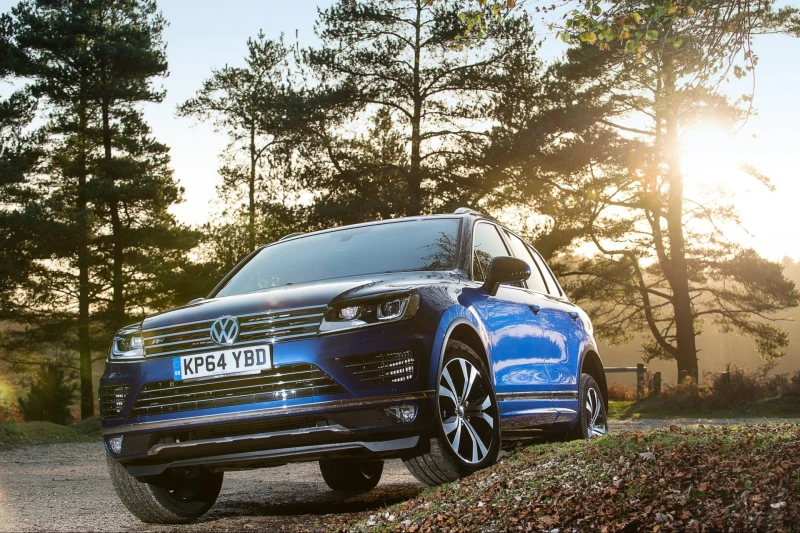
The U.S.-market second-generation Volkswagen Touareg was sold for the 2011 through 2017 model years. Its basic layout remained consistent throughout that run: a longitudinally mounted engine, an eight-speed Tiptronic automatic transmission, and standard 4MOTION all-wheel drive.
Unlike the broader global lineup, the U.S. range was comparatively simple. Buyers primarily encountered the 3.6-liter VR6 gasoline engine, the 3.0-liter V6 TDI diesel, and, through the 2015 model year, the Touareg Hybrid. The European 4.2 V8 TDI and the Terrain Tech/4XMotion low-range drivetrain were not part of the regular U.S. lineup. For used-car shoppers, model year and powertrain matter more than the generic Touareg badge because output, emissions equipment, trim structure, and availability changed over time. Design, interior, and equipment are covered in other articles in this series; this guide focuses on engines, drivetrain, dimensions, fuel economy, and ownership-related technical points.
Every U.S. Touareg 7P had AWD, but not the European off-road hardware
U.S.-spec Touareg 7P models use an eight-speed conventional automatic transmission with Tiptronic manual control. There was no DSG dual-clutch transmission in the American version. The gearbox was paired with all three U.S. powertrain families and was designed to handle the substantial torque of the TDI and Hybrid as well as the gasoline VR6.
Standard 4MOTION uses a self-locking center differential to distribute torque between the front and rear axles. It is a full-time all-wheel-drive system rather than an on-demand setup. Electronic traction and stability functions manage wheel slip and support light off-pavement driving.
The more elaborate Terrain Tech/4XMotion system offered in some other markets, with low-range gearing and additional locking capability, was not sold as a normal U.S.-market configuration on this generation. The U.S. 7P also did without the European-market factory air-suspension setup, relying instead on conventional steel springs. That distinction is important when comparing American cars with imported Touaregs or with technical data published for Europe.
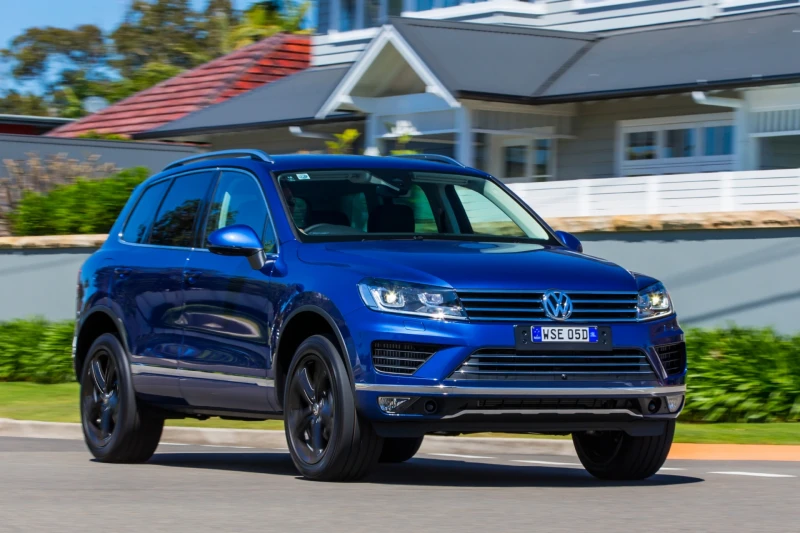
U.S. engine range: three powertrain families, with changes by model year
The American Touareg 7P lineup centered on the naturally aspirated 3.6-liter VR6 gasoline engine. The 3.0-liter V6 TDI added substantially more torque and better highway fuel economy, while the Touareg Hybrid combined a supercharged 3.0-liter V6 with an electric motor. The Hybrid disappeared after the 2015 model year, and the TDI's U.S. sales history was disrupted by the Volkswagen diesel-emissions case. By the 2017 model year, the U.S. Touareg was sold only with the gasoline VR6.
| Powertrain | Displacement | Output | Transmission | Drivetrain |
| 3.6 VR6 FSI gasoline | 3.6 liters | 280 hp, about 265-266 lb-ft | 8-speed Tiptronic automatic | 4MOTION AWD |
| 3.0 V6 TDI, early U.S. version | 3.0 liters | 225 hp, 406 lb-ft | 8-speed Tiptronic automatic | 4MOTION AWD |
| 3.0 V6 TDI, later U.S. version | 3.0 liters | 240 hp, 406 lb-ft | 8-speed Tiptronic automatic | 4MOTION AWD |
| 3.0 V6 TSI Hybrid | 3.0 liters plus electric motor | 380 hp system output, 428 lb-ft | 8-speed Tiptronic automatic | 4MOTION AWD |
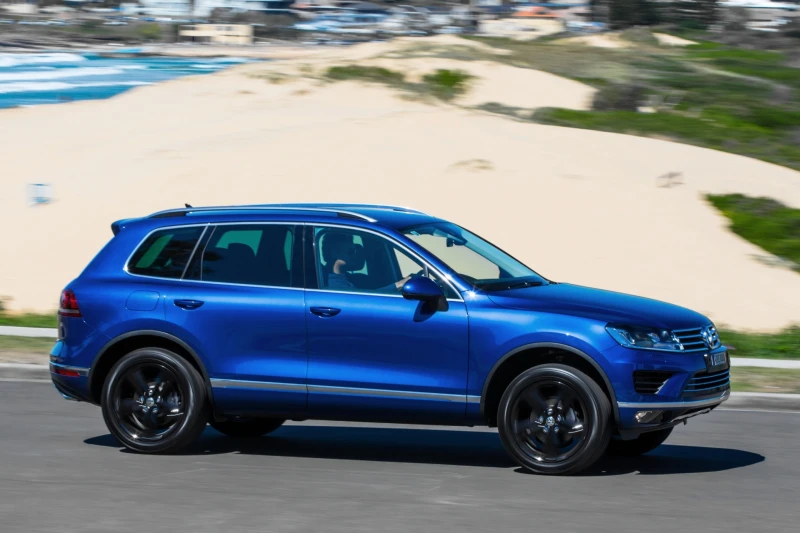
3.0 TDI: 225 hp first, then 240 hp
Early second-generation U.S. Touareg TDI models used a 3.0-liter turbocharged V6 rated at 225 hp and 406 lb-ft. From the 2013 model year, output increased to 240 hp while peak torque remained 406 lb-ft. The diesel's main advantage is not headline horsepower but low-rpm torque, which suits the Touareg's weight and towing-oriented character.
U.S.-spec TDI cars should be evaluated with particular attention to their emissions-system history. The 3.0-liter diesel was included in Volkswagen's U.S. diesel-emissions settlement, and affected vehicles may have received approved emissions modifications. For a used example, documentation of the modification status and subsequent service history is more important than treating all 3.0 TDI vehicles as mechanically identical.
Beyond emissions compliance, inspection should cover the timing-chain system, intake tract, EGR system, diesel particulate filter, SCR/DEF hardware, fuel system, and cooling system. The timing chains are located at the transmission side of the engine, which can make major chain work labor-intensive. These are inspection priorities rather than a claim that every engine develops the same faults.
3.6-liter VR6 gasoline engine
The 3.6-liter FSI engine uses Volkswagen's narrow-angle VR6 layout and produces 280 hp with roughly 265-266 lb-ft of torque in U.S. specification. It was the consistent gasoline engine across the generation and became the only U.S. powertrain for 2017.
The VR6 avoids the turbocharger, diesel particulate filter, and diesel high-pressure injection hardware of the TDI, but it is not a mechanically simple engine. Direct injection can contribute to intake-valve deposits over time, the timing-chain system deserves attention on higher-mileage vehicles, and cooling-system condition should be checked carefully. For drivers who make mostly short trips, the gasoline engine also avoids the regeneration requirements associated with a diesel particulate filter.
The Hybrid was a separate technical proposition
The Touareg Hybrid combines a 333-hp supercharged 3.0-liter V6 gasoline engine with an electric motor for a combined system output of 380 hp and 428 lb-ft. It delivers the strongest acceleration of the U.S. 7P range, but its technical complexity is also higher because the drivetrain adds a high-voltage battery, power electronics, electric-drive cooling, and a hybrid module between the engine and transmission.
Volkswagen discontinued the U.S. Touareg Hybrid after the 2015 model year. That makes it a relatively uncommon used-market configuration. A pre-purchase inspection should therefore include hybrid-system diagnostics and battery-condition checks in addition to the normal engine, transmission, cooling, brake, and suspension inspection.
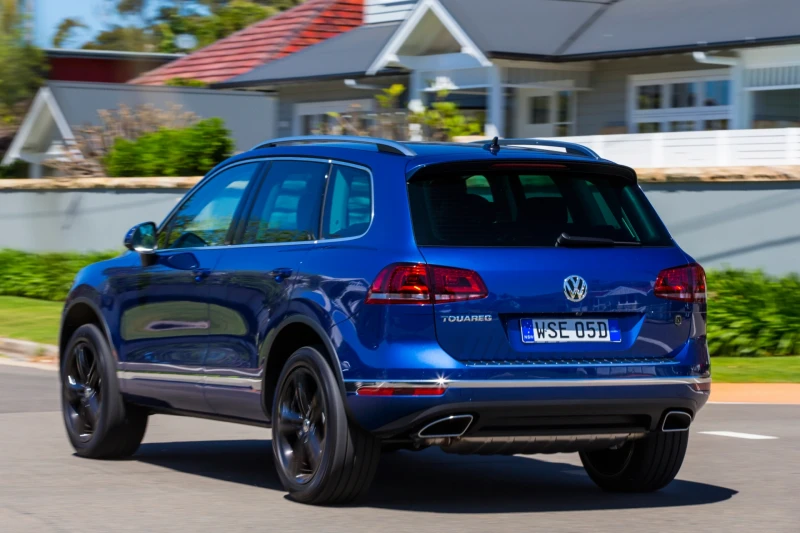
The 2015 refresh changed details, not the basic architecture
The 2015 model-year refresh brought revised exterior styling, updated interior details, and additional driver-assistance availability, but it did not replace the underlying platform. The eight-speed automatic and standard 4MOTION layout remained. The gasoline VR6 continued at 280 hp, the TDI at 240 hp, and the Hybrid remained available for one final model year.
Powertrain availability changed more significantly after the refresh than the basic chassis did. The Hybrid was dropped for 2016. The TDI's U.S. sales history was interrupted by the diesel-emissions issue, and by 2017 the Touareg lineup consisted only of the 3.6-liter VR6. When shopping used, the VIN, model year, emissions label, and service documentation are therefore more useful than assuming that every facelifted Touareg had the same engine choices.
Volkswagen Touareg 7P dimensions and weight in U.S. terms
U.S. specifications commonly list the Touareg at about 188.8-189.0 inches long, 76.4 inches wide without the mirrors, roughly 68.2 inches high, and 113.9 inches between the axles. Exact curb weight varies substantially with engine, trim, wheels, panoramic roof, and other equipment.
| Version | Length | Width | Height | Wheelbase | Approx. curb weight | Cargo volume | Drivetrain |
| 3.6 VR6 | about 188.8-189.0 in | 76.4 in without mirrors | about 68.2 in | 113.9 in | roughly 4,700-4,800 lb | about 32.1 cu ft behind row 2; 64.0 cu ft maximum | 8-speed automatic, 4MOTION |
| 3.0 TDI | about 188.8-189.0 in | 76.4 in without mirrors | about 68.2 in | 113.9 in | roughly 4,900-5,200 lb, depending on year and equipment | about 32.1 cu ft behind row 2; 64.0 cu ft maximum | 8-speed automatic, 4MOTION |
| Hybrid | about 188.8-189.0 in | 76.4 in without mirrors | about 68.2 in | 113.9 in | about 5,200 lb | cargo layout affected by hybrid hardware | 8-speed automatic, 4MOTION |
The U.S.-market Touareg 7P has about 7.9 inches of ground clearance in standard form. Unlike European versions equipped with optional height-adjustable air suspension, U.S.-spec cars do not have a factory ride-height mode that raises the body for off-road use.
Maximum braked-trailer capacity is approximately 7,716 lb when the vehicle and hitch are properly equipped. Actual towing limits still depend on the specific vehicle, tongue weight, payload, hitch equipment, and the information on the certification and owner's-manual labels for that VIN.
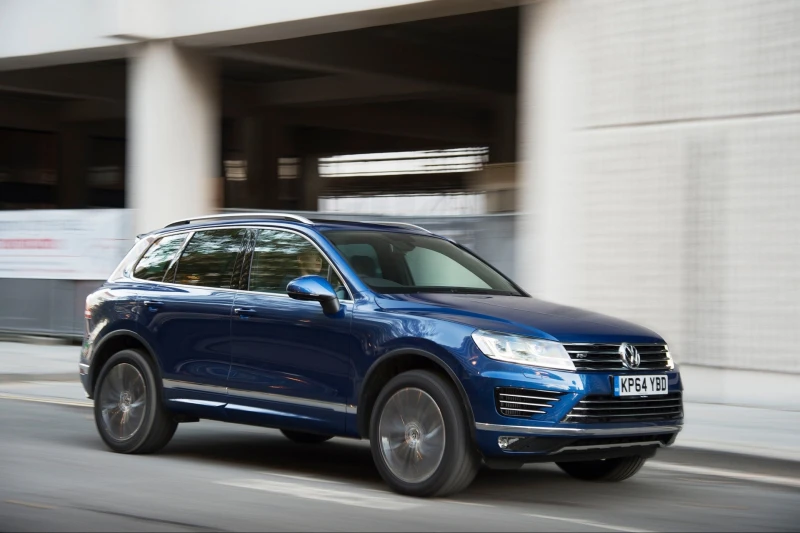
EPA fuel economy and service considerations in the United States
EPA fuel-economy ratings vary by model year, so they should not be reduced to a single number for the entire generation. As reference points, a 2011 Touareg TDI was rated at about 19 mpg city and 28 mpg highway, while the 2011 Hybrid was rated at about 20/24 mpg. Later TDI versions reached roughly the low-20s in the city and upper-20s on the highway, depending on model year and certification. The gasoline VR6 is typically in the high-teens city and low-20s highway range.
For the facelifted gasoline model, a representative EPA figure is about 17 mpg city and 23 mpg highway. These are certification values, not guarantees of real-world consumption. Tire choice, temperature, traffic, towing, elevation, maintenance condition, and driving speed can all move actual fuel economy significantly.
The eight-speed automatic should be checked for smooth engagement, consistent shifts, and stable torque-converter lockup. On a high-mileage vehicle, fluid condition and service history matter more than assuming that a transmission described as having long-life fluid never needs attention.
For the TDI, the emissions system deserves the same priority as the engine itself. For the Hybrid, battery and power-electronics diagnostics are essential. Conventional suspension, brakes, steering, and cooling-system parts are generally easier to source in the U.S. than hybrid-specific hardware. Because American 7P models use steel springs rather than the European air-suspension option, factory air-strut and compressor condition is not a normal U.S.-spec buying concern.
Which U.S.-spec configuration makes the most sense?
For many U.S. used-car shoppers, the 3.6 VR6 is the most straightforward version because it was sold throughout the generation and avoids both diesel-emissions hardware and hybrid high-voltage components. Its trade-off is fuel economy, especially in city driving.
The 3.0 TDI remains attractive for its 406 lb-ft of torque, highway efficiency, and towing-friendly character, but it should be purchased only after confirming its emissions-modification status and service history. The difference between the early 225-hp and later 240-hp versions is less important than the condition of the engine, emissions system, transmission, and cooling system.
The Hybrid is the performance-oriented outlier of the American range. Its 380-hp system output is substantial, but its rarity and additional electrical complexity make specialist inspection especially important. In the U.S. market, choosing a Touareg 7P is therefore less about finding the most powerful version and more about matching the powertrain's complexity, maintenance history, fuel economy, and towing needs to the way the vehicle will actually be used.