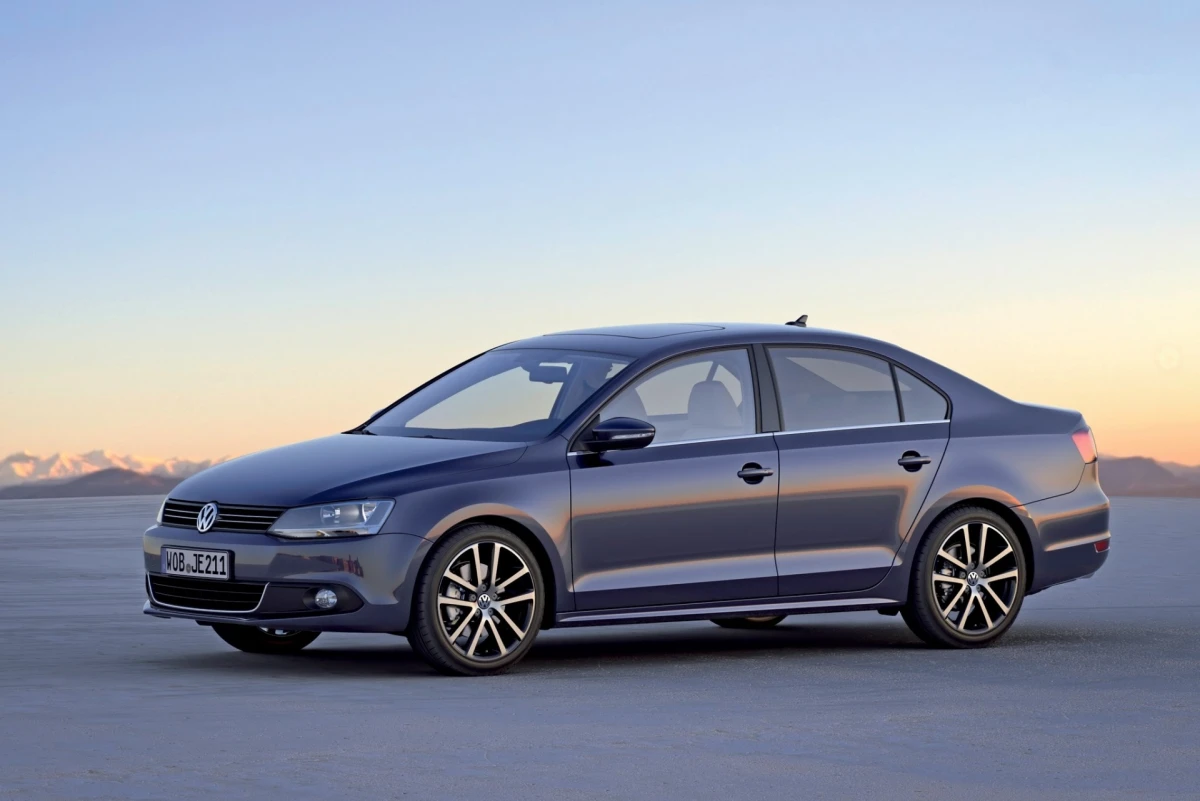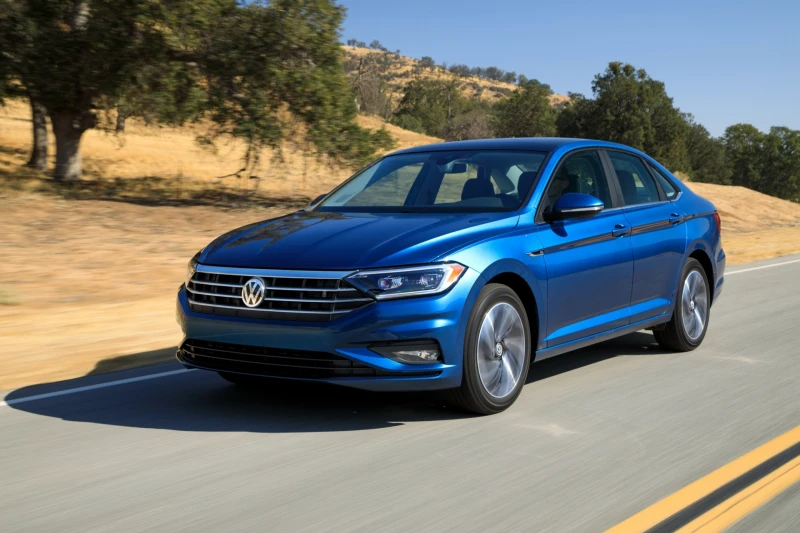
The seventh-generation Jetta, known internally as Typ BU, was developed primarily for North America and other selected markets rather than as part of Volkswagen's European passenger-car lineup. In the United States, that means the specification is relatively straightforward: early cars used the 1.4-liter turbocharged engine, later standard Jettas moved to a 1.5-liter turbo, and the GLI remained the higher-performance 2.0-liter model.
For U.S. buyers, the most common 2019–2021 Jetta configuration combines the 1.4T engine with an eight-speed automatic transmission, although a six-speed manual was also offered. From the 2022 model year, the standard Jetta switched to a 1.5T rated at 158 hp, while the GLI continued with a 2.0T and either a six-speed manual or seven-speed DSG. For the 2025 model-year update, the regular U.S.-market Jetta became automatic-only, while the manual remained available on the GLI.
Design, interior features and trim-level differences are covered in other articles in this series. Here the focus is on U.S.-market powertrains, transmissions, chassis layout, dimensions and other specifications that matter when comparing new and used Jetta VII models.
There is no European powertrain lineup for the Jetta VII
The phrase “European Jetta VII” can be misleading. Volkswagen did not position this generation as a normal part of its European model range, so there is no factory European lineup of TDI diesels, small-displacement 1.0 TSI engines or Europe-specific DSG combinations to compare with the U.S. car.
That distinction matters because the Jetta VII shares the MQB architecture with vehicles such as the Golf, yet its U.S. engine and transmission choices followed a different strategy. For American shoppers, the key split is between the 1.4T used through the 2021 model year, the 1.5T used on standard Jettas from 2022 onward, and the 2.0T reserved for the GLI.
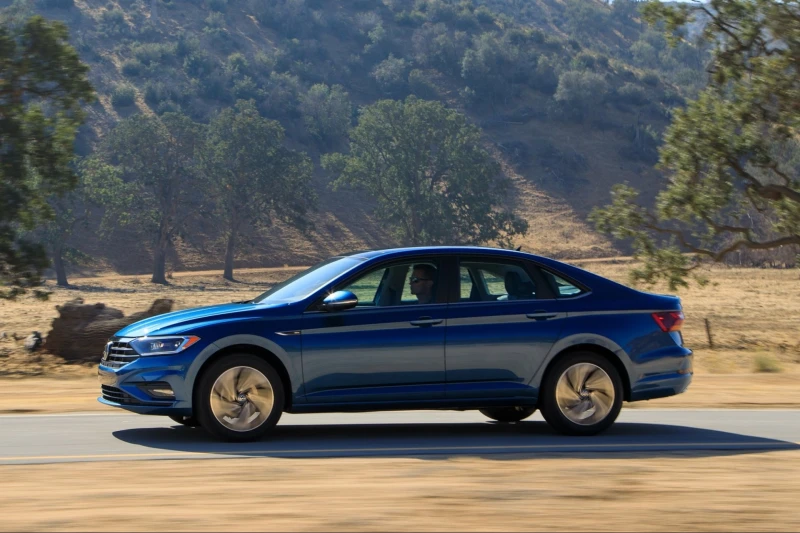
Main U.S.-market Volkswagen Jetta VII engines
| Engine and model years | Displacement | Output | Transmission | Drive |
| 1.4T EA211, U.S., 2019–2021 | 1.4 liters | 147 hp; 184 lb-ft | 6-speed manual or 8-speed conventional automatic | Front-wheel drive |
| 1.5T EA211 evo, U.S., 2022–2024 | 1.5 liters | 158 hp; 184 lb-ft | 6-speed manual on selected trims or 8-speed automatic | Front-wheel drive |
| 1.5T EA211 evo, U.S., 2025 model-year update and later | 1.5 liters | 158 hp; 184 lb-ft | 8-speed automatic | Front-wheel drive |
| 2.0T EA888, Jetta GLI | 2.0 liters | about 228 hp; 258 lb-ft in current U.S. specification | 6-speed manual or 7-speed DSG dual-clutch transmission | Front-wheel drive |
Why the 1.4T defines the early U.S.-market Jetta VII
The launch engine belongs to Volkswagen's EA211 family. It is a turbocharged, direct-injected four-cylinder gasoline engine with a timing belt. Its 184 lb-ft of torque arrives low in the rev range, which gives the car useful response in normal commuting without requiring high engine speed.
Volkswagen rated the U.S. version at 147 hp. Listings sometimes show slightly different figures because international databases may convert between SAE horsepower, metric horsepower and kilowatts. For a specific used car, the VIN, engine code and original market specification are more reliable than a generic online catalog.
Most U.S. 1.4T Jettas use an eight-speed torque-converter automatic. It is not a DSG. Under light throttle, the transmission tends to upshift early to keep engine speed low. Shift quality should be evaluated with the car fully warmed up as well as when cold; harsh or inconsistent behavior warrants a proper diagnostic check rather than assumptions based only on a short test drive.
A six-speed manual was also available on selected early U.S. trims. Because transmission availability changed by model year and trim, a listing that simply says “Jetta 1.4T” does not by itself identify the gearbox.
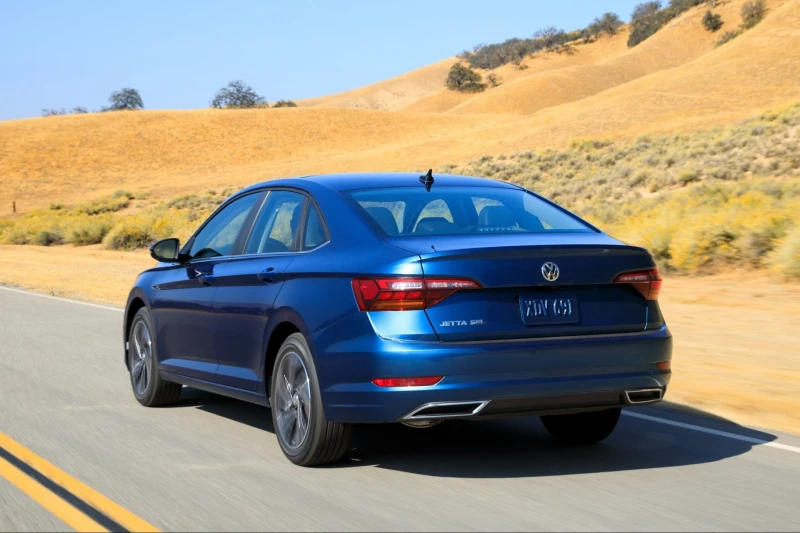
1.5T: more than a small increase in displacement
For the 2022 model year, the standard U.S.-market Jetta switched to a 1.5-liter turbocharged engine rated at 158 hp and 184 lb-ft. It remains part of the EA211 family but uses a newer combustion strategy and a variable-geometry turbocharger. The engine is designed to improve efficiency while preserving the strong low-rpm torque that characterized the earlier 1.4T.
On paper, the power increase over the 1.4T is modest and peak torque is unchanged. Mechanically, however, the 1.5T is more complex. When inspecting a used car, smooth cold starts, stable coolant temperature, normal boost behavior and the absence of mixture or turbocharger-related fault codes are more useful indicators than the small difference in rated horsepower.
Early U.S. 1.5T models could still be ordered with a six-speed manual on selected trims, while the eight-speed automatic was the more common configuration. After the 2025 model-year update, the regular Jetta moved to an automatic-only setup in the United States; the manual remained part of the GLI formula.
The Jetta GLI is mechanically distinct from the standard sedan
The GLI uses Volkswagen's 2.0-liter EA888 turbocharged engine, with current U.S. versions rated at about 228 hp and 258 lb-ft. Buyers can choose between a six-speed manual and a seven-speed DSG dual-clutch transmission.
The differences go beyond the engine. Standard 1.4T and 1.5T Jettas use a torsion-beam rear suspension, while the GLI uses an independent multi-link rear setup. It also receives larger brakes, performance-oriented chassis tuning and an electronically controlled limited-slip differential. Depending on model year and trim, adaptive dampers may also be included.
The GLI's seven-speed DSG uses wet clutches and has different service requirements from the conventional eight-speed automatic fitted to regular Jettas. It is designed for the higher torque of the 2.0T, but diagnosis and repair can still be more involved than with a manual transmission or a conventional torque-converter automatic.
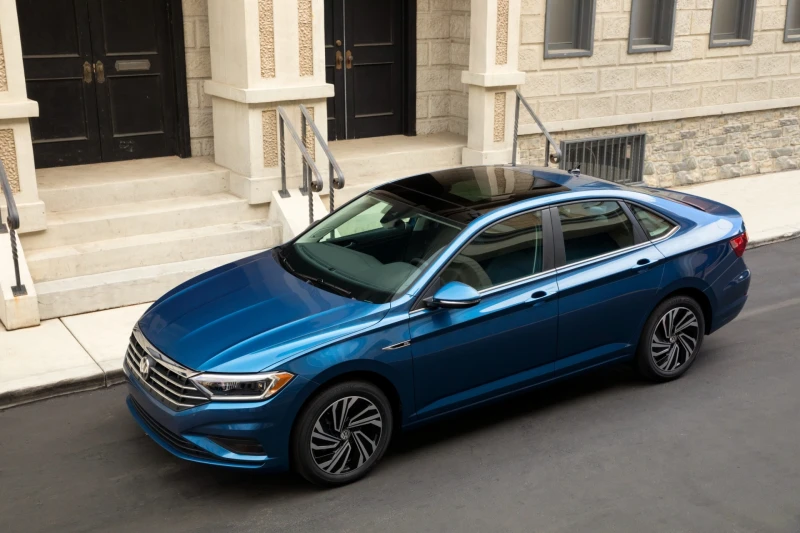
Dimensions changed slightly with styling updates
The wheelbase remained essentially unchanged at about 105.7 inches throughout the generation. Body width is roughly 70.8 inches without mirrors, while height is about 57.4–57.7 inches depending on model year and specification. Overall length changed slightly with bumper and styling revisions, from roughly 185 inches on early cars to about 186.5 inches on later versions.
| Configuration | Length | Width / height | Wheelbase | Approx. curb weight | Transmission and drive |
| Jetta 1.4T, U.S., 2019–2021 | about 185.1 in | about 70.8 / 57.4 in | about 105.7 in | roughly 2,900–3,000 lb, depending on trim and transmission | 6MT or 8AT, front-wheel drive |
| Jetta 1.5T, U.S., 2022–2024 | about 186.5 in | about 70.8 / 57.7 in | about 105.7 in | roughly 2,900–3,100 lb, depending on trim and transmission | 6MT or 8AT, front-wheel drive |
| Jetta 1.5T, U.S., 2025 update and later | about 186.5 in | about 70.8 / 57.7 in | about 105.7 in | around 3,000 lb, with variation by trim and equipment | 8AT, front-wheel drive |
| Jetta GLI 2.0T | about 186.5 in | about 70.8 / 57.7 in | about 105.7 in | roughly 3,250–3,350 lb, depending on transmission and equipment | 6MT or 7-speed DSG, front-wheel drive |
Curb-weight figures should not be transferred from one car to another without checking the vehicle's certification label. Transmission, sunroof, wheel size, power-seat hardware and other equipment can change the final number. For payload calculations, use the tire and loading information label and the certification data on the specific vehicle.
Fuel economy and day-to-day use
EPA fuel-economy ratings vary by model year, trim and transmission. Many 1.4T and 1.5T automatic Jettas fall in the low-to-mid 30-mpg range in combined driving, with highway ratings around 40 mpg on some configurations. These are EPA test-cycle figures; actual mileage can change substantially with speed, temperature, traffic, tires and driving style.
The 1.5T was introduced with efficiency as one of its main goals, and in EPA testing it generally performs at least as well as the earlier 1.4T despite the increase in rated power. The GLI's 2.0T uses more fuel, especially in urban driving or when driven aggressively. EPA ratings should be compared by exact model year and transmission rather than treated as one figure for the entire generation.
Engine condition on a used Jetta VII depends heavily on service history. For both the 1.4T and 1.5T, appropriate oil, a functioning cooling system and proper direct-injection operation matter more than broad claims about “reliability.” On a car with incomplete records, it is sensible to inspect ignition components, cooling-system hardware, turbocharger operation and fuel-trim data as part of a pre-purchase evaluation.
Routine service parts for EA211 engines, brakes and suspension are widely available in the United States through Volkswagen dealers and the aftermarket. GLI-specific hardware, driver-assistance sensors, headlights, infotainment modules and certain body components can be more expensive and may require VIN-specific ordering.
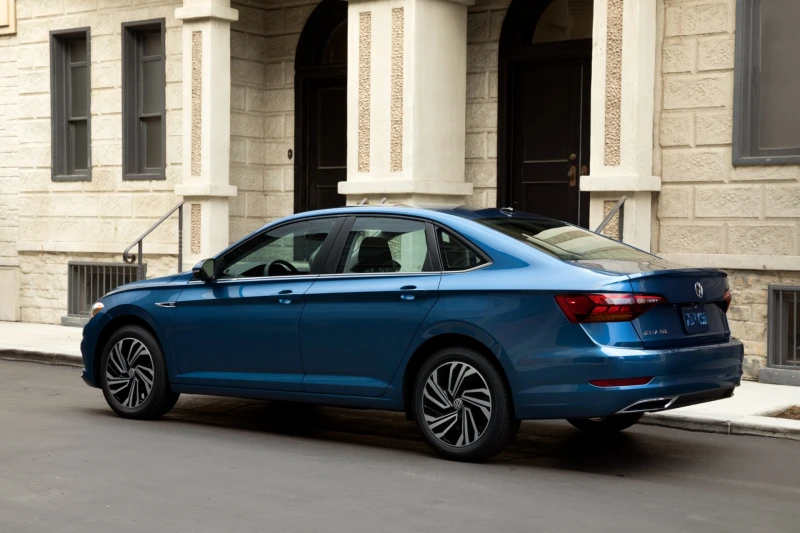
Which Jetta VII configuration makes the most sense in the U.S.?
For buyers focused on the used-car market, the 2019–2021 Jetta 1.4T with the eight-speed conventional automatic remains one of the most common early-generation configurations. It combines the simpler early powertrain layout with broad parts and service familiarity across the U.S. market.
The 1.5T is the newer standard-engine choice and brings the updated EA211 design along with newer model years and equipment. When condition and history are comparable, the decision between a 1.4T and 1.5T often comes down to budget, model year, trim and maintenance records rather than the small difference in peak horsepower.
The Jetta GLI is the appropriate choice for buyers who specifically want the 2.0T engine, multi-link rear suspension, stronger brakes and a manual or DSG performance transmission. For lower running costs and simpler day-to-day use, the standard Jetta remains the more straightforward option. As with any used car, the VIN and model-year specification should be checked because transmission availability and equipment changed during the generation.