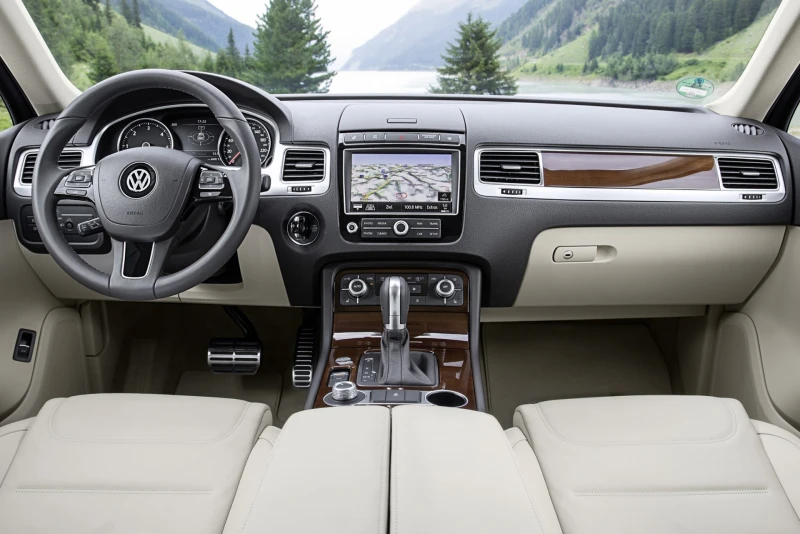
Buttons, analog gauges, and the broad center console still feel logically arranged, while the infotainment graphics and smartphone connectivity clearly belong to an earlier era. That uneven rate of aging is one of the defining traits of the second-generation Touareg on the U.S. used-car market.
The Volkswagen Touareg II interior was designed around long-distance comfort rather than complicated visual effects. Physical buttons are plentiful, the climate controls use large knobs, and major functions are separated from the touchscreen. Even on well-equipped versions, the driver does not have to dig through screen menus for routine adjustments. Compared with newer SUVs dominated by touch-sensitive controls, the layout looks conservative but remains easy to use.
A cabin where function matters more than visual drama
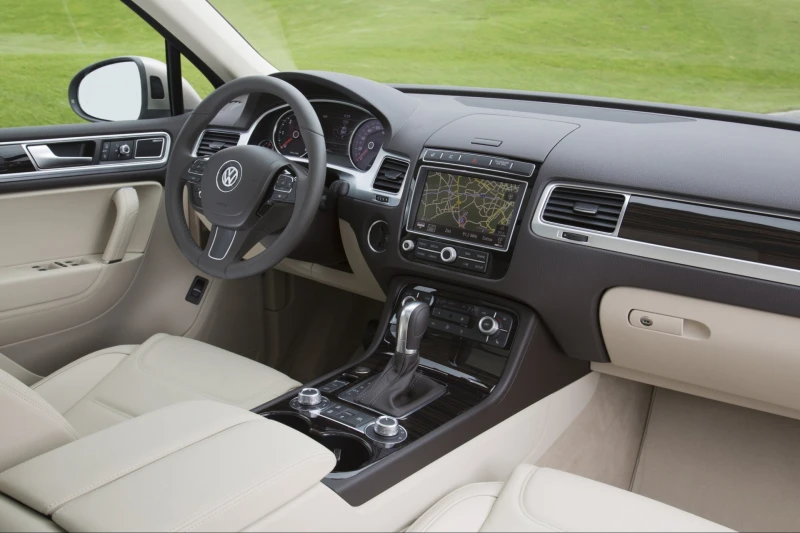
The dashboard has a strong horizontal layout. The center air vents sit above the infotainment display, with system controls and a separate climate-control panel below. Between the front seats are the eight-speed automatic shifter, cupholders, and additional vehicle controls depending on model year and trim.
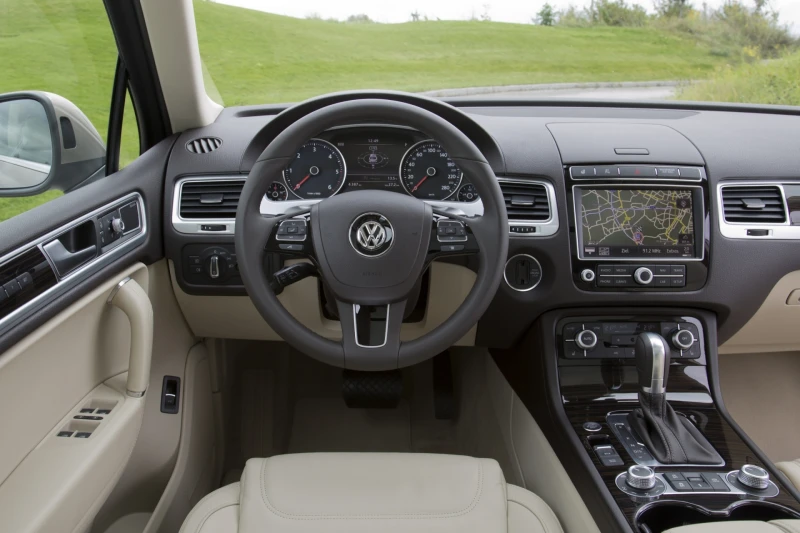
The upper dashboard uses soft-touch materials, while the doors combine padded sections with V-Tex leatherette or leather and decorative trim. U.S.-market cars were offered with finishes such as Walnut or Vavona wood, brushed-aluminum-style trim, and gloss-black accents depending on year and version. Lighter Cornsilk Beige and brown interiors can make the cabin feel noticeably different from the more common dark combinations.
In overall finish, the Touareg 7P sits between mainstream Volkswagen models and the premium SUVs that shared some of its engineering. The materials feel appropriate for a more expensive vehicle, but the design remains restrained. It lacks the more layered dashboard treatment of an Audi Q7 or the more driver-focused layout associated with a Porsche Cayenne. The Touareg cabin is more symmetrical and visually simpler.
Driving position and controls
The driver sits high, but the position does not feel like that of a traditional body-on-frame SUV. Seat and steering-column adjustment provide a broad range for different body types. A wide center tunnel separates the front seats, and the substantial armrests help make long highway drives more comfortable.
The seats vary more by trim and model year than photos may suggest. Lower-spec versions use simpler power adjustment, while higher trims can add additional adjustment, memory, power lumbar support, heating, and, on some later U.S. models, front-seat ventilation. The R-Line focused heavily on appearance, with features such as a black headliner, aluminum-look pedals, and sport-themed trim rather than guaranteeing every comfort feature.
Forward visibility is typical for a large SUV: the hood is easy to place and the side mirrors are sizable. The roof pillars and tall rear bodywork reduce visibility during parking, so a working rearview camera or Area View system is genuinely useful. Parking sensors and camera systems vary by year and trim, so their presence should be verified on the individual vehicle.
The trim badge does not tell the whole story
U.S. trim names changed during the Touareg 7P's run. Early vehicles were commonly sold as Sport, Lux, and Executive, with the Hybrid offered separately. R-Line appeared later, while the final 2017 lineup used Sport with Technology, Wolfsburg Edition, and Executive. Because equipment packages evolved from year to year, two cars with similarly upscale badges can still have very different interiors.
It is more useful to inspect the actual equipment than to rely on a listing title. Lower trims commonly used V-Tex leatherette, while higher versions offered leather seating surfaces such as Vienna leather in earlier model years. Online listings do not always describe upholstery correctly, and some surfaces can use different materials even when the main seating areas are leather.
Heated front seats are common across U.S.-spec Touareg 7P models. Heated rear seats, driver-seat memory, a power-adjustable steering column, and ventilated front seats belong to more highly equipped versions and are not universal across the generation. For example, later Wolfsburg Edition and Executive models could include front-seat ventilation, while Executive versions typically carried more of the comfort hardware.
For the U.S. market, Climatronic dual-zone automatic climate control is the key factory setup across the range. When inspecting a used Touareg, check both temperature zones, blower operation, air direction, and rear-seat airflow. Age-related faults in actuators, sensors, or control electronics can make an otherwise well-kept cabin frustrating to live with.
Infotainment and driver assistance
The RNS 850 is one of the most recognizable factory systems in U.S.-market Touareg 7P models. It uses an 8-inch touchscreen and, depending on year and trim, combines navigation, a hard drive, SD-card support, HD Radio, and other media functions. Some lower-spec versions used the simpler RCD 550 system instead. By current standards, both interfaces feel dated, and factory Apple CarPlay and Android Auto were not part of this generation's original U.S. equipment.
That is why used Touaregs often appear with add-on smartphone-interface modules or aftermarket head units. Such upgrades can be worthwhile, but they need to be checked carefully. Audio output, cameras, steering-wheel controls, the factory amplifier, and vehicle-information displays should all operate without conflicts.
The optional Dynaudio premium audio system used a dedicated amplifier and 10 speakers on U.S.-market versions that offered it. Driver-assistance equipment also changed substantially over the years. Later models could include adaptive cruise control, Front Assist, Lane Assist, Side Assist, parking sensors, Area View, keyless access, and a power liftgate. An R-Line or other appearance package by itself does not guarantee the full driver-assistance suite.
The rear seat can favor passengers or cargo
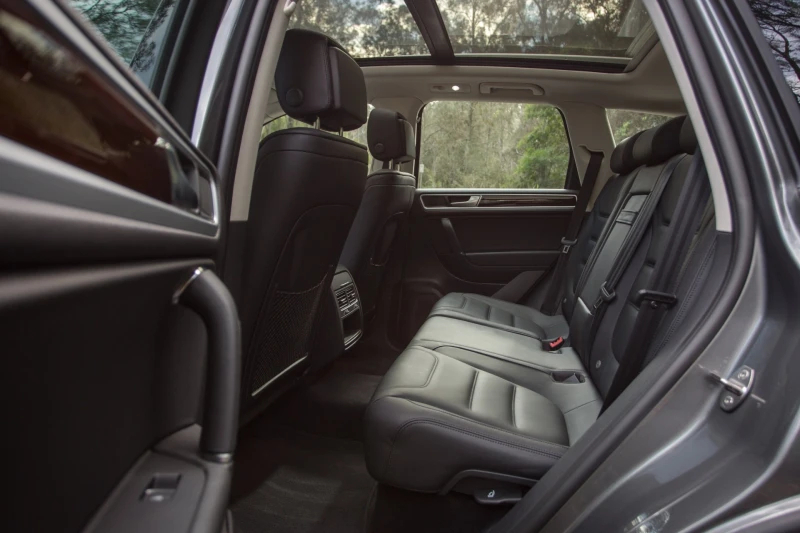
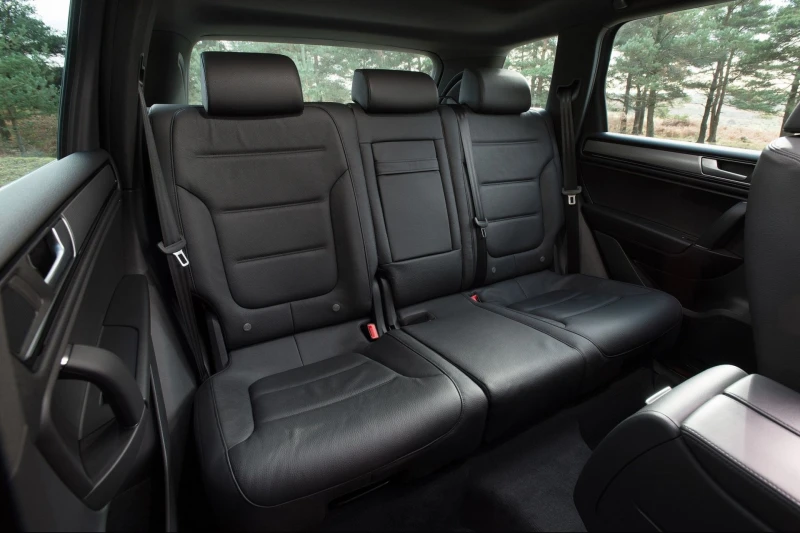
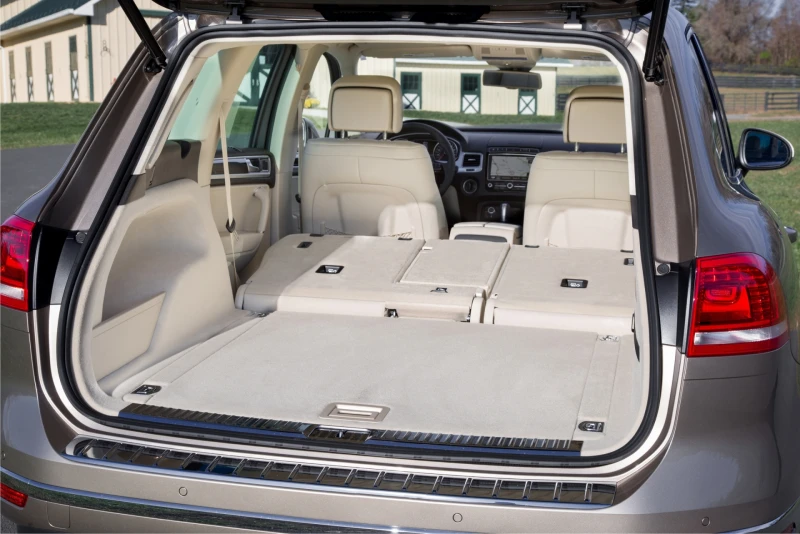
The U.S.-market Volkswagen Touareg 7P seats five and was not offered with a third row. That gives rear passengers useful space while preserving a wide, regular cargo area. The substantial center tunnel makes the middle position less comfortable for long trips, so the second row works best for two adults on extended drives.
The rear bench can slide fore and aft and the backrests can be reclined, allowing owners to trade some passenger room for cargo flexibility. U.S. specifications commonly list about 32.1 cubic feet of cargo space behind the second row, while Volkswagen quoted up to roughly 64 cubic feet with the rear seats folded on later model-year brochures. Published maximum figures can vary slightly by model year and measurement method.
The sliding rear bench is useful even when maximum cargo room is not needed. Moving it rearward gives passengers more legroom; moving it forward creates additional cargo space while keeping the rear seats usable. The 40/20/40 split-folding arrangement also makes it easier to carry long items without giving up every rear seating position.
The cargo area is part of the equipment package
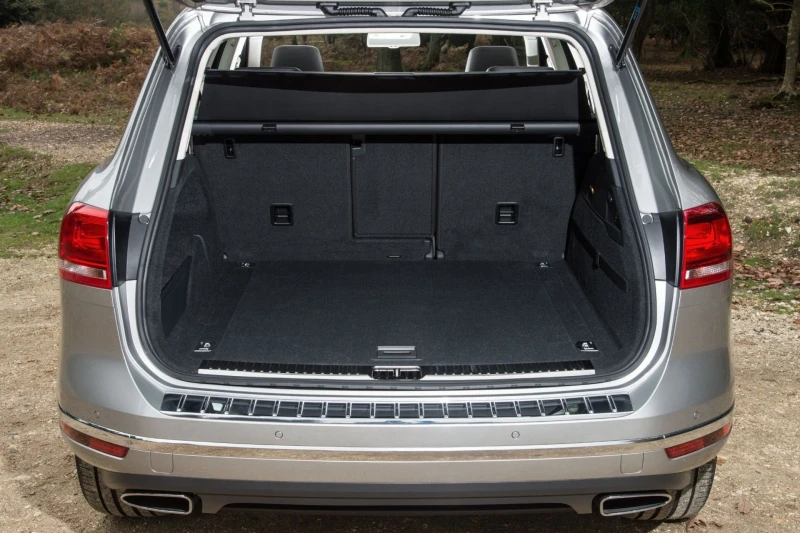
Rear-cargo convenience also depends on trim. A power liftgate is common, while the hands-free Easy Open function appears only on certain versions. Higher trims could also include electric rear-seat releases in the cargo area. U.S.-market 7P models did not use the European-market air-suspension cargo-lowering feature as a normal factory offering, so that control should not be expected on a typical American-spec vehicle.
Before buying, check not only the liftgate operation but also the cargo cover, side trim, and storage area under the floor. Water marks, damp carpeting, or a musty smell can point to leaking seals, blocked drains, or previous body repairs.
The refresh did not create an all-new interior
The global facelift appeared in 2014 and reached the U.S. as the 2015 model-year update. It changed the exterior and some technical details more noticeably than the basic cabin architecture. The gauge cluster, infotainment location, climate-control panel, and center console remained familiar, so pre-refresh and later Touareg interiors differ less than their exteriors suggest.
Later U.S. models received different trim combinations and, in some cases, more extensive driver-assistance equipment. The 7P never gained a fully digital instrument cluster or a fundamentally new infotainment architecture in the United States. Even the final 2017 models retained analog gauges and the characteristic center screen of the early 2010s.
For that reason, condition and actual equipment often matter more than whether the vehicle is pre- or post-refresh. A well-kept earlier Touareg with comfortable seats, a functioning camera, working climate control, and intact electronics can be a better ownership proposition than a newer example with neglected options or poorly executed aftermarket modifications.
How the materials and equipment handle age
The main dashboard and door panels usually retain their shape well, even at higher mileage. Age tends to show first on the driver's seat, steering wheel, and frequently used buttons. Seat bolsters can crease or wear, the steering-wheel leather can become smooth and shiny, and the finish on commonly touched switches may deteriorate.
Gloss-black trim picks up fine scratches quickly. Wood trim often hides light wear better, but it can still be damaged during careless removal of the center console or door panels. Rattles are more likely after wiring repairs, aftermarket electronics work, infotainment replacement, or repeated interior disassembly. A complete, untouched cabin should not normally be filled with constant squeaks and rattles.
The panoramic sunroof deserves a separate inspection. The glass should move smoothly, the shade should close fully, and the headliner and pillars should show no signs of moisture. In regions with heavy rain, snow, or frequent freeze-thaw cycles, clean drains and sound seals are especially important.
On a highly equipped vehicle, test seat memory, ventilation if fitted, every heated seat, keyless access, all cameras, the power liftgate, and every speaker. One failed convenience feature may be manageable, but several inoperative systems can turn a richly equipped Touareg into an expensive list of deferred repairs.
Which interior strikes the best balance?
The Volkswagen Touareg II interior still works well in terms of space, driving position, and core material quality. The infotainment system has aged more noticeably than the rest of the cabin, but smartphone integration can be added without replacing the entire dashboard. The physical controls, meanwhile, remain a practical advantage for climate and routine functions while driving.
For the U.S. used-car market, a well-balanced example has functioning power seats, driver memory if equipped, heated front seats, a rearview camera, dual-zone climate control, and a properly operating power liftgate. Heated rear seats and front-seat ventilation are worthwhile on the higher trims that offered them. A panoramic roof, Dynaudio audio, Area View, and the later driver-assistance systems add convenience, but each additional feature deserves a careful functional check.
Do not shop by an R-Line, Wolfsburg, or Executive badge alone. With the Touareg 7P, value depends more on which features are actually installed, how well the materials have been preserved, and whether every system works as intended. The condition of the specific interior tells you more about the vehicle than the trim name by itself.