


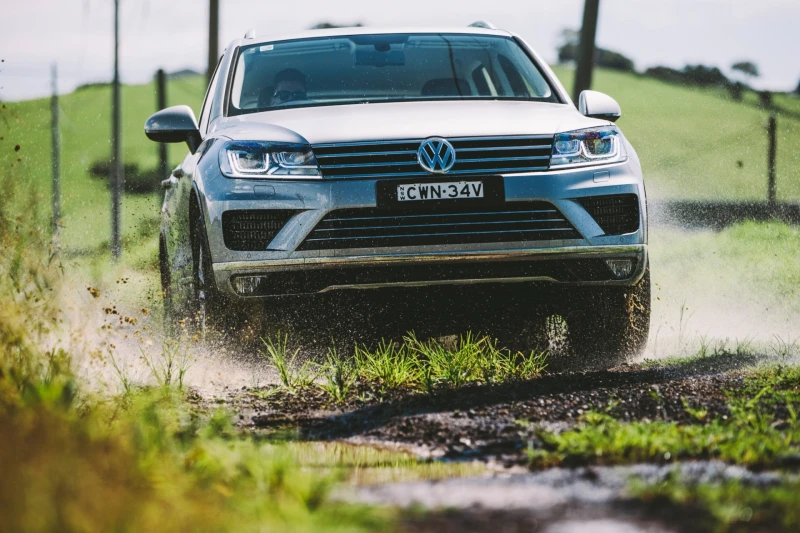
This was no longer simply an expensive Volkswagen, as the first Touareg was sometimes perceived, yet it was not as digital or electronics-heavy as the SUV that followed it overseas. The Typ 7P retained a substantial structure, standard 4Motion all-wheel drive, and strong V6 powertrains while becoming lighter, more efficient, and easier to live with every day.
Today, Americans shopping for a second-generation Touareg are not buying it for novelty. It is usually considered alongside similarly aged Audi Q7, Porsche Cayenne, BMW X5, and Mercedes-Benz M-Class models. The Volkswagen is more understated than most of those rivals, but it offers a similarly substantial cabin, strong towing capability, and a high level of available equipment without a traditional luxury-brand badge.
Why the second Touareg was more than a routine redesign
The first Touareg was an ambitious project intended to prove that Volkswagen could build a genuinely upscale SUV with serious off-road hardware. It offered complex driveline technology, powerful engines, and considerable capability, but those strengths also came with high curb weight and potentially expensive upkeep.
For the second generation, Volkswagen shifted the priorities. The Touareg remained closely related to the Porsche Cayenne and large Audi SUVs, but it became lighter and more road-focused. The body looked lower and cleaner, the cabin felt less like a traditional off-roader, and the vehicle moved toward the role of a refined two-row highway SUV.
The basic layout remained substantial: five seats, a longitudinally mounted engine, an eight-speed automatic transmission, and standard 4Motion all-wheel drive on U.S.-market models. One important distinction from some overseas versions is that American 7P Touaregs used a conventional steel-spring suspension and did not receive the height-adjustable air suspension or low-range Terrain Tech drivetrain offered in certain other markets.
For the 2015 model year, the U.S. Touareg received its midcycle update. Changes included revised front and rear styling, updated lighting, refreshed interior trim, and additional driver-assistance technology. The powertrain lineup initially remained familiar, but the U.S. offering changed significantly after the diesel-emissions crisis: the TDI disappeared from new-car sales, the Hybrid was discontinued for 2016, and the 2017 model year was sold only with the gasoline V6.
The U.S. market revolved around three V6 powertrains
Unlike many European-market Touaregs, the second-generation U.S. lineup did not include four-cylinder diesels or the 4.2-liter V8 TDI. American buyers mainly encountered three powertrains: the naturally aspirated 3.6-liter VR6 gasoline engine, the 3.0-liter TDI turbodiesel V6, and the low-volume gas-electric Hybrid.
3.0 TDI — the torque-focused used-market choice
The 3.0-liter TDI was rated at 225 hp and 406 lb-ft of torque for the 2011 and 2012 model years. For 2013, output increased to 240 hp while peak torque remained 406 lb-ft, and that specification continued through the final U.S.-market TDI model years. All were paired with an eight-speed automatic and 4Motion all-wheel drive.
For a heavy two-row SUV, the diesel's appeal is easy to understand. The strong low-rpm torque gives the Touareg relaxed highway performance and useful towing ability, while EPA ratings were notably better than those of the gasoline VR6. A 2013 TDI, for example, was rated at 20 mpg city and 29 mpg highway, compared with roughly 17/23 mpg for later gasoline V6 models.
Condition and documentation matter more than the 15-hp difference between early and later TDI versions. Buyers should confirm routine service, inspect the cooling and emissions systems, check for oil or coolant leaks, and review the vehicle's diesel-emissions modification history. Because these cars are now well into used-vehicle age, a thorough pre-purchase inspection is more valuable than choosing solely by model year or trim.
3.6 VR6 and the rare Hybrid
The 3.6-liter gasoline VR6 is the most straightforward U.S.-market configuration and the only engine offered for the final 2017 model year. It produces 280 hp and about 266 lb-ft of torque and is paired with the same eight-speed automatic and 4Motion all-wheel drive. EPA fuel economy for the 2017 model is 17 mpg city, 23 mpg highway, and 19 mpg combined.
The Hybrid combined a supercharged 3.0-liter gasoline V6 with an electric motor for roughly 380 hp of total system output. It was considerably quicker than the standard VR6 or TDI, but it was also expensive when new and is much less common on the used market. By 2016 the Hybrid had been dropped from the U.S. lineup, so today it makes the most sense for a buyer specifically seeking that powertrain and prepared to evaluate the condition of its hybrid components.
The U.S. chassis is simpler than many overseas Touaregs
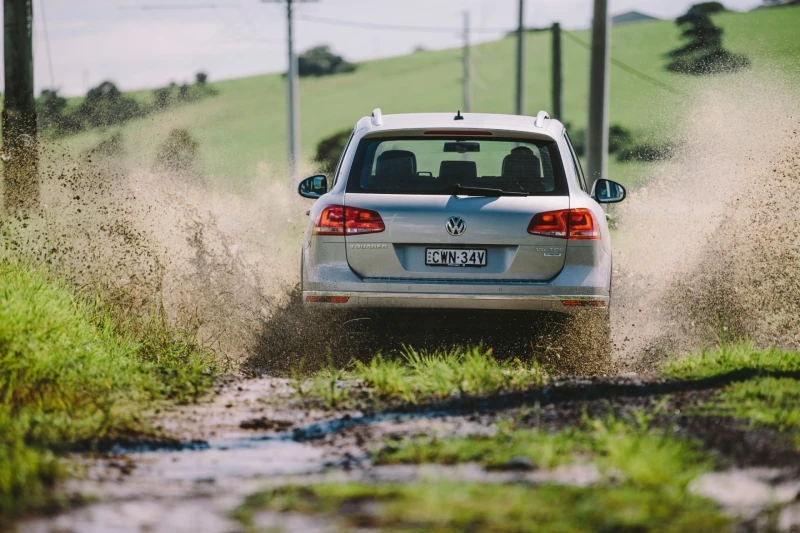
American-market 7P Touaregs are notable for what they do not have: the second generation was sold here with steel springs rather than the height-adjustable air suspension available in some other countries. That means U.S. buyers do not need to evaluate compressors, air struts, or ride-height controls when shopping a domestic-spec example.
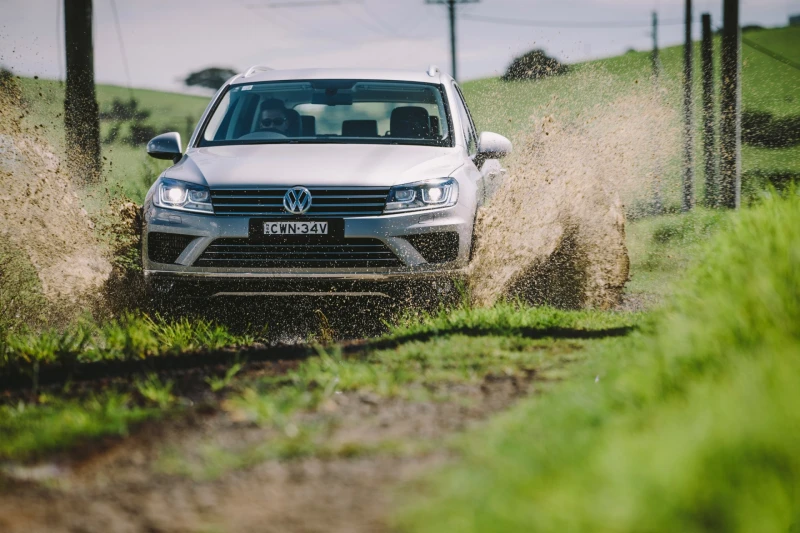
The standard 4Motion system is also more road-oriented than the hardware used by the first-generation Touareg. U.S.-market second-generation models did not receive a low-range transfer case, but they retained permanent all-wheel drive, independent suspension, substantial ground clearance, and a maximum towing rating of about 7,700 pounds when properly equipped.
That setup suits the way most American Touaregs are actually used: interstate travel, winter driving, towing, and light trail or gravel-road use rather than technical off-roading. Buyers should still inspect control-arm bushings, dampers, wheel bearings, brakes, tires, and alignment, because the Touareg's weight can make neglected chassis wear expensive to correct.
Wheel size also matters. Higher trims commonly use larger 19-, 20-, or even 21-inch wheels, which can sharpen the appearance but increase tire cost and reduce sidewall height. A well-maintained Touareg on a sensible wheel-and-tire setup can be more attractive as a daily driver than a higher-spec example with deferred suspension or tire work.
An upscale cabin without obvious luxury-brand theater
The interior reflects the Touareg's position in Volkswagen's U.S. lineup. The dashboard is restrained, the major controls are logically arranged, and physical buttons handle climate and many day-to-day functions. It does not have the layered presentation of a contemporary Audi Q7 or the sportier atmosphere of a Porsche Cayenne, but materials and assembly quality generally feel appropriately upscale.
Equipment varies significantly by trim and model year. Depending on configuration, U.S. cars could include leather upholstery, a panoramic sunroof, heated front and rear seats, ventilated front seats on later upper trims, navigation, a hands-free power liftgate, an Area View camera system, and Dynaudio premium audio.
The rear seat is designed for three passengers and slides fore and aft to balance legroom and cargo space. Cargo capacity is about 32 cubic feet behind the second row and roughly 64 cubic feet with the rear seats folded, which makes the Touareg practical for road trips without adding a third row.
By current standards, the factory infotainment system is dated. The later cars still lack the speed, graphics, and native smartphone integration of newer SUVs. As a result, used examples sometimes have aftermarket Apple CarPlay or Android Auto interfaces or replacement head units. Any modification is worth checking for installation quality and compatibility with factory audio, cameras, and steering-wheel controls.
Trim level matters, but equipment still deserves a close look
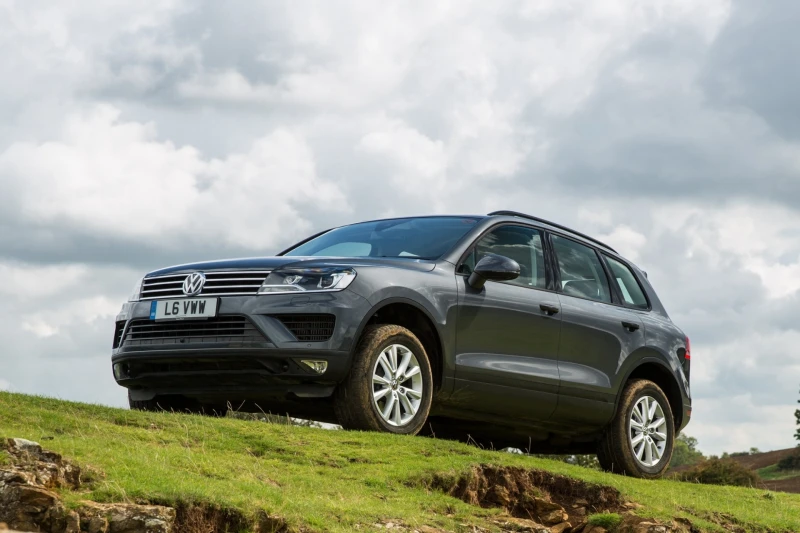
The U.S. Touareg lineup changed several times during the 7P generation. Earlier model years used names such as Sport, Lux, and Executive, while 2015 also offered Sport with Technology. For 2017, the range consisted of Sport with Technology, Wolfsburg Edition, and Executive. Engine availability changed as well, so the trim badge alone does not tell the whole story.
Useful equipment to look for includes the panoramic roof, navigation, Area View surround cameras, adaptive cruise control, blind-spot monitoring, lane assistance, heated rear seats, ventilated front seats, Dynaudio audio, and the factory trailer hitch. Availability depends on model year and trim, so a VIN-based equipment check and an in-person inspection are more reliable than an advertisement headline.
The 2017 Wolfsburg Edition replaced the previous Lux as the mid-level version and added items such as leather seating, ventilated front seats, a panoramic roof, and 20-inch wheels. Executive models brought the most extensive equipment, including the surround-view camera and premium audio. When comparing listings on Autotrader, CarGurus, or Cars.com, it is worth checking the actual option content rather than assuming two cars with the same year and engine are identically equipped.
What used Touareg prices look like in the United States
As of September 2026, nationwide asking prices vary widely by year, mileage, powertrain, history, and condition. Market data puts early second-generation examples near the lower end of the segment: 2011–2012 vehicles are often advertised roughly in the $6,000–$12,000 range, although unusually clean or low-mileage cars can sit above it.
For 2013–2015 models, a practical shopping range is roughly $8,000–$16,000. Current nationwide averages for these years generally fall in the low-$10,000s, but TDI specification, mileage, maintenance records, accident history, and dealer preparation can move an individual vehicle well away from the average.
Later 2016–2017 gasoline models commonly occupy roughly the $11,000–$20,000 portion of the market, with 2017 examples averaging around the mid-$teens nationally. Exceptional low-mileage or unusually well-kept vehicles can exceed $20,000, while cheaper listings often come with higher mileage, accident history, cosmetic needs, or deferred maintenance.
Price should never be evaluated separately from condition. Cooling-system repairs, diesel-emissions hardware, brakes, suspension work, tires, electronics, and neglected fluid service can quickly erase the savings of a bargain purchase. A more expensive Touareg with documented maintenance and a clean inspection can therefore be the less costly vehicle to own.
Who should still consider a Touareg 7P
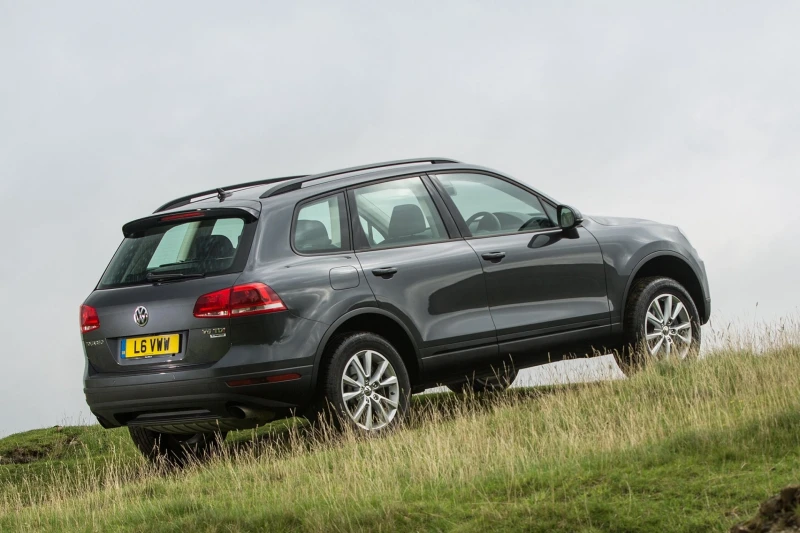
A Volkswagen Touareg II is easy to misjudge if it is evaluated only by horsepower or equipment count. Its main strengths are highway comfort, strong V6 powertrains, standard all-wheel drive, useful towing capacity, and an understated design. It suits a buyer who wants a substantial two-row SUV for commuting, long-distance travel, winter use, or towing but does not need a third row.
The second-generation Touareg should no longer be treated as a cheap shortcut to premium-SUV ownership. Purchase prices have fallen dramatically, but the vehicle's mechanical complexity, parts costs, and maintenance requirements remain those of an upscale SUV. The condition of the individual example matters more than chasing the newest year, the highest trim, or the lowest advertised price.
For the U.S. market, 2017 was the final model year before the Touareg was discontinued here. That makes the 7P a finite used-car proposition rather than an older version of a model still sold new in America. Well-kept examples continue to stand apart because they combine solid long-distance refinement, a practical five-seat cabin, and genuine towing capability in a package that is less conspicuous than many luxury-brand alternatives.