In this article, we dive deep into the technical specifications of the Volkswagen Tiguan II, covering the engines offered from 2016–2023, transmissions, drivetrains, dimensions, and weights. This overview of Tiguan powertrains will help you understand the options available on the US market and their real-world performance in American driving conditions. Data is based on official sources and major US automotive platforms.
Engines and Transmissions
The second-generation Tiguan is built on the modular MQB platform, offering a focused but capable range of powertrains. In the US market, the primary engine was the turbocharged 2.0-liter TSI gasoline unit, paired with an 8-speed automatic transmission. All models met strict EPA emissions standards. Key powertrain options for the 2018–2023 period (US-spec second generation) are shown in the table below. Power ranged from 184 hp, with both front-wheel and all-wheel drive configurations available.
| Engine (type, displacement, power) | Transmission | Drivetrain |
|---|---|---|
| 2.0 TSI (gasoline, 2.0 L, 184 hp, 221 lb-ft) | 8-speed Automatic | Front-wheel Drive (FWD) or All-wheel Drive (4Motion) |
The 2.0 TSI engine is the mainstay of the US-market Tiguan II. It delivers smooth power and decent efficiency: EPA estimates typically show 22–24 mpg city, 29–31 mpg highway, and 25–27 mpg combined when using premium unleaded fuel. Real-world figures from owners often align closely, especially on highways. The 8-speed automatic is smooth and reliable, while the available 4Motion all-wheel drive provides extra confidence in rain, snow, or light off-road conditions, though it slightly increases fuel consumption by about 1–2 mpg.
Dimensions and Weight
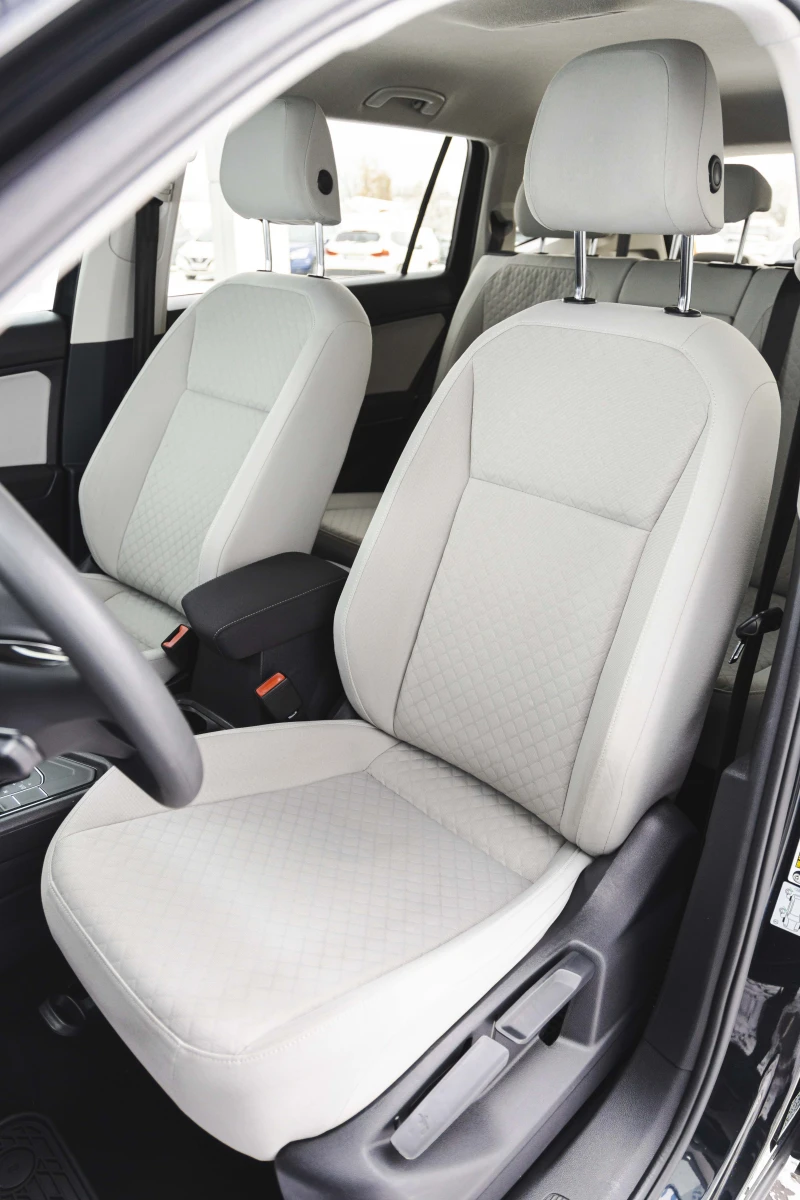
The Tiguan II strikes an excellent balance between compact size for easy city parking and generous interior space for passengers and cargo. The standard 5-passenger version dominated the US market, with the longer Allspace (7-passenger) variant also available in select years. Below are the key specs for the standard model (2018–2023 US-spec). Weights vary depending on engine, trim, and drivetrain.
| Parameter | Value (standard version) | Transmission & Drivetrain |
|---|---|---|
| Length / Width / Height, in | 185.1 / 72.4 / 66.4 | – |
| Wheelbase, in | 109.8 | – |
| Ground Clearance, in | 7.9 | – |
| Curb Weight, lbs | 3,700–4,200 (FWD) / 3,900–4,400 (4Motion) | Automatic, FWD/AWD |
| Gross Vehicle Weight, lbs | 4,800–5,200 | Automatic, FWD/AWD |
| Cargo Volume, cu ft | 37.6–73.4 (rear seats up/folded) | – |
For the Allspace variant: length around 187 in, wheelbase extended to about 110 in, with added 100–200 lbs. Real-world curb weights for popular AWD versions are typically around 4,100–4,300 lbs, which affects acceleration and fuel economy but improves stability.
Updates by Year
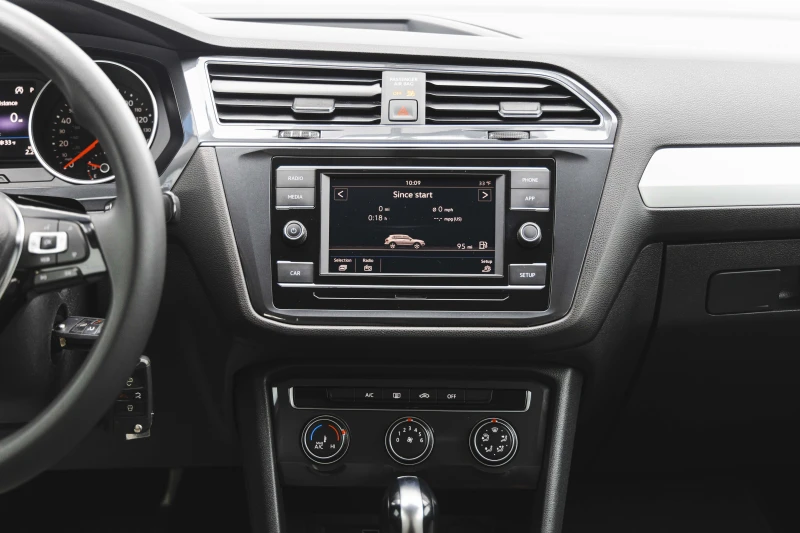
From 2018 to 2023, the US-spec Tiguan II saw steady refinements. The 2018 redesign brought the longer wheelbase, modern styling, and the 2.0 TSI with 8-speed automatic. Mid-cycle updates around 2021–2022 included refreshed styling, improved infotainment (MIB3 system), and minor efficiency tweaks. The 4Motion AWD system evolved for better traction and efficiency. Later models (2021–2023) command a 10–20% premium on the used market but offer better tech, slightly refined ride, and small fuel economy improvements.
Key Considerations for Buyers
When operating in the US, consider local factors: fuel quality, road conditions, and climate variations. Overall reliability is strong, though some nuances exist. The 2.0 TSI performs well with premium unleaded fuel (91–93 octane recommended), though minor oil consumption can appear after 60,000–80,000 miles in some units — check levels regularly. No widespread diesel options existed in the US market. The 8-speed automatic is generally durable but benefits from fluid changes every 60,000 miles. 4Motion AWD adds versatility for snowy states but requires periodic fluid maintenance. Parts availability is excellent through dealers and aftermarket, with reasonable pricing. Common issues include paint chips and minor suspension wear (bushings after 50,000 miles). A pre-purchase inspection is highly recommended.
Bottom Line
The Volkswagen Tiguan II offers excellent versatility for the US market. The sweet spot is the 2.0 TSI with 8-speed automatic and optional 4Motion AWD. This setup delivers balanced performance (0–60 mph in about 8–9 seconds), respectable fuel economy (25–27 mpg combined EPA), strong reliability with proper maintenance, and high resale value on the used market. Approximate market prices for well-maintained 2018–2023 examples currently range from $18,000–$28,000 depending on mileage, condition, and trim (as of early 2026). It strikes a great balance for families, commuters, or light adventure use — a smart all-around compact crossover.