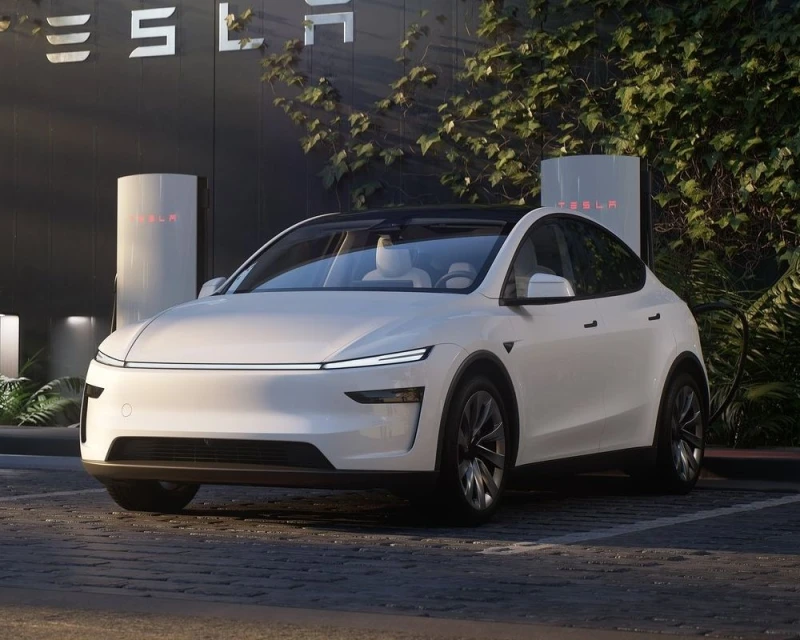
The transmission is a single-speed reducer with a fixed gear ratio. In the US market, Tesla Model Y Juniper models are primarily built at the Gigafactory in Austin, Texas, and feature the native NACS charging connector as standard. Some configurations or imports may vary, but NACS is the standard for seamless access to the Supercharger network.
Key powertrain options for the generation:
| Battery (nominal) | Drivetrain | Power (hp) | Torque (lb-ft) | Transmission | Availability | Notes |
|---|---|---|---|---|---|---|
| ~62–68 kWh (LFP) | RWD | 306–340 | ~332–369 | Reducer | 2025–present | Base version, widely available in the US |
| ~79–86 kWh (NMC) | RWD | 340–380 | ~369–406 | Reducer | 2025–2026 | Long Range RWD, available in select US configurations |
| ~79–86 kWh (NMC) | AWD | 450–510 (combined) | ~516–575 | Reducer | 2025–present | Long Range Dual Motor AWD, popular choice for US buyers |
| ~79–86 kWh (NMC) | AWD | 534–580 (combined) | ~575–627 | Reducer | 2025–present | Performance model with adaptive suspension |
All versions are equipped with a heat pump. The high-voltage system architecture is 400 V (compared to 800 V in the Cybertruck and certain Model S/X variants). Maximum DC fast-charging power reaches up to 250 kW, with real-world rates typically between 180–230 kW at most Supercharger stations across the US. US models use the native NACS connector for optimal compatibility with the charging network.
Dimensions and Weight
The dimensions of this generation have changed only marginally compared to the first-generation Model Y, though overall weight has increased due to improved sound insulation and additional equipment. Figures are averaged across the most common variants.
| Parameter | Value | Notes |
|---|---|---|
| Length | 188.6 in (4790 mm) | Increased by approximately 1.6 inches over the previous generation |
| Width (without mirrors / with mirrors) | 75.6 / 83.8 in (1920 / 2129 mm) | Unchanged |
| Height | 63.9 in (1624 mm) | Slight reduction |
| Wheelbase | 113.8 in (2890 mm) | Fixed |
| Ground clearance | 6.6–6.7 in (167–170 mm) | Performance model sits lower (~6.3 in / 160 mm) |
| Curb weight | 4,211–4,497 lbs (1910–2040 kg) | RWD models ~4,211–4,343 lbs; AWD models ~4,365–4,497 lbs |
| Gross vehicle weight (GVWR) | 5,423–5,732 lbs (2460–2600 kg) | Depends on drivetrain and battery |
| Cargo volume (rear trunk + frunk) | 30.2 + 4.1 cu ft (RWD) / 30.2 + 1.4 cu ft (AWD) | Rear cargo volume increased by about 1 cu ft (~30 L) |
Overall weight has risen by 176–331 lbs compared to the first generation, primarily due to enhanced sound deadening, revised seating, and additional equipment.
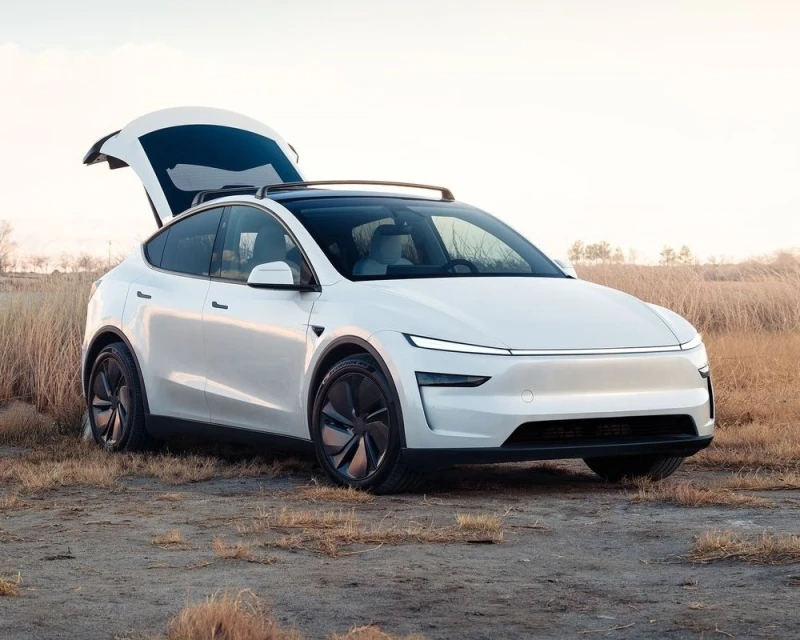
Model Year Updates and Changes
This is the current generation. Since its launch in late 2025 to early 2026, Tesla has not introduced any major styling changes but has implemented several incremental updates via production refinements and over-the-air software:
- 2025/2026: Production for the US market centered at the Austin Gigafactory in Texas. Base models use LFP battery cells (CATL), while Long Range and Performance variants feature NMC cells (LG/Panasonic).
- 2026: Expanded adoption of LFP batteries in certain Long Range RWD configurations, software optimizations for faster charging and reduced energy use, plus improved acoustic insulation materials in later builds.
In the US, all 2025–2026 configurations remain current. Older pre-refresh versions without heat pumps or with AC induction motors have been discontinued. The primary choices are the efficient RWD LFP and the balanced Long Range AWD.
Operating Characteristics and Technical Considerations
The Model Y Juniper has been on US roads since 2026. The PMSM electric motors have proven highly reliable, with major failures being uncommon. The most sought-after variants are the Long Range AWD and RWD LFP models.
According to aggregated US owner data and reports from Tesla Motors Club, Edmunds, InsideEVs, and other sources in 2026, average energy consumption in mixed driving cycles is approximately 24–29 kWh per 100 miles during summer and 31–39 kWh per 100 miles in winter (when temperatures drop to 14…5 °F). Real-world range for the Long Range AWD is roughly 280–342 miles in summer conditions and 217–280 miles in winter; the RWD LFP variant can deliver 43–75 additional miles in warm weather.
The single-speed transmission is robust and requires no scheduled fluid changes. Engaging all-wheel drive increases energy consumption by 8–15% but provides superior grip on wet or snowy roads. Replacement parts for wear items (brake pads, cabin filters, tires) are readily available and reasonably priced through Tesla and third-party suppliers. High-voltage components such as the inverter, charge controller, and battery pack are more costly and typically sourced through authorized channels. Serviceability is good at independent EV-specialist shops for most maintenance, while official diagnostics, warranty work, and battery replacements are performed at Tesla Service Centers or certified partners.
Battery degradation after 12,000–37,000 miles is generally in the 1–5% range under normal operating conditions (daily charging to 80–90% and regular use of preconditioning features).
Summary and Recommended Configuration
From a technical perspective, the Long Range AWD paired with the ~79–86 kWh NMC battery offers the best all-around package for most US buyers: solid real-world range, all-weather capability, reasonable efficiency, and strong residual values. The RWD LFP models provide excellent efficiency, lower degradation rates over time, and strong value in milder climates, though they sacrifice some performance and all-weather traction compared to the dual-motor versions.
The Performance variant appeals to enthusiasts but comes with trade-offs including higher energy use, a firmer suspension tune, and accelerated tire wear. For used purchases, buyers should verify battery state-of-health (SoH) through professional diagnostics, review charging and service history, and inspect the undercarriage for any prior damage. More in-depth coverage of styling, interior quality, equipment levels, and potential shortcomings can be found in companion articles in this series.