


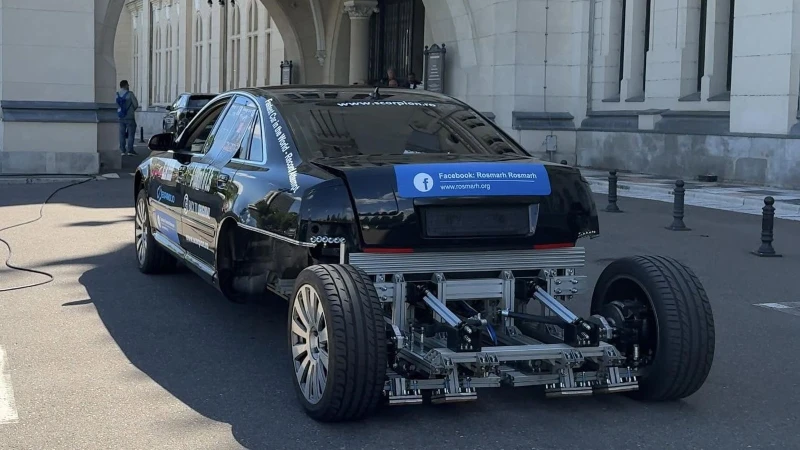
Instead of a conventional internal combustion engine, electric motors, or a traction battery, the design uses cylinders with compressed air. These cylinders act on the rear wheels, causing them to move relative to the body and create tractive force.
The development currently exists only as a prototype built on the base of an older Audi. The creators consider that such a scheme may be especially useful on slippery surfaces — snow, mud, or loose ground. However, numerous technical and engineering questions remain before the technology can be used in series production.
How the Pneumatic Drive Works
The foundation of the system consists of pneumatic cylinders connected to the rear axle. When compressed air is supplied, they perform sharp reciprocating movements and transmit force to the wheels. Visually, the operation of the mechanism resembles industrial equipment: the wheels not only rotate but also noticeably shift forward and backward on special guides.
According to the developers' concept, this principle should allow the car to grip the surface better. On loose or slippery pavement, the wheel can push more firmly against the ground than in the case of conventional torque transmission through the driveshafts. To a certain degree, this is similar to the operation of off-road equipment, where not only engine power is important, but also the ability to maintain contact with the road.
Why the System Is Installed Only at the Rear
For the full application of this scheme on all four wheels, it would be necessary to provide a large reserve of space for their longitudinal movement. On the front axle, this is particularly difficult: the wheels must turn at the same time for steering the vehicle, and additional movements may seriously affect stability and steering precision.
Therefore, Rosmar H limited the system to the rear axle. Even in this variant, the wheels protrude far beyond the usual body dimensions during the operation of the mechanism. For a road car, such a design would have to be covered with special protective elements to eliminate the risk for pedestrians, other cars, and the driver.
Questions Regarding Practical Application
The creators of the prototype claim very high dynamic capabilities, including acceleration from 0 to 100 km/h in 0.3 seconds. However, the published materials do not allow these indicators to be confirmed. In the video, the car moves slowly and jerkily, and the system itself produces noticeable noise.
In addition, for operation on public roads, the design must be adapted to modern safety requirements. Moving suspension elements, significant wheel travel, and the operation of pneumatic cylinders create additional difficulties for certification. A separate task will be the durability of the mechanism under constant loads, contamination, and low temperatures.

Experience from Previous Projects
The idea of a car running on compressed air is not new. One of the most famous projects was the French company MDI, founded by engineer Guy Nègre in the early 1990s. Later, it presented the compact Minicat model and planned to organize production together with Tata Motors.
In the MDI concept, high-pressure compressed air tanks were used. They were supposed to drive pistons that rotate the crankshaft. However, the project did not reach mass production: the system turned out to be complex, expensive, and did not provide a sufficient range.
The main feature of such solutions is that compressed air is not an independent source of energy. It must be pre-obtained using a compressor that consumes electricity or other external energy. Therefore, the efficiency of the entire scheme depends not only on the car, but also on the method of producing and storing compressed air.
The Rosmar H prototype demonstrates one of the non-standard approaches to car movement, but for now it remains a research development. For practical use, it will be necessary to confirm safety, reliability, efficiency, and the possibility of integrating such a system into a serial design.