


In this detailed breakdown we cover all key technical specifications of the Renault Megane II (2002–2009), including engines, gearboxes, dimensions, weights and important updates. This guide to Megane powertrains shows what the generation really offers. Figures are based on manufacturer data, Autoevolution, Wikipedia and real-world owner feedback.
Engines & Transmissions
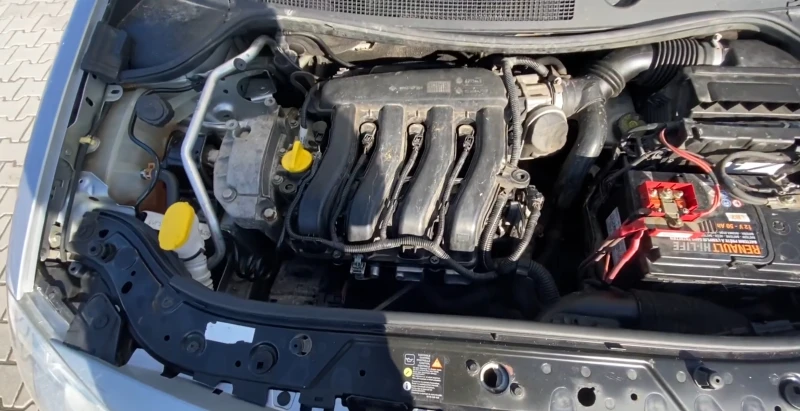
Renault offered a diverse lineup of gasoline and diesel engines, from budget-friendly commuters to hot-hatch performers. All engines are inline-4 with transverse mounting. The K- and F-series gasoline units are known for simplicity and reasonable tuning potential, while dCi diesels stand out for fuel efficiency and strong low-end torque.
Gearboxes included 5- or 6-speed manuals and a 4-speed automatic (DP0/AL4 family). Drive is always front-wheel – no AWD versions existed. Below is the main powertrain overview for the 2002–2009 period.
| Engine (type, displacement, power) | Transmission | Drive |
|---|---|---|
| Gasoline 1.4 16V K4J (1.4L, 98 hp) | 5-speed Manual | FWD |
| Gasoline 1.6 16V K4M (1.6L, 115 hp) | 5-speed Manual / 4-speed Auto | FWD |
| Gasoline 2.0 16V F4R (2.0L, 136 hp) | 6-speed Manual / 4-speed Auto | FWD |
| Gasoline 2.0 Turbo F4RT (2.0L, 165 hp) | 6-speed Manual | FWD |
| Gasoline 2.0 Turbo RS F4RT (2.0L, 225 hp) | 6-speed Manual | FWD |
| Diesel 1.5 dCi K9K (1.5L, 80–106 hp) | 5- or 6-speed Manual | FWD |
| Diesel 1.9 dCi F9Q (1.9L, 120–130 hp) | 6-speed Manual / 4-speed Auto | FWD |
| Diesel 2.0 dCi M9R (2.0L, 150–175 hp) | 6-speed Manual | FWD |
These combinations were mostly available in the US through gray-market imports and enthusiast channels. Gasoline versions are favored for smoother power delivery; diesels for excellent highway economy. Approximate real-world fuel economy (EPA-style estimates adapted from European data and US owner reports): 1.6 gasoline — city 25–28 mpg, highway 38–43 mpg, combined 31–34 mpg; 1.5 dCi — city 38–42 mpg, highway 52–58 mpg, combined 44–49 mpg. The 2.0 gasoline typically returns 22–26 mpg combined; 1.9 dCi around 40–46 mpg (varies significantly with driving style, maintenance and load).
Dimensions & Weight
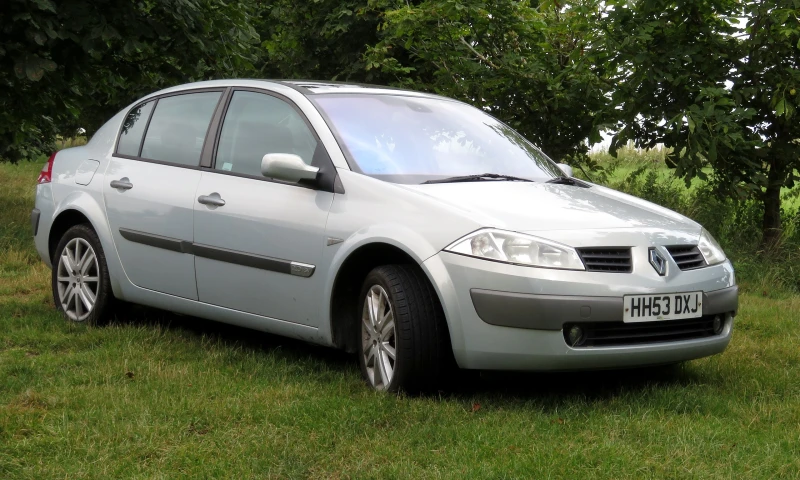
Body styles included 3- and 5-door hatchbacks, sedan, wagon (Grandtour / Sport Tourer) and convertible (CC). The Nissan-shared C-platform provided crisp handling and surprisingly good interior space for the class. Curb weight usually falls between 2,590–2,870 lbs, gross vehicle weight rating 3,750–4,100 lbs depending on equipment and engine. Key measurements below.
| Body Style | Length / Width / Height (in) | Wheelbase (in) | Curb / GVWR (lbs) | Drive / Transmission |
|---|---|---|---|---|
| Hatchback | 165.7 / 70.0 / 57.4 | 103.3 | 2,590–2,700 / 3,800 approx. | FWD / Manual or Auto |
| Sedan | 177.1 / 70.0 / 57.5 | 105.7 | 2,645–2,750 / 3,850 approx. | FWD / Manual or Auto |
| Wagon | 177.1 / 70.0 / 59.3 | 105.7 | 2,755–2,865 / 4,000 approx. | FWD / Manual or Auto |
| Convertible (CC) | 171.5 / 70.0 / 55.3 | 99.3 | 2,865–2,950 / 4,080 approx. | FWD / Manual or Auto |
These dimensions make the Megane II easy to park in American cities while still offering decent rear-seat room and trunk capacity (especially in the sedan and wagon – up to ~18 cu ft in the sedan).
Facelift & Model Year Changes (Phase 2 – 2006+)
The 2006 facelift (Phase 2) brought visual and technical improvements. New front bumper, headlights and revised interior with relocated instrument cluster (speedometer now on the right in some markets). Engines were updated to meet stricter Euro 4 emissions: new 1.5 dCi 106 hp tune, 1.9 dCi 130 hp, 2.0 dCi 150 hp. Suspension tweaks borrowed from the RS model improved handling. The automatic transmission received reliability enhancements. Post-facelift cars are generally preferred on the used market for better emissions compliance, refinement and long-term durability.
Buying Tips for US Buyers
Renault Megane II is a rare sight in the United States – most examples are gray-market imports. Reliability highlights: the 1.6 and 2.0 gasoline engines are mechanically simple but can suffer timing chain / variator issues (repair cost ~$600–$1,200). The 1.5 dCi is very frugal but sensitive to poor-quality fuel and neglected maintenance (EGR, turbo, injectors can be expensive – $1,000–$2,500). The 1.9 dCi is widely regarded as the most durable, frequently exceeding 250,000–300,000 miles with proper care.
Most imported examples feature manual transmissions and diesel engines for better economy on long highway drives. The DP0/AL4 automatic is the weakest link – prone to overheating and solenoid/valve-body failures (rebuild ~$1,500–$2,500). CV joints and wheel bearings should be inspected on higher-mileage cars.
Parts availability is surprisingly good thanks to online suppliers (RockAuto, Europarts, eBay) and cross-compatibility with other Renault/Nissan models. Expect annual maintenance costs around $500–$900 for a well-kept example. Always get a pre-purchase inspection focusing on engine compression, transmission behavior, suspension wear and rust (especially underbody on cars from salt-belt states).
Summary
The Renault Megane II remains a compelling used compact thanks to its blend of European ride quality, efficient engines and practical packaging. For US buyers the sweet spot is usually a post-2006 1.9 dCi or 2.0 dCi with manual transmission – offering strong highway economy (40+ mpg possible), solid long-term reliability and relatively affordable upkeep. Avoid high-mileage automatics and very early examples unless thoroughly inspected. When well maintained, it delivers French flair and everyday usability at a fraction of newer compact prices.