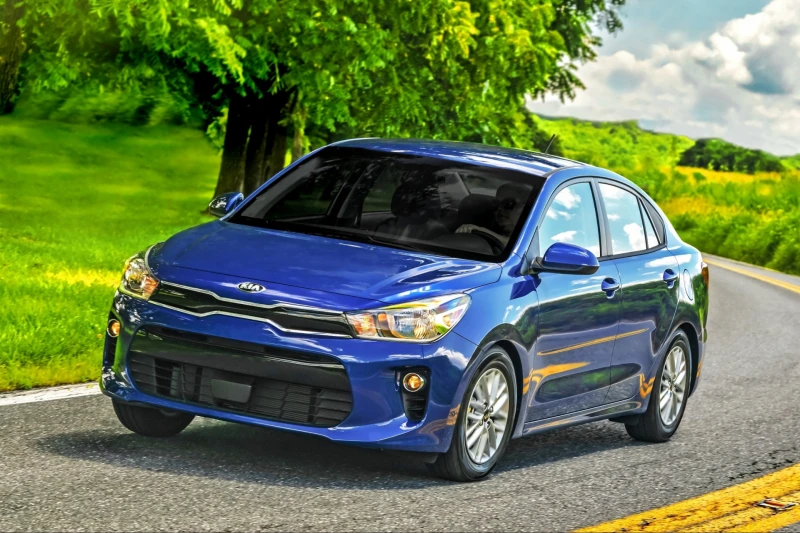
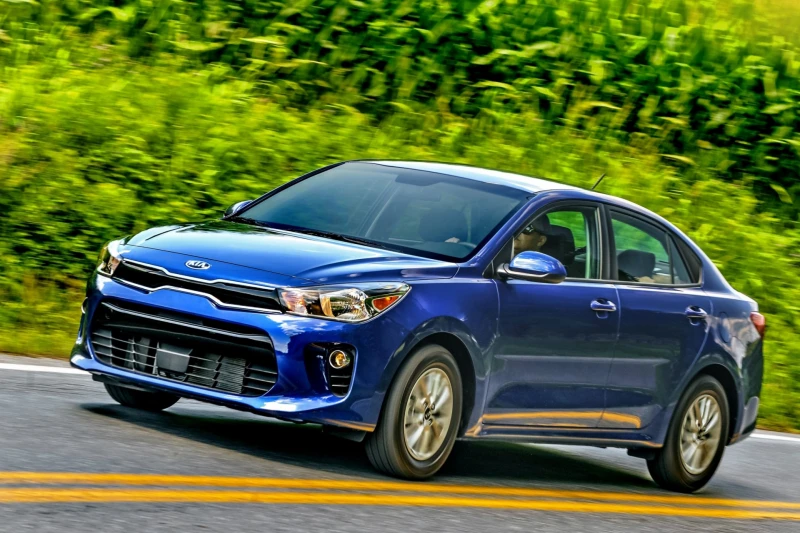
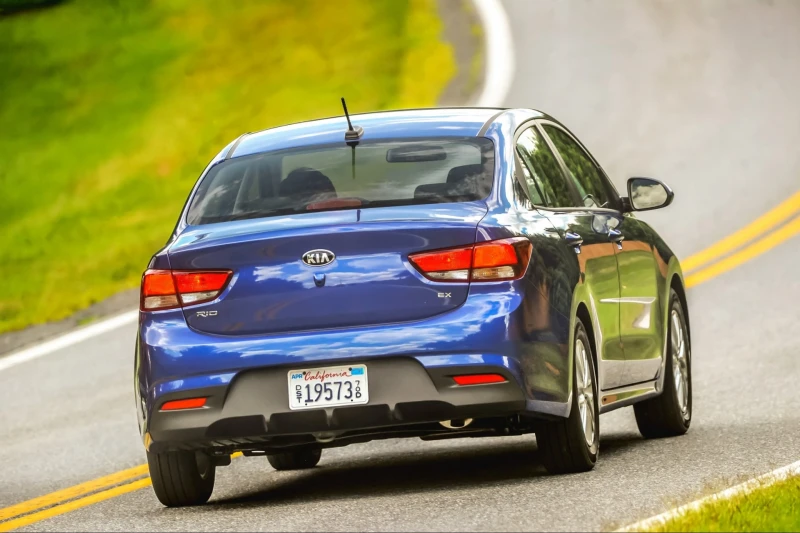
For the United States, the fourth-generation Kia Rio arrived for the 2018 model year as both a four-door sedan and a five-door hatchback. The U.S. powertrain range was much narrower than the European lineup: diesel, 1.0-liter T-GDi, mild-hybrid, iMT and seven-speed DCT versions were not offered here.
U.S.-market 2018–2019 models used a naturally aspirated 1.6-liter Gamma GDI engine rated at 130 hp and 119 lb-ft of torque. A six-speed manual was available on selected entry-level 2018 versions, while the six-speed automatic was the mainstream transmission. For 2020, Kia replaced that combination with a 1.6-liter Gamma II MPI engine producing 120 hp and 112 lb-ft, paired exclusively with an Intelligent Variable Transmission (IVT). Every U.S. Rio of this generation was front-wheel drive.
| Engine | Type / displacement | Output | Torque | Transmission | Drive | U.S. model years | Notes |
|---|---|---|---|---|---|---|---|
| Gamma 1.6 GDI | Gasoline / 1.6 liters | 130 hp | 119 lb-ft | 6-speed manual / 6-speed automatic | FWD | 2018–2019 | The manual was limited to selected entry-level 2018 configurations; the automatic was far more common. |
| Gamma II 1.6 MPI | Gasoline / 1.6 liters | 120 hp | 112 lb-ft | IVT automatic | FWD | 2020–2023 | Replaced the GDI engine and conventional automatic for improved EPA fuel economy. |
Trim availability changed during the generation. Depending on model year and body style, U.S. versions included LX, S and EX. By the final model years, the sedan was sold in LX and S trims, while the five-door hatchback was offered as an S. European engines and trim names should not be applied to U.S.-market cars.
Dimensions and weight
The sedan and five-door shared the same wheelbase, width and height, but differed substantially in overall length and cargo layout. The figures below reflect the principal U.S.-market specifications.
| Specification | Value | Notes |
|---|---|---|
| Overall length | 172.6 in. sedan / 160.0 in. hatchback | The sedan is 12.6 inches longer overall. |
| Width, excluding mirrors | 67.9 in. | Same for both body styles. |
| Height | 57.1 in. | Same for both body styles. |
| Wheelbase | 101.6 in. | Shared by the sedan and five-door. |
| Minimum ground clearance | 5.5 in. | Measured for standard U.S. configurations. |
| Curb weight | Approximately 2,648–2,767 lb. | Varies by model year, body style, trim and transmission. |
| Gross vehicle weight rating (GVWR) | Varies by configuration | Use the certification label on the specific vehicle for the authoritative figure. |
| Cargo capacity | 13.7 cu. ft. sedan / 17.4–32.8 cu. ft. hatchback | Hatchback figures are with the rear seat upright and folded. |
Automatic and IVT-equipped versions generally weigh more than the early manual-transmission model. Equipment differences can also affect curb weight, so the figure for a specific car should be confirmed by model year and VIN.
Model-year updates and refresh
The U.S. model cycle differed from the global launch schedule. The key changes were:
- 2018: U.S. launch of the redesigned Rio sedan and five-door. LX, S and EX versions were offered with the 130-hp 1.6 GDI engine; selected LX configurations were available with a six-speed manual.
- 2019: The 1.6 GDI engine and six-speed automatic continued, while the trim structure was simplified on some body styles.
- 2020: The 120-hp 1.6 MPI engine and IVT replaced the previous GDI/automatic combination. A 7-inch touchscreen with Apple CarPlay and Android Auto became standard.
- 2021: A mid-cycle refresh brought revised front and rear styling, an 8-inch touchscreen and wireless Apple CarPlay and Android Auto on U.S. models.
- 2022–2023: The Rio continued largely unchanged in LX and S sedan form and as an S five-door, with additional driver-assistance features available through the S Technology Package.
The 2023 Rio was the final U.S. model year. There was no 2024 successor in Kia America's new-vehicle lineup, so fourth-generation U.S.-spec cars are now found primarily on the used market.
Fuel economy, ownership and technical considerations
The early GDI/six-speed cars and later MPI/IVT cars should be treated as separate powertrain groups when comparing service history, parts and driving characteristics. Listings on Autotrader, CarGurus and Cars.com should be checked carefully because sellers may use generic engine or transmission descriptions.
EPA estimates for common U.S. configurations were:
- 2018 six-speed manual: 29 mpg city / 37 mpg highway / 32 mpg combined
- 2018–2019 six-speed automatic: 28 mpg city / 37 mpg highway / 32 mpg combined
- 2020–2023 IVT: approximately 32–33 mpg city / 41 mpg highway / 36 mpg combined, depending on model year and body style
These are EPA estimates, not owner-reported results. Actual fuel economy varies with speed, temperature, traffic, tire condition, vehicle load and maintenance.
For transmission and engine service, follow the maintenance schedule for the exact model year and account for severe-use conditions rather than applying one universal interval to both the six-speed automatic and the IVT. A pre-purchase inspection should include a cold start, a diagnostic scan, checks for fluid leaks and abnormal noises, a road test for smooth transmission operation, and a review of maintenance, accident and recall history. Engine condition cannot be reduced to a fixed percentage at a given mileage; oil consumption, compression, scan data and documented service history are more meaningful.
Best U.S.-market configuration
The best choice depends on priorities. A 2018–2019 Rio offers the more powerful 130-hp engine and a conventional six-speed automatic, while a 2020–2023 car provides substantially better EPA fuel economy, newer infotainment and, on appropriately equipped examples, a broader set of driver-assistance features.
Before buying, confirm the VIN, model year, body style and powertrain rather than relying solely on the listing title. Pay particular attention to transmission behavior, service records, warning lights, collision repairs and open recalls. Separate articles in this series cover exterior design, interior packaging, equipment and common ownership concerns in greater detail.