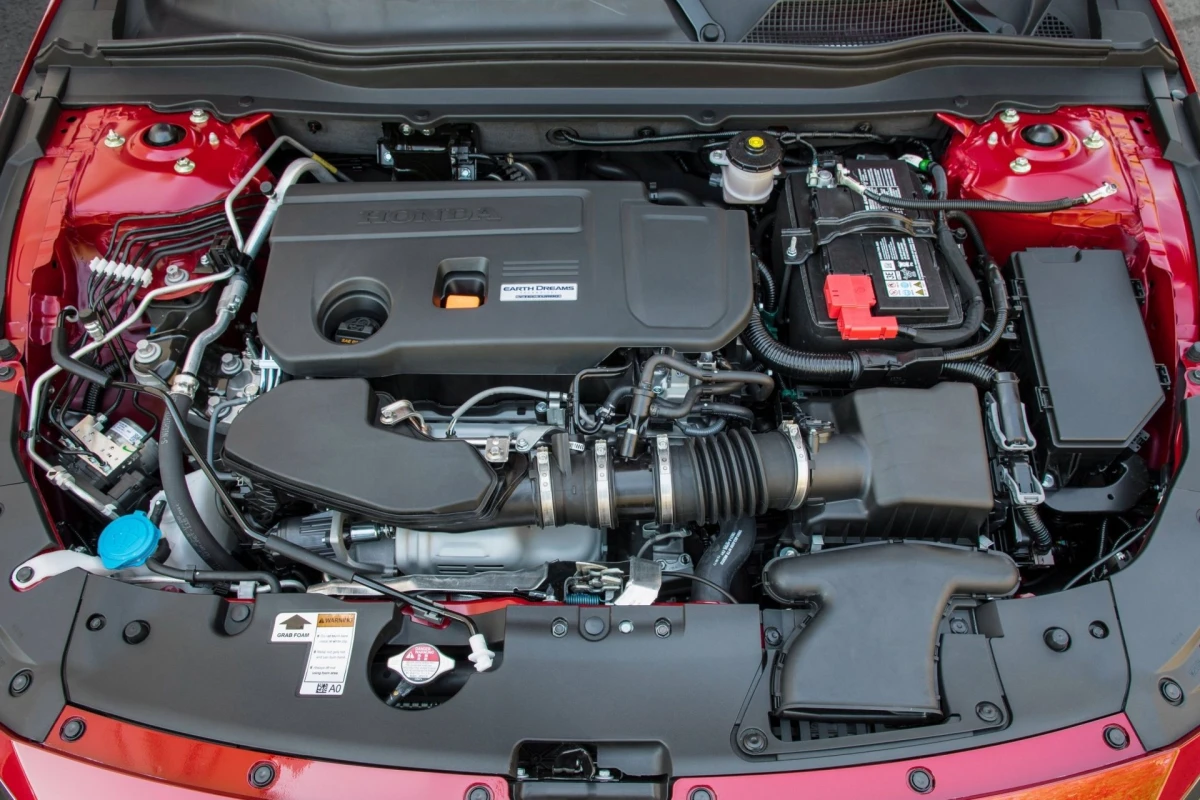
In the United States, the 11th-generation Honda Accord arrived for the 2023 model year as a front-wheel-drive sedan. Unlike some overseas versions, the U.S. lineup includes both a turbocharged gasoline powertrain and a two-motor hybrid. All-wheel drive is not offered.
The 1.5-liter turbo uses a conventional continuously variable transmission (CVT). Hybrid trims use Honda’s two-motor system with a direct-drive unit, commonly described in specifications as an electronic continuously variable transmission (eCVT), although it does not operate like a belt-driven CVT.
| Powertrain | Engine type / displacement | Output | Torque | Transmission | Drivetrain | U.S. availability | Notes |
|---|---|---|---|---|---|---|---|
| 1.5L VTEC Turbo | Turbocharged gasoline inline-four / 1,498 cc | 192 hp at 6,000 rpm | 192 lb-ft at 1,700–5,000 rpm | CVT | FWD | 2023–present | LX and EX for 2023–2024; LX and SE from 2025 |
| 2.0L two-motor hybrid | Atkinson-cycle gasoline inline-four / 1,993 cc plus two electric motors | 204 hp total system output | 247 lb-ft from the traction motor; Honda does not publish a combined system-torque figure | Direct-drive unit / eCVT designation | FWD | 2023–present | Sport Hybrid, EX-L Hybrid, Sport-L Hybrid and Touring Hybrid |
The hybrid combines a 146-hp 2.0-liter Atkinson-cycle engine with a 181-hp traction motor and a separate generator motor. At lower and moderate speeds, propulsion is primarily electric; under suitable cruising conditions, a lock-up clutch can connect the gasoline engine directly to the wheels. This is a conventional, non-plug-in hybrid, so it has no external charging port—neither NACS nor CCS—and the battery is replenished by regenerative braking and the gasoline engine.
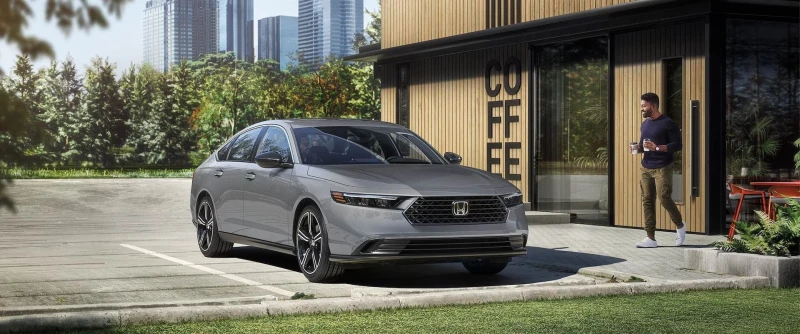
Dimensions and weight
Exterior dimensions are consistent across the current U.S. trim range. Curb weight varies with the powertrain, wheel size and equipment level; the figures below reflect official 2026 U.S. specifications.
| Measurement | Value | Notes |
|---|---|---|
| Length | 195.7 in | All U.S. trims |
| Width | 73.3 in | Excluding mirrors |
| Height | 57.1 in | All U.S. trims |
| Wheelbase | 111.4 in | All U.S. trims |
| Ground clearance | 5.3 in | Unladen |
| Curb weight | 3,239–3,532 lb | From LX to Touring Hybrid |
| Gross vehicle weight rating (GVWR) | Check the vehicle certification label | Varies by configuration and is not presented as one universal consumer-specification figure |
| Trunk capacity | 16.7 cu ft | Same published cargo volume for gasoline and hybrid trims |
Hybrid trims are heavier than the turbo models, but the battery packaging does not reduce the published 16.7-cu-ft trunk capacity. The EX-L Hybrid combines 17-inch wheels with the lowest curb weight among the hybrid trims, while Sport, Sport-L and Touring models use 19-inch wheels.
Model-year updates and trim changes
The 11th-generation Accord was revealed in November 2022 and launched in the United States as a 2023 model. Honda has made incremental equipment and trim changes rather than a major redesign:
- 2023–2024: The U.S. lineup consisted of LX and EX trims with the 1.5-liter turbo, plus Sport Hybrid, EX-L Hybrid, Sport-L Hybrid and Touring Hybrid. The previous-generation 2.0-liter turbo and 10-speed automatic did not return.
- 2025: The new SE replaced the EX in the turbocharged range. The hybrid trim structure remained Sport, EX-L, Sport-L and Touring.
- 2026: LX and SE received a standard 9-inch touchscreen, wireless Apple CarPlay and Android Auto, and a wireless phone charger. The SE also moved to 19-inch wheels; the powertrain lineup remained unchanged.
For 2026, U.S. buyers can still choose between the 192-hp 1.5-liter turbo in LX or SE form and the 204-hp hybrid in Sport, EX-L, Sport-L or Touring trim. Every version remains front-wheel drive.
Fuel economy, maintenance and used-car checks
EPA ratings depend on trim and wheel size. For 2026, the LX is rated at 29 mpg city, 37 mpg highway and 32 mpg combined, while the 19-inch-wheel SE is rated at 28/36/31 mpg. Sport, Sport-L and Touring hybrids are rated at 46/41/44 mpg, and the 17-inch-wheel EX-L Hybrid leads the range at 51/44/48 mpg. Turbo models use a 14.8-gallon tank; hybrids use a 12.8-gallon tank.
These EPA figures are laboratory estimates, not owner-reported consumption. Real-world results vary with speed, temperature, terrain, tire choice and driving style. The hybrid generally delivers its largest advantage in urban and suburban driving, where regenerative braking and frequent electric-motor operation are most effective.
Maintenance should follow the vehicle’s Maintenance Minder and the model-specific owner information rather than a universal fixed fluid-change interval. The hybrid direct-drive unit is mechanically different from the belt-driven CVT used with the 1.5-liter turbo. When evaluating a used car, review service and accident history, inspect for flood damage, verify open recalls by VIN and request a hybrid-system diagnostic when considering a Hybrid trim. Certain 2023–2025 Accord Hybrids are included in NHTSA recall 25V785 for integrated-control-module software that can cause a loss of drive power; the remedy is a dealer software update.

Which U.S.-market Accord configuration makes the most sense?
The 1.5-liter turbo is the lower-cost route into the 11th-generation Accord and suits drivers whose mileage is weighted toward steady highway travel. The hybrid offers stronger low-speed response and substantially better EPA city economy; among hybrid trims, the EX-L’s 17-inch wheels deliver the highest published fuel-economy ratings. Buyers who require all-wheel drive will need to consider a different model, because no U.S.-market Accord XI offers AWD.
For a used purchase, compare trim-specific equipment, confirm that recall work is complete, check tire and wheel condition—especially on 19-inch-wheel versions—and obtain a pre-purchase inspection. On a hybrid, a diagnostic scan of the high-voltage system is more useful than relying on unsupported assumptions about battery degradation.