


The U.S.-market tenth-generation Honda Accord, commonly identified by the CV1, CV2 and CV3 chassis codes, was sold for the 2018–2022 model years. The gasoline models launched for 2018, and the Accord Hybrid joined the lineup in March 2018. In the United States, this generation was offered only as a four-door sedan. Every version was front-wheel drive; neither a coupe nor all-wheel drive was available.
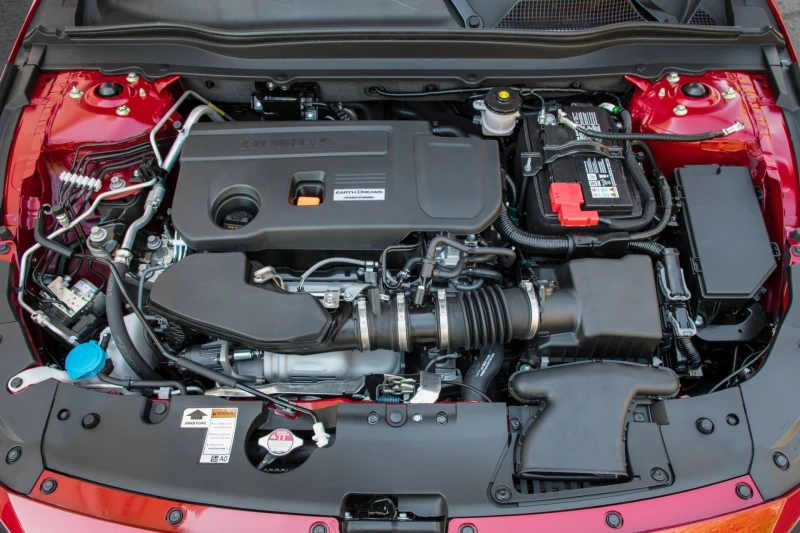
Transmission choices depended on the powertrain and model year. The 1.5T was paired mainly with a continuously variable transmission (CVT), while the 2.0T used a 10-speed automatic. Sport models could also be ordered with a 6-speed manual through the 2020 model year. The Hybrid used Honda's two-motor system with a single-speed direct-drive arrangement commonly described as an e-CVT. The main U.S. powertrains were:
| Engine | Type / displacement | Output | Torque | Transmission | Drive | U.S. availability | Notes |
|---|---|---|---|---|---|---|---|
| L15BE 1.5T | Turbocharged gasoline inline-four / 1.5 liters | 192 hp | 192 lb-ft | CVT; 6-speed manual on Sport through 2020 | FWD | 2018–2022 | The volume engine, offered across several trims depending on model year |
| K20C4 2.0T | Turbocharged gasoline inline-four / 2.0 liters | 252 hp | 273 lb-ft | 10-speed automatic; 6-speed manual on Sport through 2020 | FWD | 2018–2022 | Performance-oriented option used in Sport, EX-L and Touring configurations depending on year |
| LFA1 / LFB1 Hybrid | Atkinson-cycle gasoline inline-four / 2.0 liters plus two electric motors | 212 hp total system output | 129 lb-ft engine; 232 lb-ft traction motor | Single-speed direct drive / e-CVT | FWD | 2018–2022 | Sold in multiple Hybrid trims; motor and engine torque figures are not directly additive |
The two turbocharged engines use direct fuel injection, while the naturally aspirated hybrid engine works with Honda's two-motor system. Honda specified regular unleaded gasoline for the U.S. lineup. Trim availability changed during the generation, so engine and equipment combinations should be verified by model year and VIN rather than inferred from the badge alone.
Dimensions and weight
The wheelbase, width and height remained essentially unchanged, but the 2021 refresh increased overall length. The figures below cover the most common U.S.-market configurations; curb weight varies with trim, powertrain and equipment.
| Measurement | Value | Notes |
|---|---|---|
| Length | 192.2 in (2018–2020); 196.1 in (2021–2022) | The longer figure reflects the refreshed exterior |
| Width, excluding mirrors | 73.3 in | Unchanged across the generation |
| Height | 57.1 in | Nominal U.S. specification |
| Wheelbase | 111.4 in | Unchanged across the generation |
| Ground clearance | Not listed as a single figure in Honda's U.S. specification sheets | Actual clearance varies with tires, load and trim |
| Curb weight | Approximately 3,131–3,446 lb | Lightest early 1.5T versions to the heaviest late Hybrid Touring |
| Gross vehicle weight rating | Check the certification label on the individual car | Varies by configuration and is not consistently shown in consumer specifications |
| Trunk volume | 16.7 cu ft | Applies to gasoline and hybrid sedans in U.S. specifications |
Powertrain and equipment account for much of the weight difference. A late Hybrid Touring or 2.0T Touring is several hundred pounds heavier than an early base 1.5T model, so comparisons should be made between specific trims rather than against a single generation-wide figure.
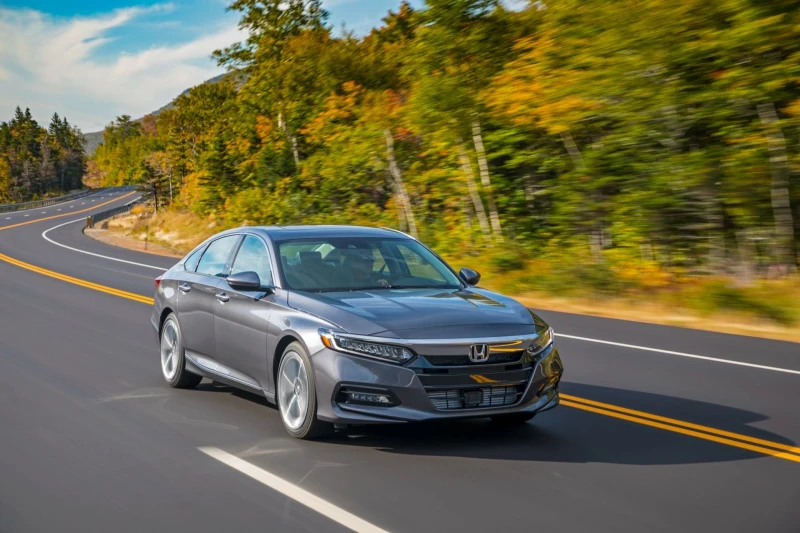
Model-year updates and refresh
This generation is no longer in production. The most important U.S.-market changes were:
- 2018: U.S. launch with 1.5T, 2.0T and Hybrid powertrains. Honda Sensing was standard, and the gasoline trim structure included LX, Sport, EX, EX-L and Touring.
- 2019–2020: Mostly incremental equipment and trim changes. The 6-speed manual remained available on Sport 1.5T and Sport 2.0T models through 2020, then disappeared from the Accord lineup.
- 2021–2022: The 2021 refresh brought revised exterior styling, broader availability of the 8-inch touchscreen, updated hybrid response and wireless Apple CarPlay and Android Auto on selected trims. The gasoline trim mix changed, and Hybrid Sport joined for 2022.
The U.S. refresh arrived for the 2021 model year, not 2019 or 2020. Later cars may have newer infotainment features and a different trim structure, but wireless smartphone integration was not fitted to every version. Equipment should be confirmed from the window sticker, VIN-specific build data or a physical inspection.
Fuel economy and ownership considerations
EPA ratings vary by model year and trim. For 2022, the 1.5T CVT was rated at 29–30 mpg city, 35–38 mpg highway and 32–33 mpg combined; the 2.0T 10-speed at 22 mpg city, 32 mpg highway and 26 mpg combined; and the Hybrid at 44–48 mpg city, 41–48 mpg highway and 43–48 mpg combined. These are EPA estimates, not owner-reported results, and actual mileage depends on driving conditions, maintenance, tires and climate.
Used examples are widely listed on Autotrader, CarGurus and Cars.com. Compare vehicles by model year, trim and powertrain, and review service documentation rather than relying on broad claims about reliability. During a pre-purchase inspection, check for stored diagnostic codes, coolant or oil leaks, abnormal cold-start noise, smooth CVT or 10-speed operation and evidence of collision or flood damage. Hybrid buyers should also request a diagnostic assessment of the high-voltage battery.
- 1.5T CVT — 29–30 city / 35–38 highway / 32–33 combined mpg for 2022, depending on trim
- 2.0T 10-speed automatic — 22 city / 32 highway / 26 combined mpg for 2022
- Hybrid — 44–48 city / 41–48 highway / 43–48 combined mpg for 2022, depending on trim
Maintenance needs depend on use, model year and the vehicle's Maintenance Minder. Claims that every CVT or 10-speed automatic requires service at one universal mileage interval should be treated cautiously; invoices and fluid condition are more useful than an unsupported schedule. The same applies to generalized claims about engine life or percentage-based wear, which cannot be established without a documented inspection.
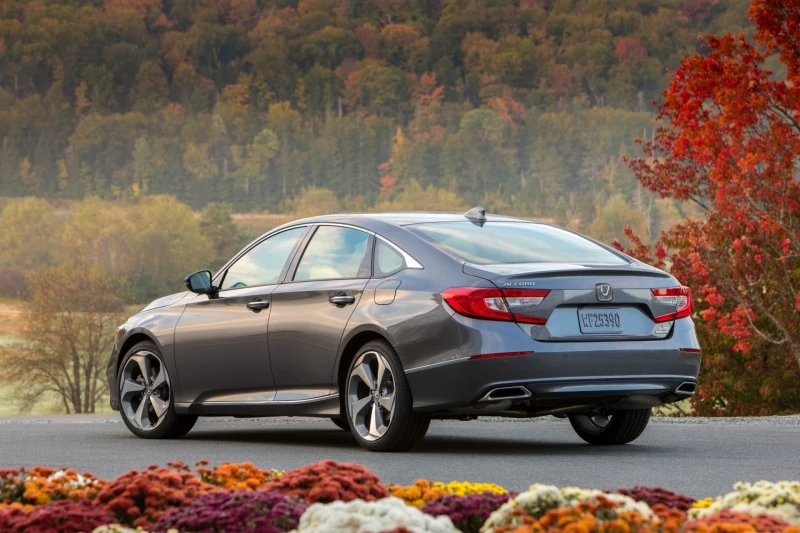
Which version makes the most sense in the United States?
The 1.5T CVT suits buyers focused on fuel economy and broad used-market availability. The 2.0T 10-speed delivers the strongest acceleration, while the Hybrid is the efficiency leader, especially in urban and mixed driving. No powertrain is automatically the best used-car choice: condition, maintenance history, accident history and purchase price matter more than the trim badge alone.
Before buying, verify the VIN, open recalls, title history and service records, then arrange an independent inspection. The test drive should include a cold start, low-speed operation, highway acceleration and checks of all driver-assistance and infotainment functions. Separate articles in this series cover exterior design, interior equipment, trim levels and common ownership concerns.