


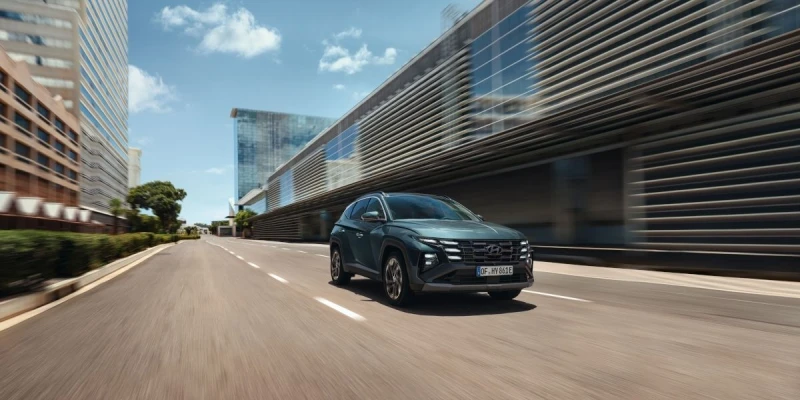
Introduced in the United States for the 2022 model year, the fourth-generation Hyundai Tucson, factory code NX4, is available with gasoline, hybrid and plug-in hybrid powertrains tailored to very different driving patterns. Whether the vehicle spends most of its time in Los Angeles traffic, on long Interstate trips or on snowy mountain roads, the engine and drivetrain choice has a direct effect on fuel economy, performance and long-term ownership costs. Design, interior features and trim levels are covered elsewhere in this series; this guide focuses on the mechanical specifications, dimensions and everyday operating characteristics.
Powertrains: what is actually offered for the 2026 model year
The U.S. Tucson lineup is built around a naturally aspirated 2.5-liter gasoline engine, a turbocharged hybrid and a plug-in hybrid. The 2025 refresh brought updated styling, cabin technology and revised powertrain calibration, while the core mechanical choices carried into the 2026 model year. Hyundai's HTRAC all-wheel-drive system is optional on gasoline models and standard on the electrified versions, making it especially relevant for drivers in the Northeast, Upper Midwest and Mountain West.
Unlike Tucson versions sold in some overseas markets, U.S.-spec models are not offered with the 2.0-liter MPI gasoline engine or 1.6-liter CRDi diesel. The main choices are the 2.5-liter Smartstream gasoline engine, the 1.6-liter turbo hybrid and the 1.6-liter turbo plug-in hybrid. These are the configurations most commonly found at American Hyundai dealerships and on the used-vehicle market.
| Engine type | Displacement | Output | Transmission | Drivetrain |
| Smartstream G2.5 GDI/MPI gasoline | 2.5 liters | 187 hp | 8-speed automatic | FWD or HTRAC AWD |
| 1.6 T-GDI Hybrid HEV | 1.6-liter turbo + electric motor | 231 hp combined | 6-speed automatic with integrated electric motor | HTRAC AWD |
| 1.6 T-GDI Plug-in Hybrid PHEV | 1.6-liter turbo + electric motor | 268 hp combined | 6-speed automatic with integrated electric motor | HTRAC AWD |
The 2.5-liter engine is the simplest and most widely available option. Its conventional naturally aspirated design, regular-unleaded fuel requirement and traditional automatic transmission help keep ownership straightforward. The hybrid adds stronger low-speed response and better fuel economy without requiring external charging. The plug-in hybrid delivers the highest output and can handle many short daily trips primarily on electricity when it is charged regularly.
How the transmissions behave on American roads
All U.S.-market Tucson powertrains use conventional stepped automatic transmissions rather than a dual-clutch gearbox or continuously variable transmission. The 8-speed automatic paired with the 2.5-liter engine prioritizes smooth shifts and relaxed highway cruising. Hybrid and plug-in hybrid models use a 6-speed automatic with the electric motor integrated into the drivetrain, producing a more familiar acceleration feel than the engine-speed flare common in many e-CVT-equipped rivals. In stop-and-go traffic, the electrified versions also move away from a standstill more quietly and with stronger initial torque.
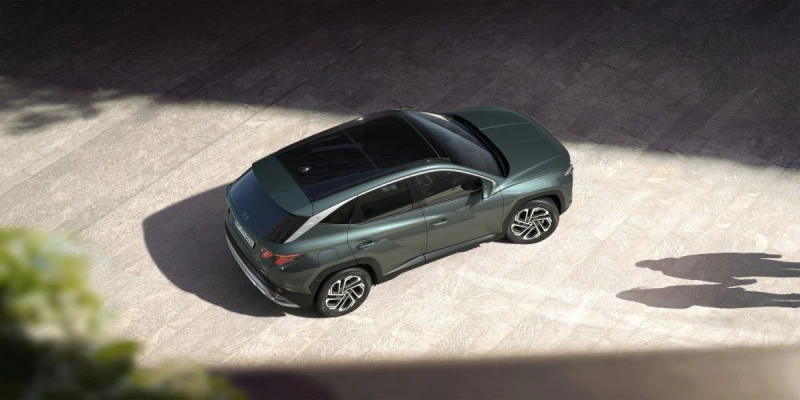
Dimensions and weight: practicality by the numbers
The U.S.-spec Tucson uses the longer-wheelbase NX4 body, giving it more rear-seat and cargo room than the previous-generation model. Exterior dimensions are largely consistent across the range, while curb weight and ground clearance vary by powertrain and drivetrain. The figures below represent the most common specifications for American-market models.
| Specification | Value | Notes |
| Length | 182.3 in | Long-wheelbase body used for the U.S. market |
| Width | 73.4 in | Excluding mirrors |
| Height | 65.6–66.3 in | Varies by drivetrain and roof rails |
| Wheelbase | 108.5 in | Supports generous second-row space |
| Curb weight | Approximately 3,330–4,240 lb | Gas FWD models are lightest; PHEV models are heaviest |
| Gross vehicle weight rating | Approximately 4,760–5,250 lb | Varies by powertrain and equipment |
| Ground clearance | About 7.1–8.3 in | AWD models provide the greater clearance |
The long wheelbase helps the Tucson balance urban maneuverability with highway comfort. Properly equipped models can tow up to about 2,000 lb with trailer brakes, which is enough for a small utility trailer, lightweight personal watercraft or compact camping trailer. It is still a compact crossover rather than a heavy-duty tow vehicle, so payload, tongue weight and the owner's manual limits remain important.
Changes within the generation and current configurations
Since its 2022 U.S. launch, the NX4 Tucson has received a substantial mid-cycle update for the 2025 model year. The refresh focused on the dashboard, infotainment layout, driver-assistance features and exterior details, but it also brought revised calibration for the hybrid system. The 2026 lineup continues the same basic strategy: an affordable gasoline model, a fuel-efficient hybrid and a plug-in hybrid for owners who can charge at home or work.
Gasoline FWD versions make sense in warmer climates and for buyers who prioritize a lower purchase price. HTRAC AWD is a practical upgrade for regular snow, steep grades and unpaved access roads. Hybrid models are especially well suited to dense urban traffic, while the plug-in hybrid offers the greatest benefit when daily mileage fits within its electric range and charging is convenient.
Ownership considerations and real-world efficiency
The 2.5-liter gasoline engine is designed to run on regular 87 AKI unleaded fuel, which keeps refueling costs predictable across the United States. Real-world combined fuel economy generally falls in the mid-to-high 20-mpg range, depending on FWD or AWD, traffic, temperature and driving style. Owners should follow Hyundai's oil-life and maintenance schedule, with shorter service intervals appropriate for frequent short trips, heavy traffic, extreme temperatures or towing.
The hybrid typically returns roughly 35–38 mpg combined in mixed driving, with the best results in city traffic where regenerative braking can recover energy. The plug-in hybrid can cover approximately 30 miles on electricity under favorable conditions and delivers its strongest cost advantage when charged regularly. On longer highway trips after the battery is depleted, its fuel economy is closer to that of a conventional hybrid crossover.
The 8-speed and 6-speed automatics are conventional units with smooth everyday behavior. HTRAC AWD uses electronically controlled torque distribution and requires no unusual owner intervention beyond scheduled fluid inspections and service. Tire condition remains especially important because mismatched tread depth can place additional strain on any all-wheel-drive system.
Parts availability and dealer support are generally strong across major U.S. metropolitan areas. Hyundai's new-vehicle limited warranty is commonly listed at 5 years or 60,000 miles, while the original owner's powertrain limited warranty extends to 10 years or 100,000 miles. Coverage can differ for subsequent owners and individual components, so used-car buyers should verify the remaining warranty by VIN.
Best configurations for different drivers
For many family buyers, the 2.5-liter gasoline model with FWD offers the simplest ownership experience and the lowest entry cost. Drivers who regularly face snow or mountain travel should consider the HTRAC AWD version. The hybrid is the strongest all-around choice for commuters who want better mileage without changing their refueling habits, while the plug-in hybrid makes the most sense for owners with dependable home charging and a short-to-moderate daily commute.
Overall, the Hyundai Tucson IV (NX4) delivers a well-balanced combination of interior space, familiar controls and multiple levels of electrification. Its three U.S.-market powertrain paths cover most compact-SUV use cases, from affordable daily transportation to efficient city driving and limited electric-only commuting.