


The Kia Carnival is neither an old-school, boxy minivan nor a three-row crossover pretending to offer minivan practicality. It was designed for buyers who need generous passenger and cargo space but also care about contemporary styling, composed road manners, and car-like technology. In the United States, the fourth-generation KA4 arrived for the 2022 model year and quickly became a distinctive alternative to the Honda Odyssey, Toyota Sienna, and Chrysler Pacifica.
Why this generation stands apart from its predecessor
The previous YP-generation Sedona was competent but conservative. It felt like a conventional family van: practical, spacious, and easy to understand, but visually anonymous. With the KA4, Kia changed direction. The vehicle moved to the N3 platform, adopted a stiffer body structure with extensive use of high-strength steel, and gained styling intended to blur the line between a minivan and an SUV.
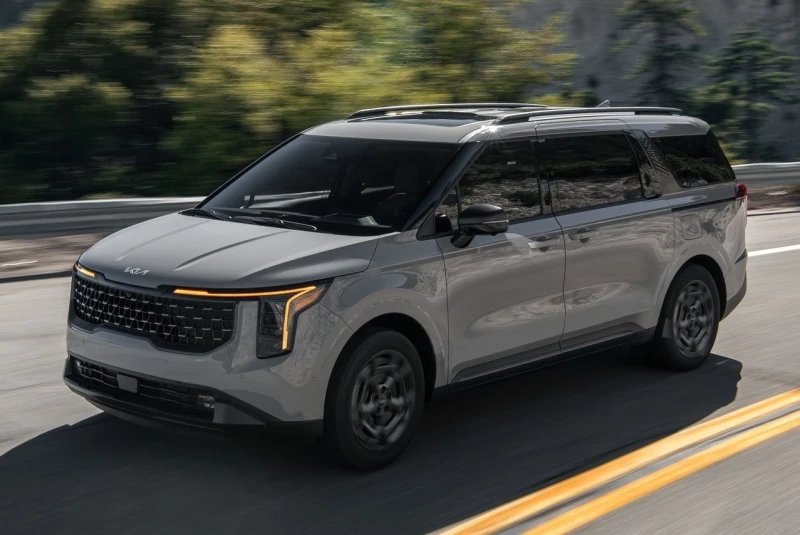
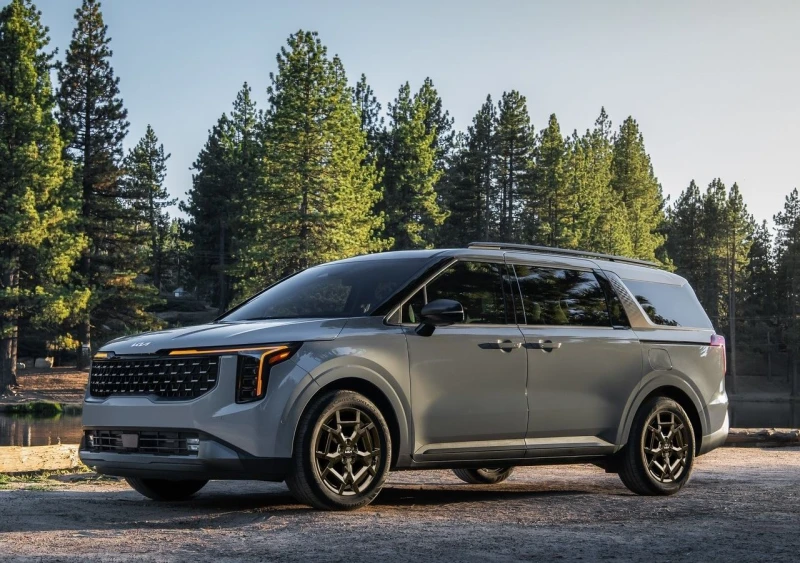
The original U.S. version already featured a long hood, a broad grille, and heavily sculpted wheel arches. For the 2025 model year, Kia introduced a substantial exterior update with vertically arranged lighting, a more assertive grille, sharper body detailing, and revised taillights. The 6.8-inch ground clearance and SUV-like proportions create a more rugged appearance, although every U.S.-market Carnival remains front-wheel drive.
Overall dimensions are substantial but typical for the class: the Carnival is about 203 inches long with a 121.7-inch wheelbase. More important than the numbers is the way it presents itself. It looks more upscale and less utilitarian than a traditional minivan, yet it retains sliding rear doors and a low, family-friendly step-in height.
Platform and road behavior
The N3 platform brought meaningful improvements in ride control and steering precision. The suspension uses MacPherson struts in front and a multi-link arrangement at the rear. The ride is generally compliant over broken pavement and highway expansion joints, while body motions remain controlled for a vehicle that weighs roughly 4,500 pounds in gasoline form and close to 4,900 pounds as a hybrid.
Electric power steering makes the Carnival easier to place than its size suggests. It tracks confidently at interstate speeds and remains manageable in parking lots, although its length and turning circle are still those of a full-size minivan. All-wheel drive is not offered. In snowy states, a quality set of winter or all-weather tires matters more than the vehicle's SUV-inspired appearance.
Four-wheel disc brakes are standard. Depending on trim and model year, available driver-assistance features include adaptive cruise control, blind-spot monitoring, lane-centering assistance, a surround-view monitor, and a blind-spot camera display. Upper trims provide a technology package comparable to well-equipped three-row crossovers rather than a basic passenger van.
U.S. powertrains and model-year changes
The American powertrain lineup is much simpler than the versions sold in Korea or Europe. U.S. buyers never received the 2.2-liter CRDi diesel. The KA4 launched with a naturally aspirated V6, while a turbocharged conventional hybrid joined the range for the 2025 model year:
| Powertrain | Output | Torque | Transmission | EPA fuel economy |
| 3.5L V6 GDI (2022–2024) | 290 hp | 262 lb-ft | 8-speed automatic | 19/26/22 mpg city/highway/combined |
| 3.5L V6 GDI (2025–2026) | 287 hp | 260 lb-ft | 8-speed automatic | 18/26/21 mpg city/highway/combined |
| 1.6L turbo hybrid (2025–2026, combined) | 242 hp | 271 lb-ft | 6-speed automatic | 34/31/33 mpg for 2025; 34/31/32 mpg for 2026 |
The V6 remains the straightforward choice for drivers who prioritize smooth acceleration, highway passing power, and maximum towing capacity. Its eight-speed automatic is conventional and generally unobtrusive. EPA ratings changed slightly with the 2025 redesign, so the earlier 22-mpg combined figure should not be applied to 2025–2026 vehicles.
The hybrid combines a 1.6-liter turbocharged gasoline engine with electric assistance. It delivers less peak horsepower than the V6 but more low-speed torque, and its strongest advantage is fuel economy in urban and mixed driving. This is a conventional hybrid, not a plug-in: it does not require external charging. A pre-purchase inspection of the hybrid system and service history is still advisable when shopping used.
Every U.S. version is front-wheel drive and uses a fuel tank of about 19 gallons. Gasoline models are rated to tow up to 3,500 pounds when properly equipped, while the hybrid is rated at up to 2,500 pounds. Buyers planning to tow should verify the specific vehicle's equipment, payload, and hitch installation rather than relying only on the headline rating.
Interior space and everyday practicality
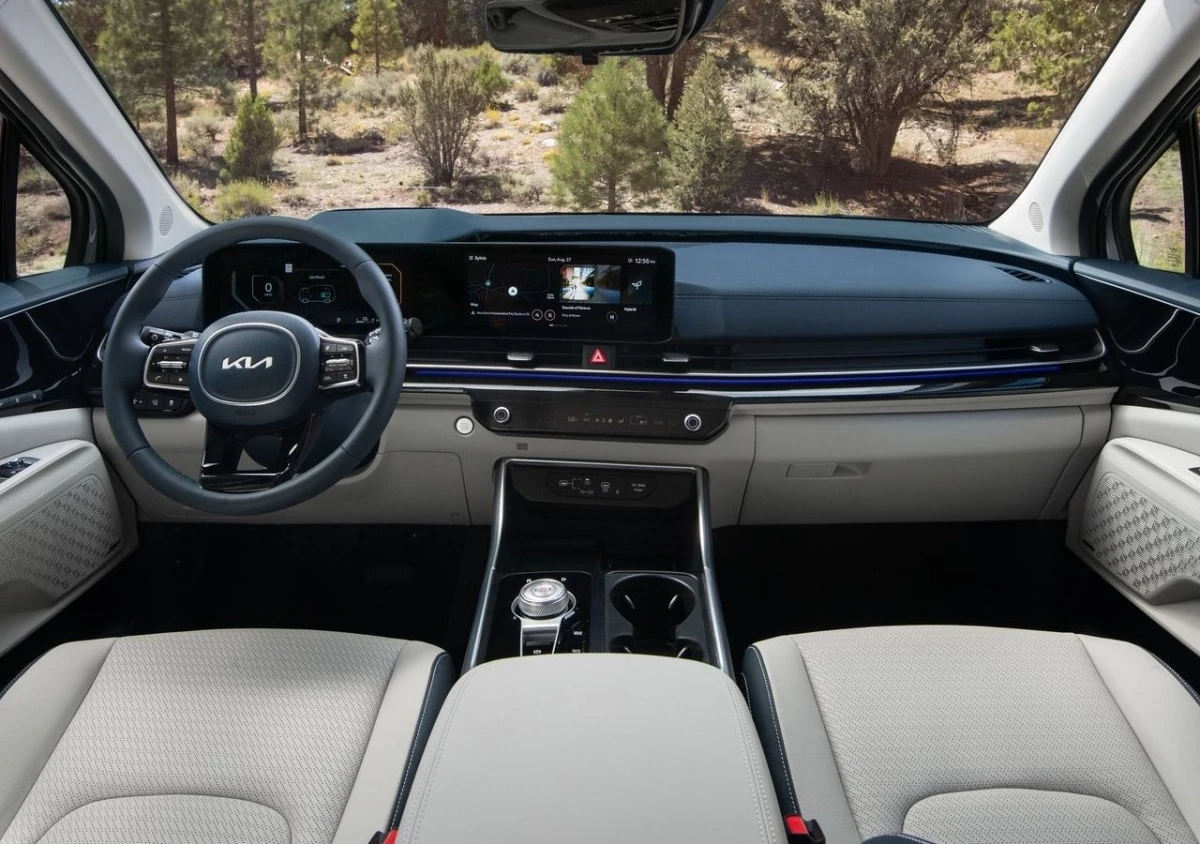
Inside, the Carnival feels closer to a modern crossover than a traditional fleet-oriented van. Depending on trim and model year, it offers a 12.3-inch infotainment display and an available panoramic dual-screen layout with a 12.3-inch digital instrument cluster. Upper trims add features such as ventilated front seats, dual sunroofs, a Bose audio system, a surround-view monitor, and higher-grade upholstery.
U.S. models are configured for seven or eight occupants; nine-seat layouts sold in some overseas markets were not part of the regular American lineup. Most versions use a removable or sliding second-row arrangement, while available VIP Lounge Seats on certain SX Prestige models prioritize passenger comfort with power adjustment, heating, ventilation, and leg supports. The third row folds into the floor. Cargo capacity is about 40.2 cubic feet behind the third row and can reach roughly 145 cubic feet in configurations that allow the second-row seats to be removed. VIP Lounge Seats reduce maximum cargo flexibility because they are not designed for quick removal.
For family use, the practical advantages are clear: wide sliding doors simplify loading child seats, the deep cargo well can hold groceries or luggage with all three rows in use, and access to the third row is easier than in most similarly sized SUVs. Large windows and an upright seating position also improve outward visibility, although higher trims rely heavily on cameras and parking sensors in tight spaces.
What the U.S. used market offers in 2026
By mid-2026, the American used market is centered on 2022–2025 model-year vehicles. Listings on Autotrader, CarGurus, and Cars.com vary widely by mileage, trim, accident history, and region. Many 2022 examples fall in the low-to-upper $20,000 range, while low-mileage SX and SX Prestige vehicles can reach the low-to-mid $30,000s. Clean 2023–2024 examples often sit from the mid-$20,000s into the upper $30,000s. Facelifted 2025 models and hybrids remain newer and can extend well into the $40,000 range, especially in premium trims.
Most U.S.-market Carnivals were built in South Korea and sold through Kia's official dealer network. A used-car inspection should include the maintenance record, body and undercarriage condition, operation of both power sliding doors, infotainment functions, cameras and driver-assistance sensors, and transmission behavior. On hybrid models, the diagnostic scan should also cover the high-voltage system. Recall completion should be checked by VIN through official U.S. channels.
Typical U.S. trim names include LX, LXS, EX, SX, and SX Prestige, although availability changed by model year. Lower trims focus on eight-passenger practicality and core safety equipment. EX and SX versions add more convenience and driver-assistance features, while SX Prestige models emphasize premium materials, upgraded audio, additional displays, and available VIP Lounge Seats. Feature content can vary even within the same trim depending on model year and option packages.
The fourth-generation Kia Carnival is not a universal answer for every household. It is a large front-wheel-drive vehicle that requires more parking space than a midsize crossover, and buyers seeking standard all-wheel drive must look elsewhere. In return, it offers genuine three-row usability, strong cargo capacity, comfortable highway manners, and a choice between a smooth V6 and a more efficient hybrid. In the U.S. market, that combination makes it one of the clearest examples of a modern minivan designed for families who do not want their vehicle to look like a traditional van.