


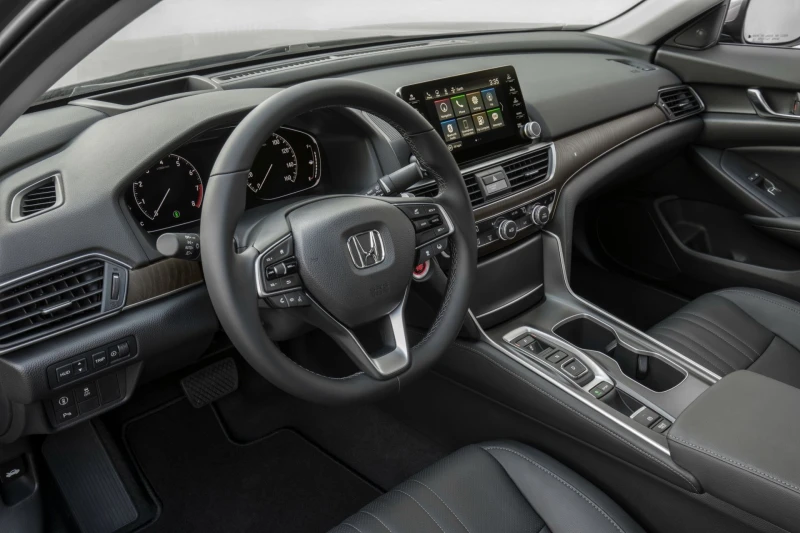
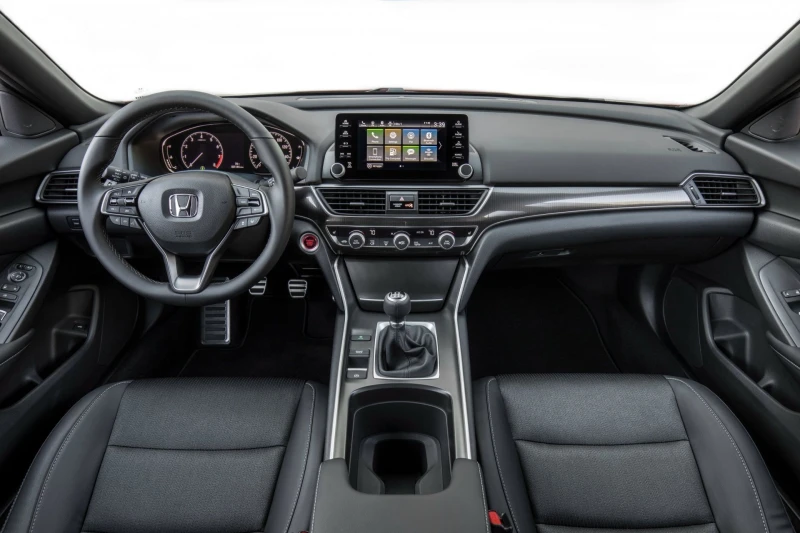
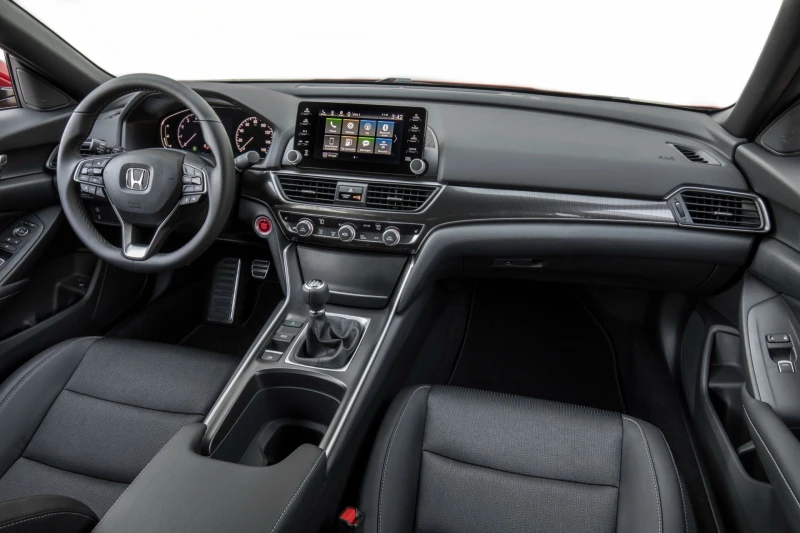
The 10th-generation Honda Accord arrived in the United States for the 2018 model year with a low, horizontal dashboard, clear controls, and more passenger space than its predecessor. Every version uses a 7-inch color TFT Driver Information Interface alongside a conventional speedometer rather than a 10.2-inch fully digital instrument cluster. From 2018 through 2020, an 8-inch Display Audio touchscreen with physical volume and tuning knobs was standard on Sport, EX, EX-L, and Touring trims, while the LX used a simpler 7-inch screen. For 2021 and 2022, Honda made the 8-inch touchscreen, Apple CarPlay, and Android Auto standard across the gasoline lineup.
U.S.-market upholstery depended on trim. LX, Sport, and the 2018–2020 EX generally used cloth, while EX-L and Touring received leather-trimmed seats; the 2021–2022 Sport Special Edition also added leather-trimmed upholstery. Honda did not offer factory Nappa leather, suede seat centers, carbon-fiber trim, or massaging seats on this generation. The cabin combines soft-touch surfaces in frequently handled areas with harder plastics lower on the dashboard and doors. Its noise-control package included an acoustic laminated windshield, front-door acoustic glass on EX and higher trims, additional insulation, and Active Noise Cancellation.
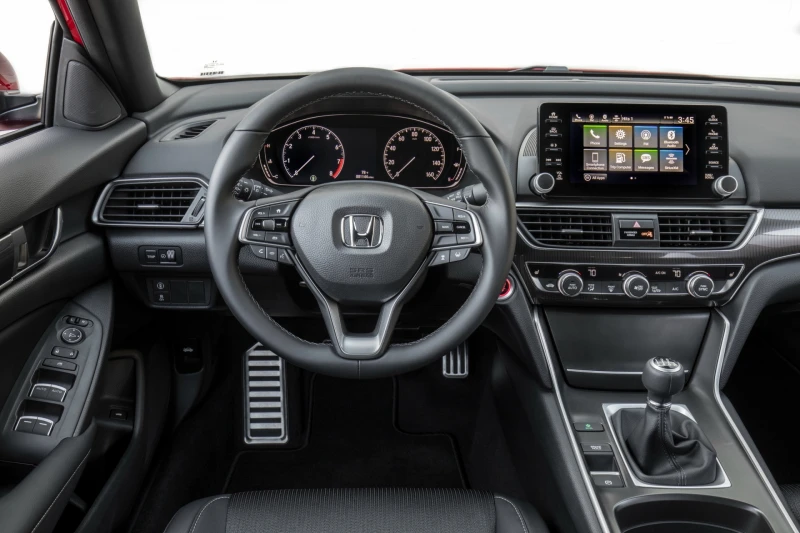
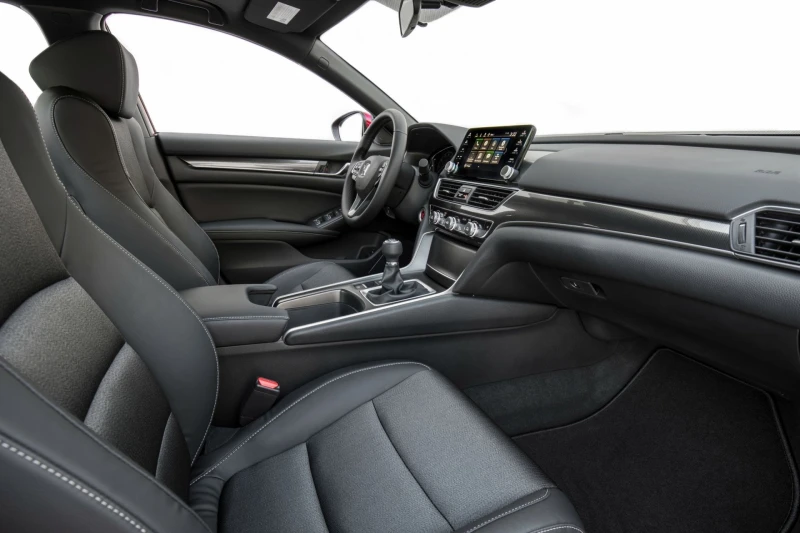
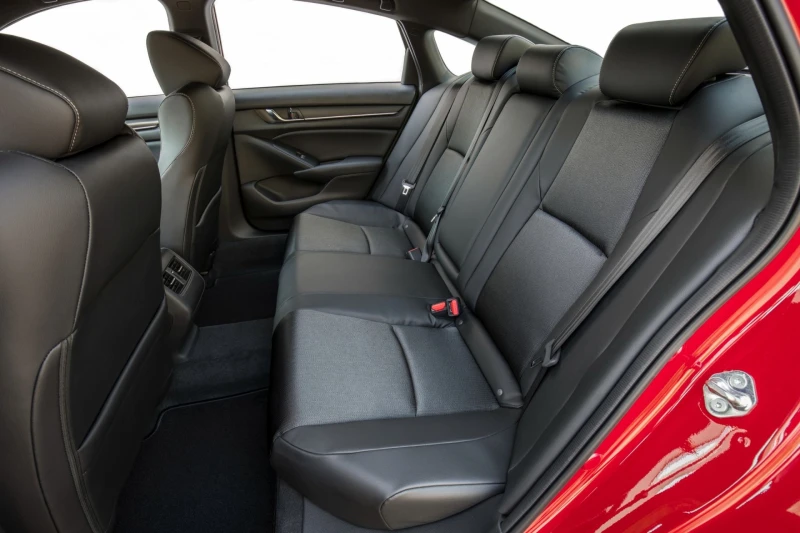
The driving position is one of the cabin's strengths. Sport and higher trims offered a 12-way power driver's seat with 4-way lumbar adjustment, while EX-L and Touring added two-position driver's-seat memory and a power front-passenger seat. The steering wheel tilts and telescopes through a useful range, and the slim windshield pillars help forward visibility. Rear-seat space is generous for a midsize sedan, supported by the 111.4-inch wheelbase, although the sloping roofline and seat-cushion shape are worth checking in person if tall adults will regularly ride in back.
Trunk capacity is 16.7 cubic feet, and the opening is wide with a relatively low lift-over height. A fold-down rear seatback was standard, with a 60/40 split on Sport and higher trims. Cabin storage includes a covered center console, door pockets, cupholders, and front USB connections; rear USB charging ports and wireless phone charging depend on trim and model year. Factory ports were USB-A rather than USB-C. The sedan-style trunk is spacious for luggage and groceries, but its fixed rear shelf and opening are less accommodating than a hatchback when carrying bulky items.
U.S. Trim Levels and Interior Equipment
The U.S. lineup changed during the generation, so equipment should be checked by model year rather than inferred from the badge alone. The 2018–2020 range included LX, Sport, EX, EX-L, and Touring, while the refreshed 2021–2022 lineup added Sport Special Edition and dropped the gasoline EX trim.
| Trim level | Seats and interior trim | Displays and audio | Climate and comfort | Driver assistance | U.S.-market notes |
|---|---|---|---|---|---|
| LX | Cloth upholstery and straightforward cabin trim | 7-inch audio screen for 2018–2020; 8-inch touchscreen for 2021–2022; 7-inch TFT driver display throughout | Dual-zone automatic climate control; manual driver's-seat height adjustment | Honda Sensing and a multi-angle rearview camera | Entry trim, paired with the 1.5-liter turbo engine and CVT |
| Sport / EX / Sport Special Edition | Sport used cloth; EX added heated cloth seats; Sport Special Edition added leather-trimmed, heated front seats | 8-inch touchscreen and 8-speaker audio; Apple CarPlay and Android Auto | 12-way power driver's seat; moonroof, heated seats, and power passenger seat vary by trim | Honda Sensing; blind-spot monitoring was included on EX and selected higher-spec versions | Sport emphasized styling and 19-inch wheels; EX was offered through 2020; Sport Special Edition arrived for 2021 |
| EX-L / Touring | Leather-trimmed seats; driver's memory and power front-passenger adjustment | 8-inch touchscreen and 450-watt 10-speaker audio; Touring added navigation and a 6-inch head-up display | Heated front seats and a one-touch power moonroof; Touring added ventilated front seats and heated outboard rear seats | Honda Sensing and blind-spot monitoring; Touring added parking aids and other low-speed assistance depending on year | EX-L is the comfort-focused trim; Touring adds adaptive dampers, but Sport does not |
Most used examples in the United States have the 1.5-liter turbo engine and CVT. The 2.0-liter turbo with a 10-speed automatic was offered on Sport, EX-L, and Touring depending on model year, while a 6-speed manual was available on Sport through 2020. Hybrid trims share the same basic cabin layout and retain the full 16.7-cubic-foot trunk because the battery is packaged beneath the rear floor. Apple CarPlay and Android Auto were wired on most early cars; wireless integration became standard on selected higher trims after the 2021 update.
Interior Changes by Model Year
This generation is complete in the U.S. market. Its main cabin changes were:
- 2018: U.S. launch with the 7-inch TFT Driver Information Interface, a 7-inch audio screen on LX, and an 8-inch touchscreen with wired Apple CarPlay and Android Auto on Sport and higher trims.
- 2019–2020: No major interior facelift. Honda largely carried over the dashboard, displays, materials, and trim structure, with smaller equipment adjustments by model year.
- 2021: The actual mid-cycle update. The 8-inch touchscreen, Apple CarPlay, and Android Auto became standard across the gasoline range. Wireless smartphone integration and wireless charging were included on selected higher trims, the Sport Special Edition joined the lineup, and USB access was revised.
- 2022: Mostly a carryover year, retaining the 2021 dashboard, infotainment hardware, and trim structure.
For shoppers comparing used cars, the clearest technology dividing line is the 2021 refresh, not 2019. Earlier models can still have the same 8-inch touchscreen on Sport and higher trims, but the LX has the simpler audio system and most 2018–2020 versions require a cable for Apple CarPlay or Android Auto.
Cabin Drawbacks and Used-Car Inspection Points
When inspecting a used 2018–2022 Accord, pay particular attention to the following areas:
- Seat wear: light-colored leather can show dye transfer, creasing, and stains more clearly than black upholstery.
- Interior noises: drive over broken pavement and listen for rattles from the door panels, center console, dashboard, and rear parcel shelf.
- Road noise: cars with 19-inch wheels may transmit more tire noise and impact harshness than versions on 17-inch wheels; tire brand and condition also matter.
- Rear-seat comfort: check headroom, thigh support, and the center seating position with the passengers who will actually use the car.
- Rear visibility: the fastback-style roofline and substantial rear pillars make the backup camera especially useful.
- Gloss-black trim: piano-black surfaces around the console and controls collect fingerprints and develop fine scratches easily.
Also test the touchscreen, physical knobs, Bluetooth, USB ports, steering-wheel controls, backup camera, climate-control system, and every powered or heated seat function fitted to the car. Interior condition depends more on use, previous repairs, and maintenance than on model year alone, so a later car should not automatically be assumed to be quieter or better preserved.
Is the Interior Still Relevant?
In 2026, the 10th-generation Accord cabin no longer looks as screen-heavy as the newest midsize sedans, and it lacks the fully digital instrument cluster found in the current Accord. It remains competitive, however, for seating space, outward visibility, trunk capacity, physical controls, and straightforward ergonomics.
For many used-car buyers, the 2021–2022 EX-L offers the strongest balance of comfort and technology, including leather-trimmed seats, premium audio, wireless smartphone integration, and 17-inch wheels that generally deliver a more compliant ride than the Sport's 19-inch setup. Touring is the better fit when ventilated front seats, heated rear seats, a head-up display, navigation, and adaptive dampers are priorities. Sport and LX remain simpler alternatives, but equipment varies substantially by year.
Before buying a used Accord, check:
- seat bolsters, upholstery, stains, and signs of previous interior repair
- rattles or trim movement on uneven roads
- touchscreen response, smartphone connectivity, audio, and camera operation
- USB ports, wireless charger, and all steering-wheel controls
- air conditioning, seat heating and ventilation, and power-seat functions
The interior remains one of the 2018–2022 Honda Accord's strongest attributes on the U.S. used-car market, provided the trim level, model-year equipment, and condition match the listing.