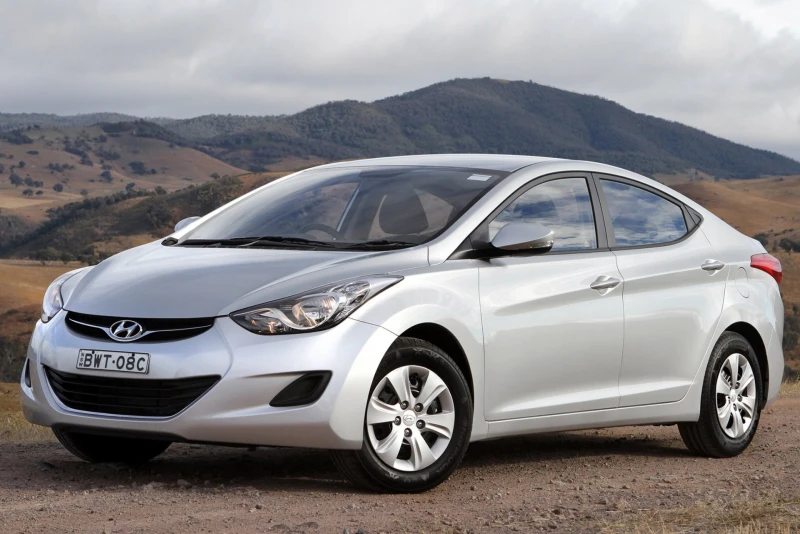
In the United States, the Hyundai Elantra was offered almost exclusively with gasoline engines and front-wheel drive. This article details the technical specifications of the fifth-generation Elantra, focusing on engines, transmissions, dimensions, and operating characteristics relevant to American roads and conditions.
A full review of exterior design, interior, trim levels, and common issues is covered in separate articles in this series.
Engines and Transmissions
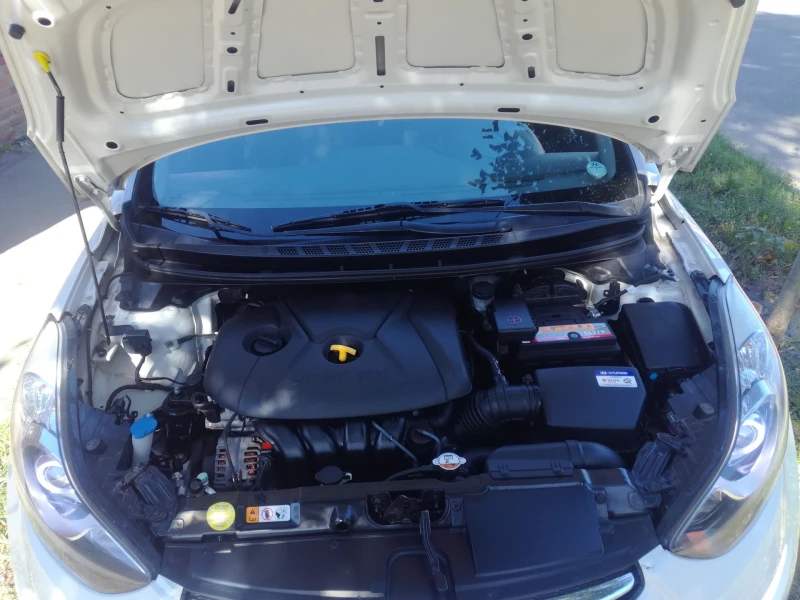
For the North American market, the 2011–2016 Hyundai Elantra came with naturally aspirated gasoline engines from the Gamma and Nu families. No diesel or all-wheel-drive versions were offered in the US during this generation.
Main powertrain options included:
| Fuel Type | Displacement | Engine Code | Horsepower | Transmission | Drivetrain | Notes / Market |
| Gasoline | 1.8L | Nu G4NB (MPI) | 145–148 hp | 6-speed Manual / 6-speed Automatic | Front | Primary engine for most US models |
| Gasoline | 2.0L | Nu G4NA (MPI) / G4KD (earlier) | 156–173 hp | 6-speed Manual / 6-speed Automatic | Front | Common in Sport, Limited, and Coupe variants |
| Gasoline | 1.6L | Gamma G4FC / G4FG (MPI) | 128–132 hp | 6-speed Manual / 6-speed Automatic | Front | Rare in US – mostly fleet or import |
The 1.8L Nu MPI was the most common engine across base, GLS, and Limited trims, usually paired with the 6-speed automatic. After the 2013 facelift, minor updates improved throttle response and NVH levels. The 2.0L version delivered noticeably better performance in the Coupe and Sport models.
Dimensions & Weight
Exterior dimensions remained largely consistent throughout the generation, with very minor changes after the 2013 facelift (mainly bumper and aero tweaks). Figures below are for the sedan – the most popular body style in the US.
| Parameter | Value | Notes |
| Length, in | 178.3 in | Pre-facelift ≈ 178.3 in, post-facelift similar |
| Width, in | 69.9 in | Excluding mirrors |
| Height, in | 56.7–56.9 in | Depending on trim and wheels |
| Wheelbase, in | 106.3 in | Consistent across all versions |
| Curb Weight, lb | 2,710–2,900 lb | 1.8L auto ≈ 2,760–2,850 lb; 2.0L versions heavier |
| Gross Vehicle Weight, lb | 3,880–4,000 lb | Varies by engine and equipment |
| Trunk Volume, cu ft | 14.8 cu ft | VDA equivalent; no spare in most US models |
| Fuel Tank Capacity, gal | 12.8 gal | Standard across the range |
Values are typical for gasoline front-wheel-drive sedans. The Coupe variant was slightly lighter.
Yearly Changes & 2013 Facelift
2011–2012 models launched with the 1.8L (148 hp) and early 2.0L engines, paired with 6-speed manual or automatic. By 2013, minor power and efficiency tweaks were introduced, and the 2013 facelift (for model year 2014) brought revised front and rear lighting, new grille, updated steering wheel, and improved infotainment. Suspension tuning and sound insulation were also refined. The 1.8L remained the volume engine through 2016.
Pre-facelift (2011–2013) cars are more budget-friendly on the used market, while post-facelift (2014–2016) models command higher prices due to the refreshed styling and small improvements.
Ownership Experience & Technical Notes
The Nu 1.8L and 2.0L engines are generally reliable when properly maintained. The most popular used configurations in the US are the 1.8L with automatic (good balance of economy and smoothness) and the 2.0L in sportier trims. The chain-driven timing system typically lasts 120,000–160,000 miles but should be inspected for tensioner wear. EPA fuel economy ratings are approximately:
- 1.8L automatic: 28 city / 38 highway / 32 combined mpg
- 2.0L automatic: 24–28 city / 34–37 highway mpg
The 6-speed automatic (A6MF1/A6GF1 family) is smooth but sensitive to fluid condition – fluid & filter changes every 60,000 miles are strongly recommended. The manual gearbox is durable, with clutch life usually 80,000–120,000 miles. The suspension is comfortable for daily driving but bushings and struts may need attention by 50,000–80,000 miles on rough roads.
Parts availability is excellent and affordable (both OEM and aftermarket), and most independent shops are very familiar with this platform.
Summary & Best Choice for the US Market
Technically, the 1.8L automatic offers the best all-around package for most American buyers: decent acceleration, excellent fuel economy, low maintenance costs, and strong resale value. The 2.0L variants appeal to those wanting more power and are especially desirable in the Coupe or Sport trims.
The manual transmission suits enthusiasts looking for maximum efficiency and lower long-term costs. When shopping used, pay close attention to service history, automatic transmission condition (test drive & scan), timing chain noise, and underbody rust (especially in salt-belt states).
The 2011–2016 Hyundai Elantra remains one of the most practical and reliable choices in the compact sedan segment on the American used-car market.