Engines and Transmissions
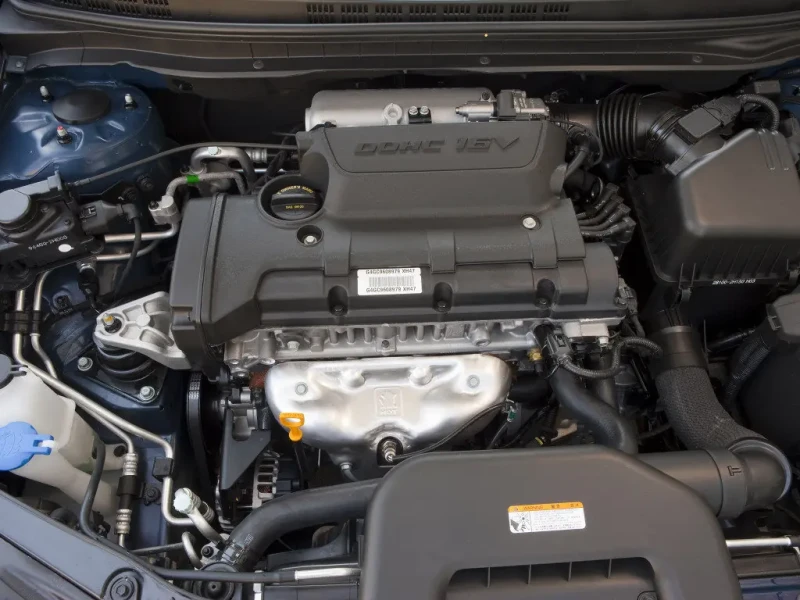
The fourth-generation Hyundai Elantra (HD) was primarily equipped with gasoline engines from the Gamma and Beta families featuring multi-point fuel injection (MPI). Diesel versions (mainly the 1.6 CRDi) were offered in Europe but are very rare in the United States, appearing mostly through private gray-market imports. No hybrid powertrains existed in this generation.
For the North American market (including the United States), the main gasoline engines were the 2.0-liter Beta II (G4GC) and, in later years, variants of the 1.6-liter Gamma (G4FC) with CVVT. Power outputs typically ranged from 138–140 hp for the 2.0L and around 122 hp for later 1.6L versions in some export specs, though the 2.0L was far more common in the US. Transmissions included a 5-speed manual or 4-speed automatic (A4CF1/A4CF2). Drive was always front-wheel drive (FWD); no all-wheel-drive versions were offered.
| Fuel Type | Displacement, cu in | Engine Code | Power, hp | Transmission | Drive | Market Notes |
| Gasoline | 1975 | G4GC (Beta II) | 138–140 | 5-MT / 4-AT | FWD | Most common in the United States |
| Gasoline | 1591 | G4FC (Gamma) | 122 (later models) | 5-MT / 4-AT | FWD | Less common in US; more frequent in other markets |
| Diesel | 1582 | D4FB (U II CRDi) | 90–115 | 5-MT / 4-AT | FWD | Primarily Europe; extremely rare in USA |
In the US market the 2.0-liter gasoline engine was the dominant choice across most trims and model years. Many owners later installed aftermarket performance upgrades or tuning.
Dimensions and Weight
The Hyundai Elantra IV (HD) is a four-door compact sedan in the C-segment. Dimensions remained nearly constant throughout production with only minor variations depending on trim and market. The figures below represent typical US-market specifications. Curb weight ranged from approximately 2,800–3,000 lbs depending on engine and transmission, while gross vehicle weight rating reached about 3,900–4,000 lbs.
| Parameter | Value | Notes |
| Length, in | 177.4 | Standard sedan |
| Width, in | 69.9 | Without mirrors |
| Height, in | 58.3–58.7 | Depending on tires and load |
| Wheelbase, in | 104.3 | Consistent across generation |
| Curb Weight, lbs | 2,800–3,000 | ~2,800 lbs with 2.0 MT, ~3,000 lbs with AT |
| Gross Vehicle Weight, lbs | 3,900–4,000 | Depending on version |
| Trunk Volume, cu ft | 14.2 | Standard |
| Drivetrain / Transmission | FWD / 5-MT or 4-AT | All main versions |
These dimensions are typical for US-market Elantras, which were almost exclusively sedans with the 2.0-liter engine.
Yearly Changes and Facelift
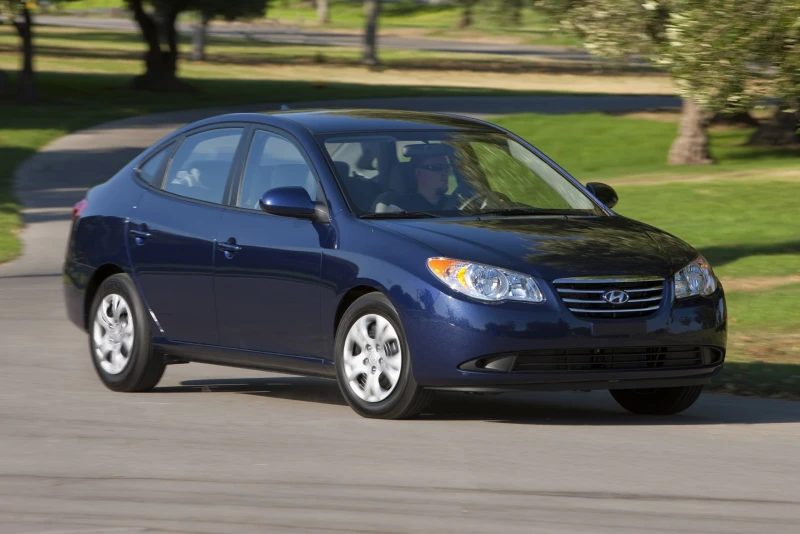
The Hyundai Elantra HD was produced from 2006 to 2010 without a major redesign, but it received a mid-cycle facelift (refresh) during 2008–2009. Changes included a revised front grille, headlights, bumpers, updated interior trim, and minor mechanical refinements.
Engine updates: Starting in 2008–2009 the 1.6L Gamma (G4FC) received improved CVVT tuning in some markets, raising output to around 122 hp. The 2.0L Beta II (G4GC) saw no major changes. Transmissions remained the same — 5-speed manual and 4-speed automatic. Emissions standards progressed toward stricter EPA Tier 2 requirements in the US.
Later 2009–2010 models are more frequently seen in the used market with slightly better refinement and equipment.
Ownership Experience and Technical Notes
In the United States the Hyundai Elantra IV (HD) is generally regarded as a reasonably reliable compact car when properly maintained. The 2.0L MPI (Beta II) engine — with a timing belt (recommended replacement every 60,000 miles) — is simple, durable, and widely supported by independent shops. The less common 1.6L is also reliable but far rarer in the US.
According to data from major US used-car sites (Cars.com, Autotrader, forums), real-world fuel economy is roughly: 2.0 MT — 24–28 mpg combined (EPA ratings around 25–29 mpg highway), 2.0 AT — 22–26 mpg combined. The 4-speed automatic should have its fluid changed every 30,000–40,000 miles to avoid late-life issues. The suspension is compliant and handles American roads well, though bushings, struts, and control arms typically need replacement by 80,000–100,000 miles.
Parts are inexpensive and widely available (plenty of aftermarket and OEM through dealers), and most independent mechanics are very familiar with the model. Common issues include: rust on lower doors and wheel arches (especially pre-2008 builds in salt-belt states), minor electrical gremlins (sensors), and CV joint wear.
Summary and Best Choice for the US Market
The technical specifications of the Hyundai Elantra IV (HD) show that the 2.0L engine paired with either the 5-speed manual or 4-speed automatic remains the most balanced and practical choice on the American used-car market. This combination offers decent fuel economy for its era, low maintenance costs, acceptable performance, and strong parts availability.
The automatic is more convenient in heavy traffic, though it deserves careful inspection of shift quality and service history. The rarer 1.6L versions usually cost less but offer little advantage in the US. Diesel models are not recommended due to their extreme scarcity and potential parts/fuel-quality issues. When shopping, prioritize 2008–2010 examples with documented service history and verified mileage.
Detailed reviews of styling, interior, trim levels, and common complaints are covered in other articles in this series.