


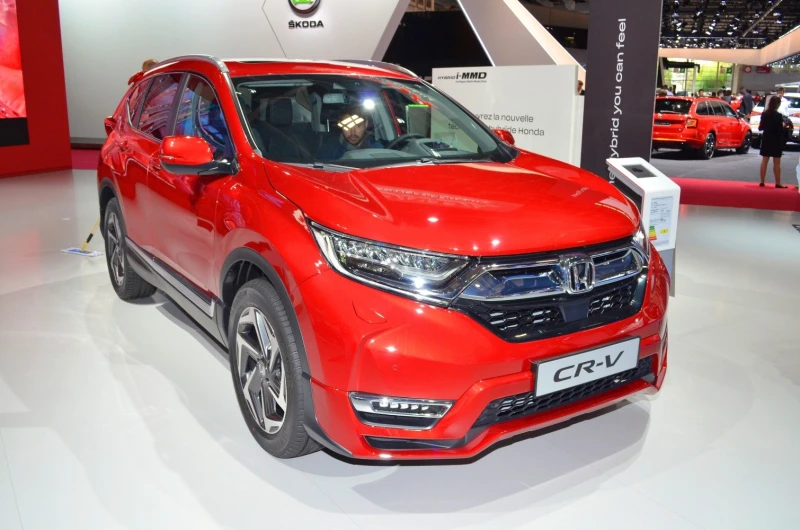
The fifth-generation Honda CR-V officially arrived in the United States as a 2017 model and rapidly became one of the top-selling compact SUVs thanks to its blend of reliability, fuel efficiency, spaciousness, and strong resale value. This article dives deep into the powertrains, dimensions, year-by-year updates, and real-world ownership notes specific to the American market. Styling, interior, trim levels, and known issues are covered in separate articles in this series.
Engines and Transmissions
Honda CR-V 2017–2022 engines were engineered to meet U.S. EPA and CARB standards, with emphasis on turbocharged gasoline engines and – starting in 2020 – the highly efficient i-MMD hybrid system. The continuously variable transmission (CVT) became the standard across gasoline models, while the hybrid uses an e-CVT.
Here is the main powertrain lineup for the Honda CR-V (2017–2022) in the U.S. market:
| Engine | Type | Displacement | Power | Transmission | Drivetrain |
|---|---|---|---|---|---|
| 2.4 i-VTEC | Gasoline, naturally aspirated | 2.4 L | 184 hp | CVT | FWD, AWD |
| 1.5 T-GDI | Gasoline, turbocharged | 1.5 L | 190 hp | CVT | FWD, AWD |
| 2.0 i-MMD Hybrid | Hybrid (2.0 L gasoline + electric motor) | 2.0 L | 212 hp (combined) | e-CVT | FWD, AWD |
The 1.5L turbo quickly became the most popular choice in the U.S., delivering strong low-end torque and combined fuel economy around 28–30 mpg. The 2.4L naturally aspirated engine was offered only in early years (2017–2019). From 2020 onward, the 2.0 i-MMD hybrid became a major hit with EPA ratings of 38–40 mpg combined.
Dimensions and Weight
The fifth-generation CR-V rides on Honda’s Compact Global Platform, which brought increased interior room, better structural rigidity, and improved ride quality.
| Parameter | Value |
|---|---|
| Length | 180.6 in |
| Width | 73.0 in |
| Height | 66.1 in (FWD) / 66.5 in (AWD) |
| Wheelbase | 104.7 in |
| Ground Clearance | 8.2 in |
| Curb Weight | 3230–3421 lb (gasoline) / 3613–3786 lb (hybrid) |
| Gross Vehicle Weight | 4530–4700 lb |
| Cargo Volume | 39.2–75.8 cu ft (rear seats folded) |
| Drivetrain | FWD or Real Time AWD |
| Transmission | CVT (gasoline), e-CVT (hybrid) |
These dimensions make the CR-V easy to maneuver in urban environments like Los Angeles or New York, while the 8.2-inch ground clearance handles light off-road trails, snow, and most parking-lot obstacles comfortably. Real Time AWD adds capability in rain and light snow but increases weight by roughly 150–200 lb.
Year-by-Year Updates
The most significant changes arrived with the 2020 facelift (model years 2020–2022):
- Engines: The 2.4L was discontinued; all gasoline models received the refined 1.5L turbo (190 hp, 179 lb-ft). The 2.0 i-MMD hybrid (212 hp combined) debuted and quickly became a favorite for its 38–40 mpg EPA ratings.
- Transmissions: CVT received G-Design Shift logic for more natural feel. Hybrid models use a two-motor e-CVT.
- Chassis & NVH: Body rigidity increased by ~20%, noise reduced by ~4 dB, suspension retuned for better comfort without sacrificing handling.
- Technology: Honda Sensing suite became standard (adaptive cruise, lane keeping, collision mitigation). Larger 7–9 inch touchscreen and wireless charging added on higher trims.
Post-2020 models (especially hybrids) are the most sought-after on the used market today due to better efficiency, refinement, and stronger resale value.
Ownership Notes: What to Know Before Buying
When shopping for a used 2017–2022 CR-V in the U.S., keep these points in mind:
- Engine reliability: The 1.5L turbo is generally durable (250,000+ miles possible), but early units (2017–2018) can suffer from oil dilution during short trips or cold weather – use full synthetic and change every 5,000–7,500 miles. The 2.4L is very robust. Hybrid battery packs routinely last 10+ years.
- Most popular configurations: 1.5T + CVT + AWD is the sweet spot for most buyers (27–30 mpg combined). Hybrids (2020+) are increasingly common due to excellent fuel economy (38–40 mpg).
- CVT & AWD concerns: CVT is reliable with fluid changes every 30,000–40,000 miles; avoid units with neglected maintenance. Real Time AWD is low-maintenance but check for rear differential leaks around 150,000+ miles.
- Parts & service: Honda parts are widely available and reasonably priced nationwide – oil filters $8–15, shocks/struts $150–300 each (aftermarket). Service is straightforward at dealers and independent shops.
- Real-world fuel economy: Expect 27–31 mpg (1.5T), 34–38 mpg highway (hybrid), depending on driving style and conditions (EPA figures are realistic for most owners).
Always check CARFAX/AutoCheck, service history, and have a pre-purchase inspection focusing on CVT fluid condition, oil consumption (early 1.5T), and suspension wear.
Best Choice on Today’s Used Market
Considering current U.S. fuel prices, road conditions, and resale trends, the strongest overall pick is a 2020–2022 2.0 i-MMD Hybrid AWD. Reasons:
- Fuel economy: 38–40 mpg combined saves significantly over long-term ownership.
- Reliability: Proven hybrid system with excellent long-term durability.
- Resale value: Hybrids hold value better than gas-only models. Approximate market prices today: $24,000–$32,000 depending on mileage and condition.
- All-weather capability: AWD + 8.2 in clearance handles snow, rain, and light trails well.
For a lower budget, look for a well-maintained 2019–2022 1.5T AWD (roughly $20,000–$27,000). Avoid very early 2017–2018 1.5T models unless service records clearly show diligent oil-change intervals.
Overall, the 2017–2022 Honda CR-V remains one of the smartest used compact SUV choices in America – especially the later hybrid models with AWD.