


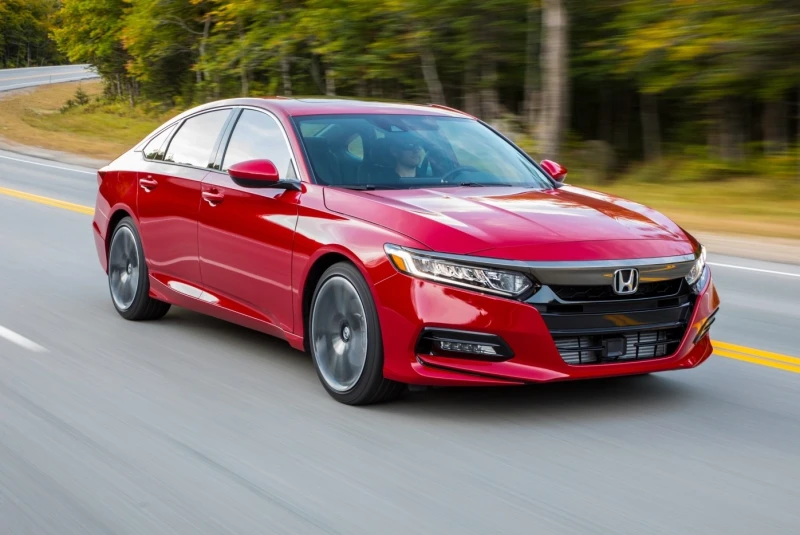
The tenth-generation Honda Accord is a midsize four-door sedan built on a new Honda-developed architecture. U.S.-market gasoline and hybrid versions are commonly associated with the CV-series chassis family.
Honda revealed the redesigned Accord in Detroit in July 2017, and U.S. sales began that fall as a 2018 model. All U.S.-market versions were assembled at Honda's Marysville, Ohio plant. Unlike several earlier generations, this Accord was not part of Honda's regular new-car lineup in Western Europe.
In the United States, the Accord competed with the Toyota Camry, Nissan Altima, Hyundai Sonata, Kia Optima and later K5, Subaru Legacy, Mazda6 and Volkswagen Passat.
The defining features were a 192-hp 1.5-liter turbo engine, a 252-hp 2.0-liter turbo engine, a 212-hp two-motor hybrid system, an available 10-speed automatic, standard Honda Sensing driver-assistance technology and a spacious cabin. Every U.S. version used front-wheel drive. A 6-speed manual was available on Sport models with either turbo engine through the 2020 model year, while adaptive dampers were reserved for Touring trims.
What Changed from the Previous Generation
The tenth-generation Accord was redesigned from the ground up compared with the ninth-generation U.S. model sold for 2013–2017.
Major changes included:
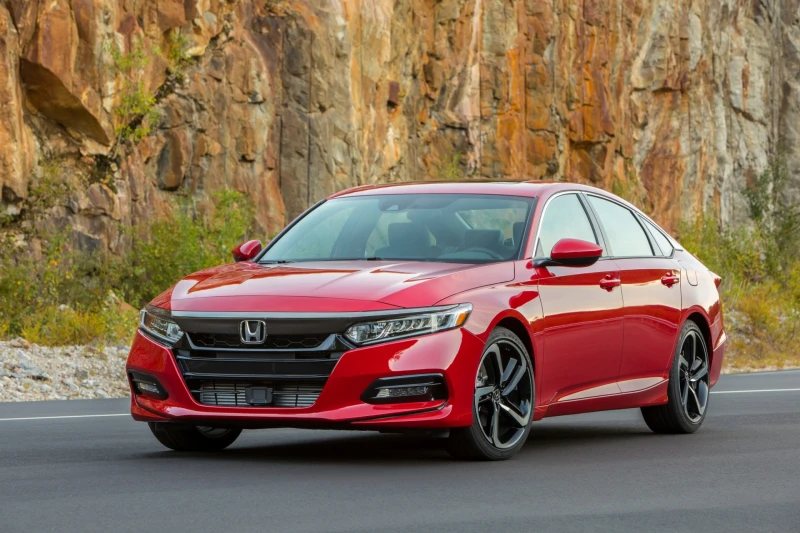
- Exterior design: a lower, wider and more fastback-like sedan profile, with available full-LED headlights and shorter overhangs
- Proportions: the wheelbase grew by about 2.2 inches to 111.4 inches, while the body became roughly 0.4 inch shorter, 0.4 inch wider and 0.6 inch lower
- Powertrains: the naturally aspirated 2.4-liter four-cylinder and 3.5-liter V6 were replaced by 1.5T and 2.0T engines, while the hybrid system continued in a new generation
- Transmissions: a CVT was paired with the 1.5T, a Honda-developed 10-speed automatic with the 2.0T, and a 6-speed manual was offered on 2018–2020 Sport models
- Chassis: MacPherson-strut front suspension and an independent multi-link rear suspension, with adaptive dampers on Touring versions
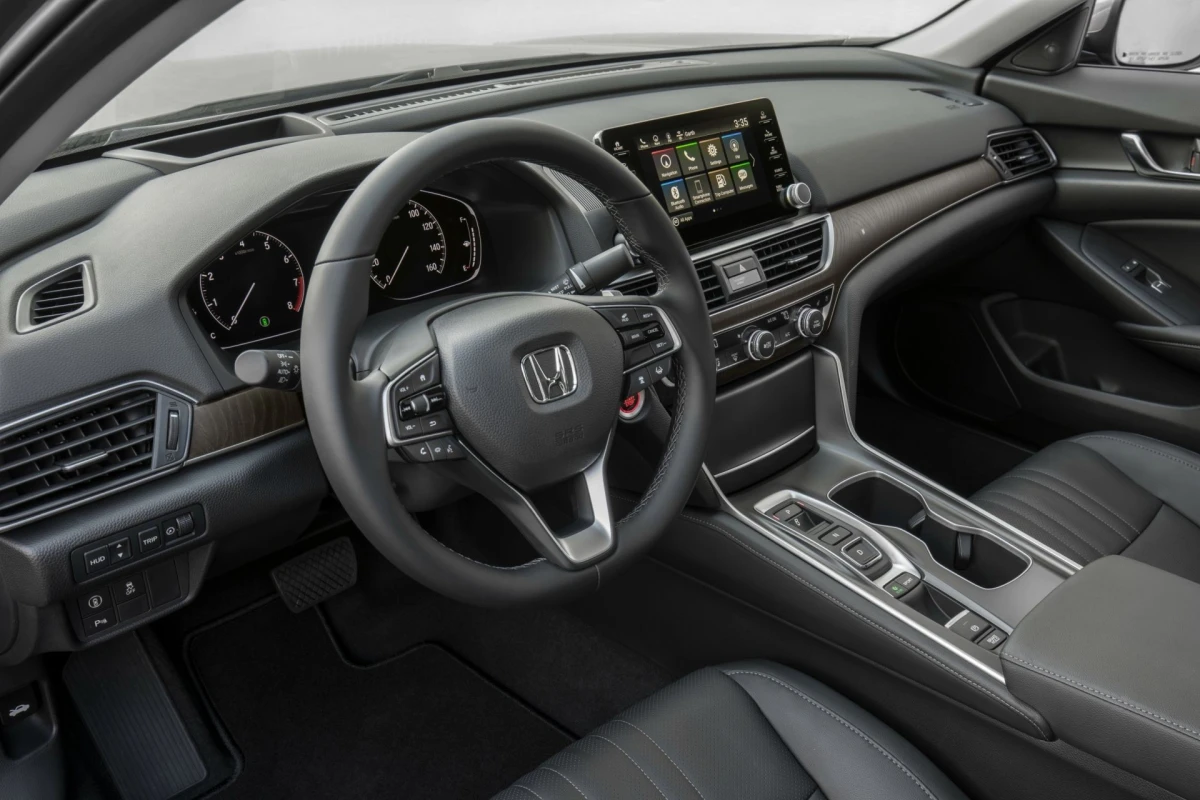
- Interior: a 7-inch digital driver-information display, an available 8-inch touchscreen with physical volume and tuning knobs, and Apple CarPlay and Android Auto on equipped trims
- Safety and practicality: Honda Sensing became standard across the lineup, while trunk capacity increased to 16.7 cubic feet on gasoline and hybrid models
Current Status of the Generation
The tenth-generation Accord ended in the United States after the 2022 model year and was replaced by the redesigned 2023 Accord. The final U.S. powertrain lineup included:
- 1.5T: 192 hp and 192 lb-ft, CVT, front-wheel drive
- 2.0T: 252 hp and 273 lb-ft, 10-speed automatic, front-wheel drive
- Hybrid: 212 hp total system output, two-motor direct-drive hybrid system, front-wheel drive
Key lifecycle changes:
- 2018: U.S. launch with 1.5T, 2.0T and Hybrid powertrains; a 6-speed manual was optional on Sport 1.5T and Sport 2.0T
- 2019–2020: the lineup changed only modestly, and the 2020 model carried over virtually unchanged
- 2021: a mid-cycle refresh brought revised front styling, broader LED-headlight availability, standard 8-inch Display Audio with Apple CarPlay and Android Auto, wireless smartphone integration on select trims, and a new Sport Special Edition; the manual transmission and EX-L 2.0T were discontinued
- 2022: gasoline models carried over, while Hybrid Sport replaced the previous Hybrid EX trim
There is no single best version for every buyer. The 2.0T offers the strongest acceleration, the Hybrid prioritizes fuel economy, and the 1.5T is usually the most affordable entry point. EPA ratings vary by trim and model year: late 1.5T models reached roughly 31–33 mpg combined, 2.0T models were rated at about 26 mpg combined, and hybrids ranged from the low to upper 40s.
U.S. Used-Car Market
As of July 2026, the tenth-generation Accord is available only as a used vehicle, with thousands of examples listed nationwide on platforms such as Autotrader, CarGurus and Cars.com. Current market data places the average asking price for a 2018 Accord at roughly $18,000 and a 2022 model at about $24,500, although trim, mileage, title status, accident history and location can move an individual car far outside those averages.
Mileage varies widely, from lightly used cars to high-mileage commuter vehicles. The 1.5T is the most common powertrain, while clean 2.0T and Hybrid examples often command a premium.
Broad nationwide asking-price ranges for July 2026 are shown below. They are market estimates rather than appraisal values:
| Powertrain | Model years | Typical mileage | Typical asking price | Market notes |
|---|---|---|---|---|
| 1.5T | 2018–2022 | 50,000–140,000 miles | $14,000–$25,000 | Most common in LX, Sport, EX, EX-L and Sport SE trims |
| 2.0T Sport / Touring | 2018–2022 | 35,000–120,000 miles | $18,000–$31,000 | Sport, EX-L and Touring; EX-L 2.0T ended after 2020 |
| Hybrid | 2018–2022 | 40,000–130,000 miles | $16,000–$29,000 | Base, EX or Sport, EX-L and Touring, depending on year |
Main U.S. Versions and Trim Levels
Trim names and equipment changed during the five-model-year run, so a used Accord should be checked by exact model year rather than by badge alone:
- Entry and mainstream trims — LX, Sport, EX and Sport Special Edition: cloth or cloth-and-leather seating, 17- or 19-inch wheels, dual-zone climate control and standard Honda Sensing; EX was offered through 2020, while Sport Special Edition arrived for 2021
- Upper-mid trims — EX-L and Hybrid EX / EX-L: leather-trimmed seating, heated front seats, a 450-watt 10-speaker Honda premium audio system and additional convenience features; the gasoline EX-L 2.0T was offered only through 2020
- Performance and flagship trims — Sport 2.0T, Touring and Hybrid Touring: available 19-inch wheels, head-up display, ventilated front seats, heated outboard rear seats and adaptive dampers on Touring models; Touring 1.5T was limited to the earlier model years
The rear suspension is independent and multi-link on every version, but adaptive damping is not fitted to Sport models. The 8-inch touchscreen was available on higher trims from launch and became standard for 2021. Apple CarPlay and Android Auto were wired on most compatible versions, while wireless integration was limited to select 2021–2022 trims unless a later dealer-installed Honda software upgrade was added.
Conclusions and Used-Buying Relevance
The tenth-generation Accord remains a practical used midsize sedan because it combines a roomy rear seat, a 16.7-cubic-foot trunk, standard Honda Sensing and three distinct powertrain choices. Its appeal depends less on a universal reputation and more on the condition, history and specification of the individual car.
Sport 2.0T and Touring 2.0T models suit buyers who prioritize performance, while the Hybrid is the efficiency-focused choice. The 1.5T generally costs less to buy, and refreshed 2021–2022 cars add useful infotainment and lighting updates. Hybrid battery condition should be assessed with a proper diagnostic rather than estimated from age or mileage alone.
Before buying a used Accord in the United States, check:
- the VIN, title status and history of collision, flood or structural repairs
- cold-start behavior, coolant level, oil condition, warning lights and any evidence of misfires or abnormal engine noise
- CVT or 10-speed automatic shift quality and documented fluid-service history; on manual cars, clutch operation
- hybrid-system fault codes, battery health and the condition of the battery-cooling path
- Honda Sensing operation and correct camera or radar calibration after windshield or front-end repairs
The 2018–2022 Honda Accord remains widely available on the U.S. used market, but a clean service history and a thorough pre-purchase inspection matter more than choosing a particular trim badge.