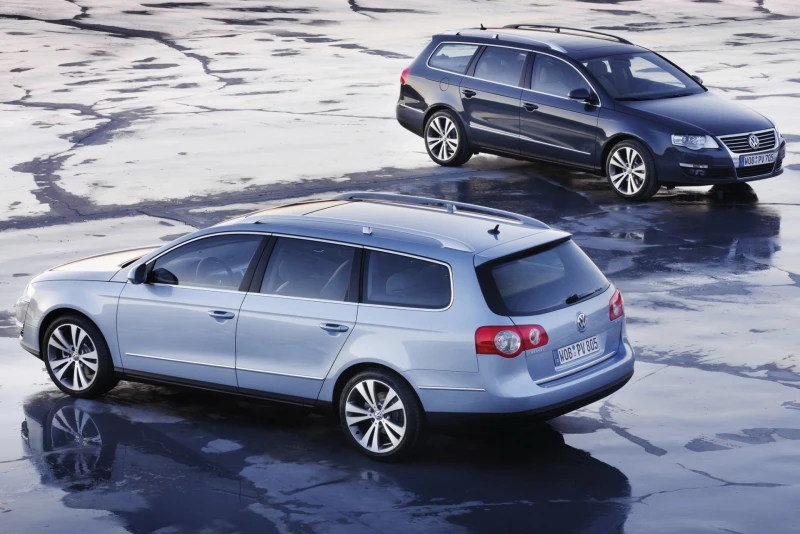
Volkswagen Passat VI technical specifications cover a wide range of engines, transmissions, and design features originally built to European standards but perfectly suited to real-world driving conditions across the US. In this article, we dive deep into the 2005–2010 Passat engines, dimensions, model-year updates, ownership considerations, and buying tips. This guide will help you understand why the B6 Passat continues to be a strong contender in the used car market. Exterior styling, interior features, trim levels, and common issues are covered in separate articles in the series.
Engines and Transmissions
The Volkswagen Passat VI engine lineup offers impressive variety—from efficient gasoline engines to torque-rich diesels. All engines are mounted transversely for better packaging and lower weight. Gasoline options include naturally aspirated and turbocharged units, while diesels are all turbocharged. Transmission choices include 5- or 6-speed manuals, 6-speed Tiptronic automatics, and 6- or 7-speed DSG dual-clutch units. Most models are front-wheel drive (FWD), with all-wheel-drive 4Motion (using a Haldex clutch) available on higher-power versions. Below is a table of the main powertrain options offered in the US from 2005 to 2010.
| Engine (type, displacement, horsepower) | Transmission | Drivetrain |
|---|---|---|
| Gasoline 2.0T Turbo (1984 cc, 200 hp) | 6-speed manual, 6-speed Tiptronic auto, 6-speed DSG | FWD / 4Motion |
| Gasoline 3.6L V6 (3597 cc, 280 hp) | 6-speed DSG | 4Motion |
These powertrains deliver 0-60 mph times ranging from roughly 6 to 9 seconds depending on the version. Real-world fuel economy (based on owner reports and EPA estimates): the 2.0T typically achieves 22–28 mpg combined, while the V6 is closer to 18–23 mpg. Performance varies with driving style and conditions on American highways.
Dimensions and Weight
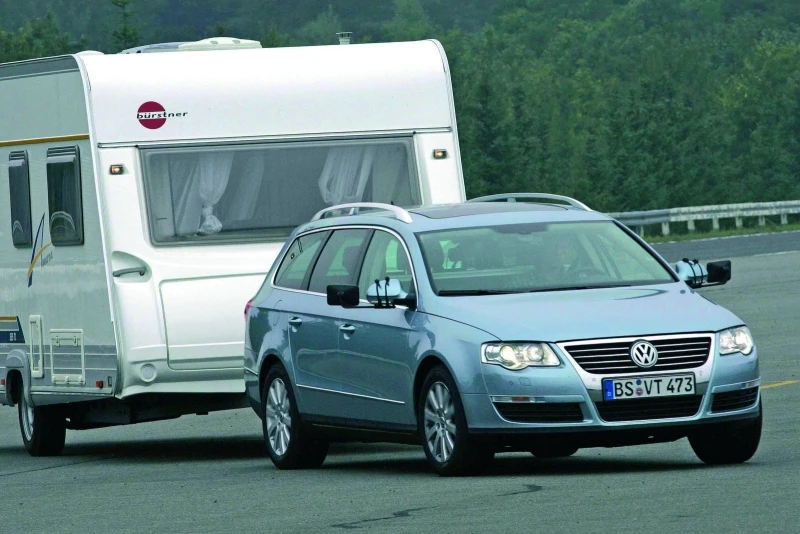
The Passat VI rides on the PQ46 platform, which provided noticeably larger dimensions than its predecessor. Sedan and wagon (Variant) body styles share similar footprints, though the wagon is slightly longer and taller. Curb weight ranges from approximately 3,200 to 3,800 lbs, with gross vehicle weight up to around 4,800 lbs. All-wheel-drive and DSG models add roughly 200–300 lbs. Below are the key dimensions for the main US-market variants.
| Measurement | Sedan | Wagon (Variant) |
|---|---|---|
| Length | 188.2 in | 188.0 in |
| Width | 71.7 in | 71.7 in |
| Height | 58.0 in | 59.7 in |
| Wheelbase | 106.7 in | 106.7 in |
| Curb weight (base) | 3,250–3,500 lbs | 3,400–3,700 lbs |
| Gross vehicle weight | 4,400–4,800 lbs | 4,500–4,900 lbs |
| Drivetrain | FWD / 4Motion | FWD / 4Motion |
| Transmission | Manual / Tiptronic / DSG | Manual / Tiptronic / DSG |
These dimensions make the Passat VI comfortable both in city traffic and on long interstate drives, with ground clearance around 5.5–6.5 inches depending on suspension setup.
Model-Year Updates
Although a full redesign arrived in 2011 with the B7, the B6 generation saw meaningful updates throughout its run—particularly in engine technology and transmissions—that improved efficiency and drivability. Early 2005–2007 models primarily used the 2.0T turbo four-cylinder. In 2008, Volkswagen introduced the more powerful 3.6L V6 paired exclusively with 4Motion and DSG, and refined the 2.0T for better low-end response and fuel economy. DSG availability expanded, and suspension tuning was tweaked for a smoother ride on American roads.
What to Look For When Buying
Ownership considerations for the Passat VI in the US revolve around fuel quality, maintenance history, and typical wear items. The 2.0T engine is generally robust but benefits from regular timing belt/chain service (every 90–120k miles) and premium fuel. Early DSG units (especially 2006–2008) can develop mechatronic issues if fluid changes were neglected—later versions are more reliable. The Tiptronic automatic is considered the most trouble-free. 4Motion adds traction in wet or snowy conditions but requires Haldex fluid changes every 40k miles. Parts availability is excellent nationwide, with both OEM and quality aftermarket options readily available.
Common concerns include carbon buildup on the 2.0T intake valves (addressed with periodic cleaning), potential oil consumption on higher-mileage engines, and occasional water pump failures. Always verify service records and have a pre-purchase inspection performed—typical mileage on well-maintained examples today is 150–250k miles.
Orientative market price for the United States (well-maintained examples with 100–150k miles): $5,500–$9,000 for 2.0T models, $8,000–$12,000 for V6 4Motion wagons.
Bottom Line
In summary, the Volkswagen Passat VI technical specs make it a dependable, spacious, and enjoyable midsize car that still holds strong appeal on the used market. The sweet spot for most buyers is a later 2008–2010 2.0T with the 6-speed Tiptronic or manual transmission—offering the best balance of performance, fuel economy, reliability, and cost of ownership. With proper maintenance, these cars routinely exceed 250k miles. More on design, features, and trim levels in the rest of the series.