



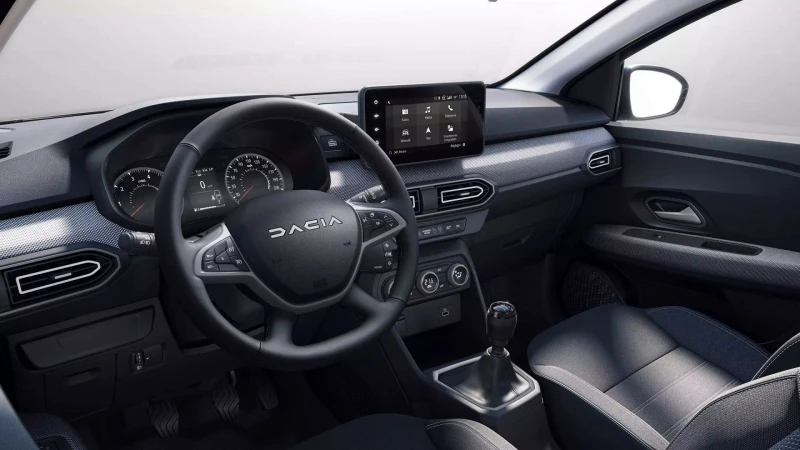
The third-generation Dacia Sandero interior is designed around practicality and low running complexity rather than premium materials. The BJI-generation hatchback and the related Sandero Stepway share the same basic cabin architecture. For U.S. readers, one point matters immediately: Dacia does not officially sell the Sandero in the United States, so there is no U.S.-market trim walk, factory warranty program or dealer specification to follow. Cars encountered in the U.S. would be privately imported or otherwise outside the normal Dacia retail network, and their equipment should be checked against the country in which they were originally sold.

Cabin overview
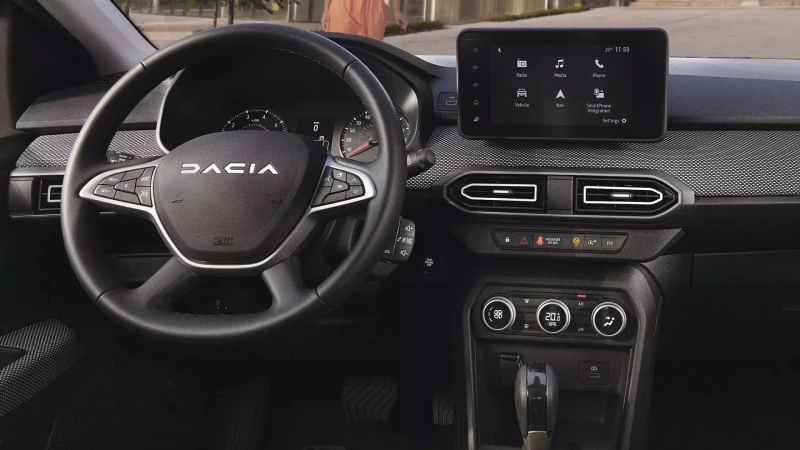
The dashboard has a straightforward horizontal layout, with physical climate controls low in the center stack and multimedia hardware positioned higher for easier viewing. Entry versions of the third-generation car were notable for Dacia's Media Control concept, which uses the driver's smartphone in a dedicated dashboard mount as the main connected interface. Higher trims added Media Display or Media Nav with an 8-inch center touchscreen.
Cabin materials are mostly hard-wearing plastics, with fabric trim and decorative inserts varying by version. Stepway models generally use more distinctive upholstery and trim details than the standard hatchback. The overall approach is functional: frequently touched controls are conventional, storage areas are easy to reach, and the interior avoids the dense touch-sensitive interfaces found in many more expensive cars.

The driving position offers more adjustment than earlier Sandero generations, and Dacia redesigned the front seats when the third generation arrived. Depending on trim and market, equipment can include a height-adjustable driver's seat, center armrest, manual or automatic climate control, rear parking sensors and a reversing camera. Transmission controls vary with the powertrain and model year.
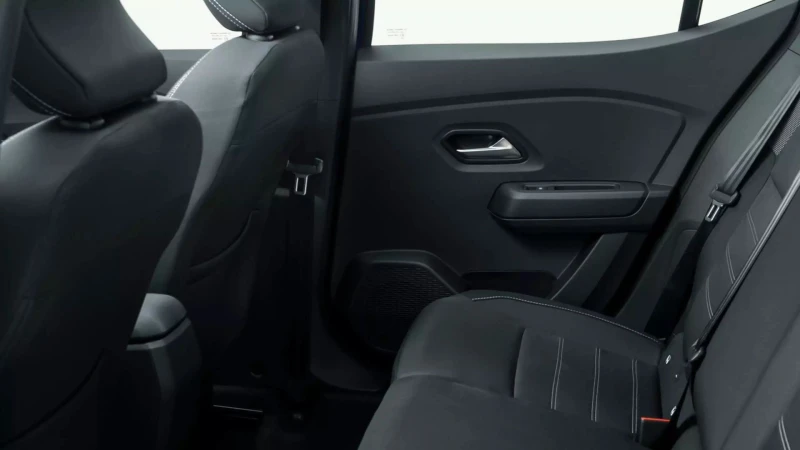
Rear-seat space is one of the Sandero's practical strengths. The 2,604 mm wheelbase is about 102.5 inches, and Dacia's 2022 technical data lists 186 mm, or about 7.3 inches, of rear knee room using its measurement method. The rear bench is designed for three passengers, although the center position is naturally narrower than the outer seats. Split-folding rear seatbacks are offered on many versions, but exact equipment depends on trim and country.
Dacia lists 410 liters of luggage volume to the top of the rear seatback for the third-generation Sandero, about 14.5 cubic feet, and up to 1,455 liters, about 51.4 cubic feet, with the second row folded. The same technical documentation also gives a 328-liter VDA figure, illustrating why cargo numbers can differ depending on the measuring method. A false floor is available on some versions, and the hatchback layout makes the load area relatively easy to use.

Trims and equipment: no official U.S. lineup
Because the Sandero is not officially sold in the United States, American buyers should not use European trim names as if they were U.S. specifications. Dacia's trim structure also varies by country and model year. In the current UK range, for example, the standard Sandero is offered as Essential, Expression and Journey, while Sandero Stepway is offered as Essential, Expression and Extreme.
On current European-market cars, Essential is the entry point and uses Media Control rather than a built-in center touchscreen as standard in some markets. Equipment can include air conditioning, cruise control, rear parking sensors and the required European-market driver-assistance systems, but the exact list must be checked for the car's original market and model year.
Expression moves the cabin toward a more conventional modern setup. On the updated model, it can include the 10-inch Media Display touchscreen with wireless smartphone mirroring, a reversing camera, a center console with armrest and additional exterior and convenience equipment. Earlier third-generation Expression or equivalent mid-level cars used the previous 8-inch multimedia hardware.
Journey is the more equipment-focused Sandero trim in markets that offer it, while Stepway's higher-grade version is commonly called Extreme. Depending on market and year, these versions can add features such as automatic climate control, a hands-free key card, upgraded upholstery, blind-spot warning, navigation and additional convenience equipment. These are European-market configurations, not U.S. factory specifications.
Sandero Stepway is a crossover-styled derivative rather than a separate U.S.-style SUV trim. It adds raised ride height, roof bars and model-specific exterior and cabin details. Some European Stepway versions have also been offered with equipment not universally available on the standard Sandero, so a used or imported car should be identified by its original market, trim and build date rather than by the Stepway badge alone.
Interior changes by year
When the third generation launched in 2020, Dacia introduced a completely redesigned dashboard, new seats and three multimedia approaches: Media Control using a smartphone, plus Media Display and Media Nav with dedicated screens. The early cars retained conventional analog instruments, and the 8-inch touchscreen became the familiar higher-trim setup during the first phase of production.
In 2022, Dacia rolled out its new visual identity across the range, including the new Dacia Link emblem and revised trim naming in many markets. That change should not be confused with a major interior facelift: it did not suddenly make a digital instrument cluster standard across Sandero models. Safety-related equipment was expanded again for the 2024 model year in Europe as the range was updated to meet newer GSR II requirements.
The larger cabin technology change arrived with the latest Sandero update introduced for the 2026 model year in several European markets. The revised range can feature a 10-inch central touchscreen, a 7-inch digital driver display, wireless Apple CarPlay and Android Auto through Media Display, wireless phone charging on selected versions, new upholstery and trim details, and Dacia's YouClip accessory mounting points. Equipment still varies by trim and country.

What to check in a used or imported Sandero
For an older third-generation Sandero, inspect the high-contact areas first: steering wheel rim, driver's seat bolster, gear selector, door pulls and the hard-plastic surfaces around the center console. Wear depends far more on mileage, previous use and cleaning history than on a fixed odometer threshold, so there is no reliable mileage at which a Sandero interior should be expected to show a specific level of deterioration.
Listen for trim rattles over rough pavement and make sure all seat, window, climate and locking controls work correctly. On cars with Media Control, confirm that the phone mount, USB connection, Bluetooth and steering-wheel controls function properly. On 8-inch Media Display or Media Nav cars, test the touchscreen, audio, smartphone integration and any reversing camera fitted to that specific vehicle.

On later cars with the 10-inch display and digital instrument panel, check both screens for dead areas, slow responses or warning messages and verify wireless smartphone mirroring where fitted. Also inspect the cabin for signs of water entry, damaged trim clips, poorly installed aftermarket electronics or previous repair work. For a car imported into the United States, documentation is especially important because Dacia has no normal U.S. dealer network for model-specific parts, warranty support or software campaigns.
Interior condition on the used market varies widely. A clean, high-mileage car can be better preserved than a lower-mileage example used for short urban trips or commercial work, so seat structure, upholstery, switches, carpets and cargo-area trim should all be judged individually rather than by mileage alone.

Conclusion: a simple cabin that has become more digital
The third-generation Sandero cabin started with a deliberately simple formula: generous space, physical controls, smartphone-based Media Control on lower trims and an 8-inch screen higher in the range. The newest European-market update moves that formula further toward current expectations with a 10-inch touchscreen, a 7-inch digital driver display and additional connected features while keeping the basic layout straightforward.
For a U.S. reader, the most important buying distinction is not a nonexistent American trim hierarchy but the car's original European specification and production date. An early 2020–2022 car, a post-2022 model with Dacia's revised branding, a 2024 safety-updated version and a 2026-model-year car can differ meaningfully in multimedia and driver-assistance hardware.
Before buying an imported or used example, check:
- Seat, steering wheel and interior trim condition;
- Rattles or loose trim during a road test;
- Media Control, touchscreen, Bluetooth and smartphone integration;
- Operation of the instrument display, camera and parking sensors where fitted;
- The vehicle's original market, trim level and equipment documentation.
The Dacia Sandero III remains a space-efficient, deliberately uncomplicated small hatchback, but its interior equipment evolved substantially during the generation. For U.S. enthusiasts, accurate identification of the original European specification matters more than trying to map the car onto a U.S. trim structure that never officially existed.