


The second-generation Dacia Duster interior was designed around simplicity, everyday usability and low ownership costs rather than premium materials. For U.S. readers, one point is essential: Dacia did not offer the Duster II through an official U.S. dealer network, so there is no American trim structure or factory U.S.-market specification to reference. Any Duster II encountered in the United States would be an imported vehicle, and equipment depends on the country for which that individual vehicle was originally built. As of 2026, every second-generation Duster is also less than 25 years old, so the general federal 25-year exemption for nonconforming vehicles does not apply.

Cabin overview
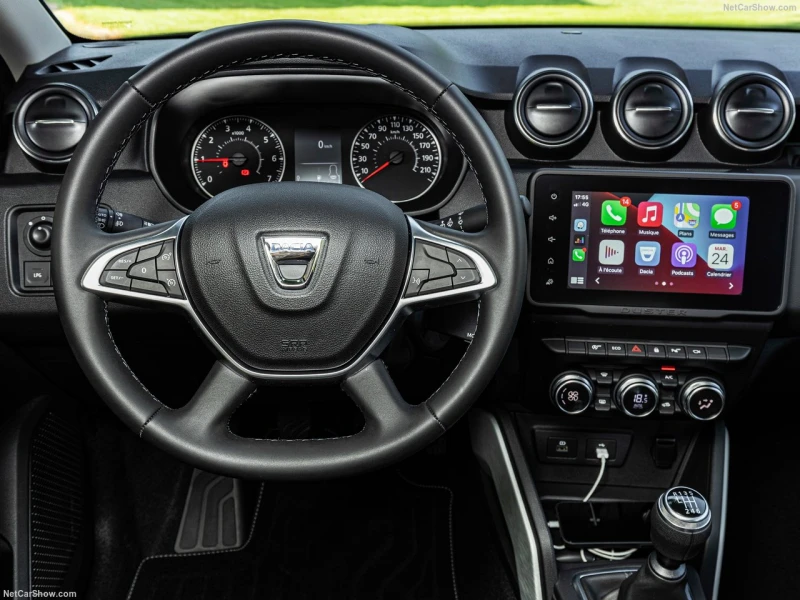
The Duster II introduced a completely redesigned dashboard compared with the first generation. The center stack places the infotainment system higher on the dash, while the climate controls and physical switches remain easy to reach. Most versions use conventional analog gauges with a small trip-computer display rather than a full digital instrument cluster.
Cabin materials are deliberately straightforward. Hard plastics cover much of the dashboard and door panels, with cloth upholstery on most versions and upgraded trim materials on selected higher specifications. The overall impression is functional rather than luxurious, which is consistent with the Duster's value-oriented positioning in Europe.

Driver ergonomics are similarly simple. Seat, steering-wheel and convenience adjustments vary by market and trim, so an imported vehicle should be checked individually rather than judged by the badge alone. Manual-transmission models use a conventional shifter, while some later European versions were available with Dacia's EDC dual-clutch automatic transmission.
The cabin seats five. The wheelbase is about 105.3 inches, giving the Duster useful passenger room for its compact exterior dimensions. Rear-seat comfort is adequate for two adults, while a third passenger has a narrower center position. Rear-seat configuration and center-armrest availability vary by specification.
European two-wheel-drive specifications list about 15.7 cubic feet of VDA-measured cargo space under the parcel shelf, while published maximum-volume figures with the rear seat folded reach roughly 57 cubic feet using the manufacturer's liter-based measurement. Four-wheel-drive versions can have different cargo figures, and European VDA measurements are not directly equivalent to the SAE cargo-volume method commonly used in U.S. specifications. Many versions have a split-folding rear seat, while load-floor details vary by trim and drivetrain.

Trim levels and equipment for U.S. readers
There was no U.S.-market Dacia Duster II trim lineup. In Europe, trim names changed by country and model year. Early second-generation cars in some markets used names such as Access, Essential, Comfort and Prestige, while later Dacia naming shifted toward Essential, Expression, Journey and Extreme. These names should not be treated as universal because the same badge could be paired with different equipment in different countries.
Entry-level versions typically focused on basic transportation, with cloth upholstery and simple audio or infotainment hardware. Depending on market and year, features such as air conditioning, cruise control, parking sensors and a touchscreen could be standard, optional or unavailable.

Better-equipped Duster II versions could add automatic climate control, keyless entry, blind-spot warning, a MultiView camera system, navigation and upgraded infotainment. Early cars commonly used a 7-inch Media Nav touchscreen on higher trims. After the 2021 facelift, Dacia introduced new 8-inch Media Display and Media Nav systems with Apple CarPlay and Android Auto compatibility, while the redesigned high center console could include a sliding armrest.
Later Journey- or Prestige-type specifications generally emphasized comfort and navigation features, but the exact combination depended on the original market. An imported example should therefore be identified by VIN, original sales documents and its actual equipment rather than by applying a generic European trim chart.
Extreme appeared as a higher-spec, outdoor-themed version in the later life of the generation in some European markets. Depending on year, it could include distinctive interior accents and MicroCloud upholstery. Features such as panoramic roofs or 18-inch wheels should not be assumed: they were not universal Duster II equipment and varied significantly by market and generation.

Interior changes by model year and the 2021 facelift
From the 2017 launch through 2020, the Duster II used the original second-generation dashboard architecture, conventional gauges and, on better-equipped versions, a 7-inch Media Nav touchscreen. The main strengths were simple controls, abundant practical storage and a relatively uncluttered layout rather than extensive digital technology.

The 2021 facelift brought the most important cabin update. Dacia added a higher center console with a sliding armrest and introduced new 8-inch multimedia systems. Smartphone integration improved through Apple CarPlay and Android Auto support, and some configurations offered Wi-Fi-based smartphone mirroring and additional USB connections. These changes are more significant than cosmetic claims about softer plastics or measured noise reductions, which were not consistent across every market specification.
Further updates followed as Dacia rolled out its new brand identity in 2022, including revised logos and updates to infotainment graphics and selected interior details. In 2023, the Extreme trim expanded across parts of the Dacia range, bringing distinctive upholstery and copper-colored accents to certain Duster versions. The third-generation Duster arrived in 2024, so late-registered vehicles should be checked carefully to confirm whether they are second- or third-generation models.

Used-interior checks and common wear points
Because the Duster II was designed as an affordable, hard-use compact SUV, condition matters more than broad claims about a particular mileage threshold. On a used example, inspect the steering wheel, driver's seat bolster, seat fabric, gearshift area, door pulls and frequently touched plastics for wear. Uneven damage can say more about previous use than the odometer alone.
Drive over rough pavement and listen for trim rattles from the dashboard, center console and door panels. A rattle does not automatically indicate a serious problem, but it can reveal loose clips or previous interior disassembly. Also check that seat mechanisms, window switches, climate controls and all steering-wheel buttons operate correctly.

On cars with Media Nav, Media Display or camera systems, test the touchscreen, Bluetooth connection, smartphone integration, USB ports, navigation where fitted, rear camera and parking sensors. On higher-spec versions, also verify blind-spot warning, keyless entry and automatic climate control if the vehicle is equipped with them.
For a U.S.-based owner, serviceability deserves extra attention. Dacia has no official U.S. retail network, so replacement trim pieces, infotainment components and market-specific electrical parts may require specialist sourcing. Before buying an imported vehicle, confirm both its legal import status and the availability of parts for its exact original-market specification.

How relevant is the Duster II interior in 2026?
By 2026 standards, the Duster II cabin is clearly from an earlier generation of budget crossover design. Most versions rely on analog instruments, relatively small infotainment screens and extensive hard-plastic trim. That makes it less digital than newer compact SUVs, but the basic layout remains practical and easy to understand.

For a U.S. enthusiast considering a legally imported Duster II, the most desirable interior specification depends less on a particular trim name and more on verified equipment. A facelifted 2021–2024 example with the 8-inch multimedia system, functioning climate control and intact upholstery offers the most modern version of the second-generation cabin, but drivetrain, trim naming and feature content must still be checked against the vehicle's original market.
During a pre-purchase inspection, focus on upholstery and plastic condition, signs of previous disassembly, operation of the touchscreen and cameras, climate-control performance, seat adjustments, switches and evidence of water or electrical damage. For a U.S. purchase, those checks should be paired with documentation confirming how the vehicle was imported and whether it can be legally registered for road use.