


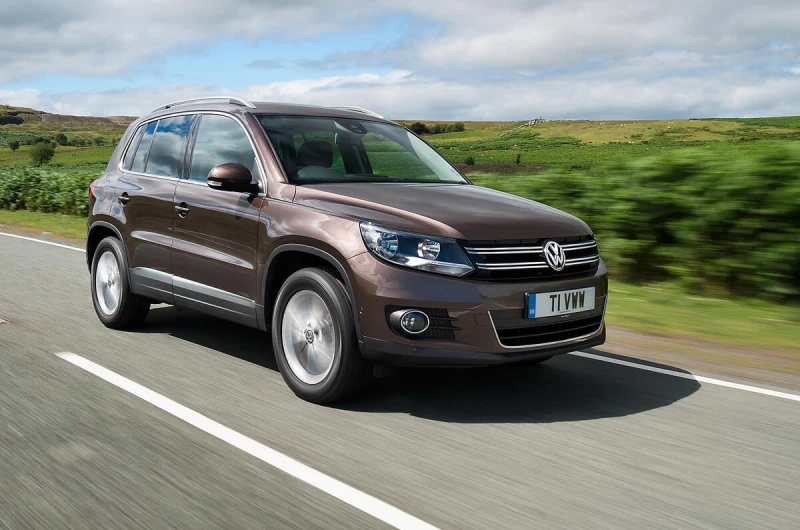
This model still enjoys strong demand on the US used market thanks to its reliable PQ35 platform (shared with the Golf V/VI), capable 4Motion all-wheel drive, and reasonably spacious interior. However, like any vehicle now 9–18 years old, the Volkswagen Tiguan I has some significant drawbacks. In this guide, we break down the most common Volkswagen Tiguan 2007–2016 problems, what to inspect carefully when buying a used Volkswagen Tiguan in the United States, and how much you should budget to bring one into solid condition.
For a full overview of the generation, specs, and interior details, check out our other articles in the series.
Key Drawbacks of the Generation
Owners and specialists point out these major weak areas:
- High fuel consumption — especially the 2.0 TSI (170–200 hp) easily hits 13–16 mpg in city driving; the twin-charged 1.4 TSI (CAWA/CAWB) often returns 10–12 mpg.
- Poor sound insulation — wheel arches, doors, and floor have almost no factory noise deadening; after 60,000 miles, you’ll start hearing lots of creaks and tire roar.
- Rust issues — sills, wheel arches, lower doors, tailgate (especially around chrome trim), and windshield frame. Vehicles from salt-belt states often show rust bubbles by 8–10 years.
- Outdated infotainment — RCD-310/510 and RNS-510 units frequently glitch, the navigation is obsolete, and Bluetooth connection can be choppy.
- Expensive OEM parts — especially suspension components (control arms ~$350–450 each OEM), 4th-gen Haldex coupling, and high-pressure fuel pump on 2.0 TSI.
- Timing chain problems on early 2.0 TSI (pre-2011) — chain stretch and potential skipping can destroy the engine.
- DSG-6 DQ250 transmission — the wet-clutch 6-speed DSG up to 2013–2014 models tends to overheat in traffic and needs fluid changes every 25,000 miles.
Model Years & Versions: What to Watch Closely
- 2007–2011 (pre-facelift) — the most trouble-prone years. Early 2.0 TSI engines (CBAB, CCZC, CCZD) with weak chain tensioners and oil-consuming pistons. Early DSG-6 revisions. Thinnest sound deadening and cheapest interior materials.
- 2011–2016 (facelift) — much improved: updated pistons in 2.0 TSI (CCZB), stronger timing chain, switch to the more reliable 1.4 TSI EA211 (CZDA/CZEA) instead of the problematic twin-charged EA111. From 2014, more powerful versions got the much tougher DSG-7 DQ500.
- 2.0 TDI diesel — rare in the US, but if you find one: carefully check the DPF and EGR valve. After 120,000 miles, injectors and HPFP often need replacement.
Recommendation: the most reliable choices are facelifted 2014–2016 models with the 1.4 TSI 150 hp (CZEA) + 6-speed manual or late-revision 2.0 TSI 180–211 hp (CCZC/CCZB) + serviced DSG-6.
Used Market Specifics in the United States: Key Risks
Most first-gen Tiguans in the US are imports or former lease/fleet vehicles. Pay special attention to:
- Rust — even vehicles from milder climates can develop arch and sill corrosion after 10–12 years, especially if they saw winter road salt.
- Rolled-back odometer — many advertised examples show 110–140k miles, while real mileage is frequently 190–250k+ miles.
- Salvage/rebuilt titles — plenty of flood-damaged or major accident repairs.
- Service history — best when you see records from US or European dealers up to 2018–2020.
- Trim level mismatches — sellers often advertise base S models as loaded SE or SEL by swapping steering wheel and head unit only.
Budget to Bring a Typical Example Up to Good Condition
To get an average 2012–2015 Tiguan into solid shape, expect to spend approximately:
- Full underbody rustproofing + rust repair — $800–$1,500
- Additional sound deadening (4 doors + arches + floor) — $600–$1,000
- Timing chain kit + tensioner + sprockets (if not previously done) — $800–$1,200
- DSG-6 service (fluid + filter + clutch if needed) — $400–$1,200
- Full suspension control arm replacement (OEM or Lemförder) — $900–$1,300
- Modern aftermarket head unit (9–10″ Android + backup camera) — $350–$600
- Haldex coupling service/repair + fluid — $300–$700
Total estimate: to bring a decent 2012–2015 Tiguan to excellent condition, budget $3,000–$5,000 on top of the purchase price.
A clean, well-maintained 2014–2016 example with verified mileage under 125,000 miles and recent service history usually sells for $10,000–$14,000 — in that case, additional investment can be much lower (around $1,000–$2,000).
Final Thoughts & Recommendations
Is the first-gen Volkswagen Tiguan still worth buying in 2025–2026?
Yes — if:
- you choose a facelifted 2014–2016 model,
- prefer the 1.4 TSI 150–160 hp (CZEA) with manual or post-2013 2.0 TSI,
- are ready to check the body with a paint meter, scope the engine, and fully diagnose the transmission/Haldex.
Avoid or inspect extra carefully:
- pre-facelift 2007–2010 models,
- early 2.0 TSI with oil consumption and old-style chain,
- cars advertised at suspiciously low prices with “under 110k miles”,
- examples lacking proper service records or showing obvious backyard repairs.
With the right example and $1,000–$3,000 invested upfront, the first-generation Volkswagen Tiguan remains one of the most versatile, enjoyable-to-drive compact crossovers available on the American used market today.