


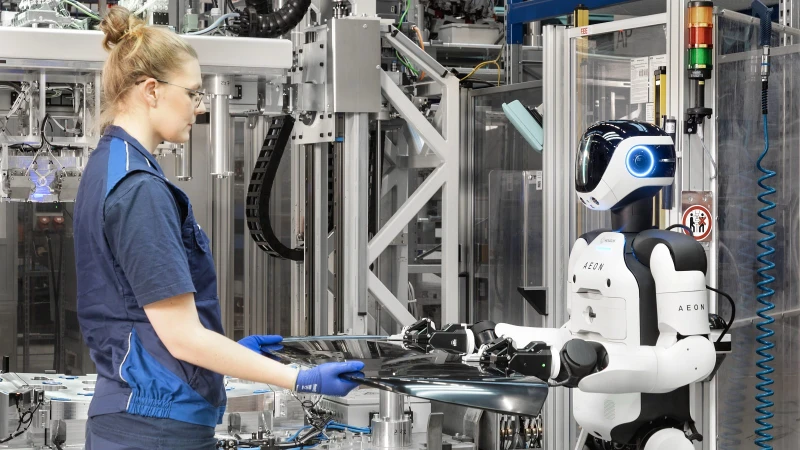
The discussion centers on machines that go beyond the conventional industrial robotic arms long standard in automotive manufacturing. These newer systems are designed to more closely mirror human form and function. Their purpose is to support areas of production that involve repetitive manual tasks, with the longer-term potential to assume responsibility for specific operations.
Why Automakers Are Pursuing Humanoid Robots
Automotive manufacturing has relied on automation for decades. Robots perform body welding, paint application, heavy component handling, and high-precision operations. Nevertheless, numerous processes continue to require human workers. Some tasks prove difficult to standardize, and traditional industrial robots are frequently mismatched with workspaces laid out for human operators.
Humanoid robots are being developed specifically to address these environments. They can be integrated into existing production lines without necessitating major facility redesigns. These machines are capable of operating alongside personnel, manipulating tools, replicating operator movements, and functioning in locations where conventional robotic installations would be impractical or excessively expensive.
What BMW Is Evaluating
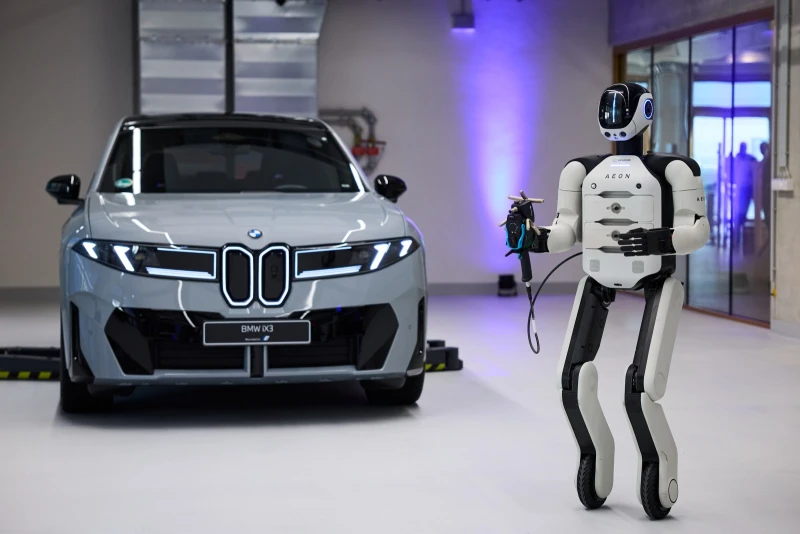
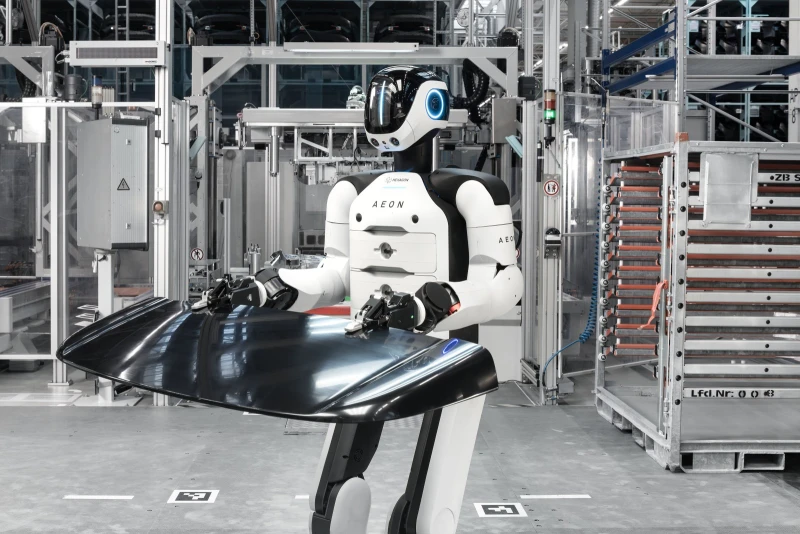
BMW is working with Swedish company Hexagon on its Aeon humanoid robot program. The developer characterizes these machines as "physical artificial intelligence systems," combining mechanical structures, sensor arrays, software controls, and algorithms that allow them to interpret and respond to their surroundings.
In current applications, the robots do not yet function as complete replacements for human labor. They are undergoing training and testing phases, during which they observe employee activities, replicate selected tasks, and accumulate operational data. Setup and programming remain necessary for their function, although developers project that observation-driven learning will become substantially more efficient in the years ahead.
Potential Effects on Factory Operations
The core aim of these projects is to enhance production efficiency while reducing dependence on manual labor for monotonous activities. This objective carries particular weight for automotive assembly operations, which run on tight schedules where personnel shortages can directly affect output.
BMW states that the robots are intended to ease the workload on employees and contribute to improved working conditions. The company also references the possibility of future difficulties in recruiting workers for assembly line positions. In such a context, humanoid robots could assume roles that become harder to fill with human staff.
Implications for Employment
The arrival of these technologies naturally raises questions about workforce impacts. Automation has the capacity to displace certain simple, repetitive functions. At the same time, the automotive industry's experience indicates that new technologies tend to both eliminate some positions and generate others. Emerging roles often involve equipment maintenance, programming, quality control, safety management, and production data analysis.
A parallel development took place with the broad introduction of industrial robots during the 1970s. Assembly methods evolved significantly, yet plants did not operate without human workers. Humanoid systems are anticipated to follow a comparable, phased introduction—beginning with targeted applications before expanding to additional tasks.
Current Technical Constraints
These robots continue to face limitations related to battery endurance, the pace of learning, precision of movement, and the robustness of their control software. The Aeon unit can operate for several hours before autonomously navigating to a battery exchange station. This capability reduces downtime but does not remove the need for monitoring, servicing, and coordination with plant-wide systems.
Successful large-scale deployment will require robots to perform reliably amid real-world variables: dynamic human movement, part-to-part variations, evolving production sequences, and rigorous safety requirements. As a result, the shift from prototype testing to routine operational use is expected to proceed gradually.
Conclusion
BMW's project reflects the automotive industry's ongoing movement into a further stage of automation. Humanoid robots have not reached the stage of fully supplanting human workers, but they are already acquiring the capability to handle portions of existing tasks. In the coming years, such systems may become standard components of manufacturing environments, especially for repetitive physical work. For the sector, this development suggests improvements in efficiency. For employees, it points to shifts in the skills and occupations that will be most valued.