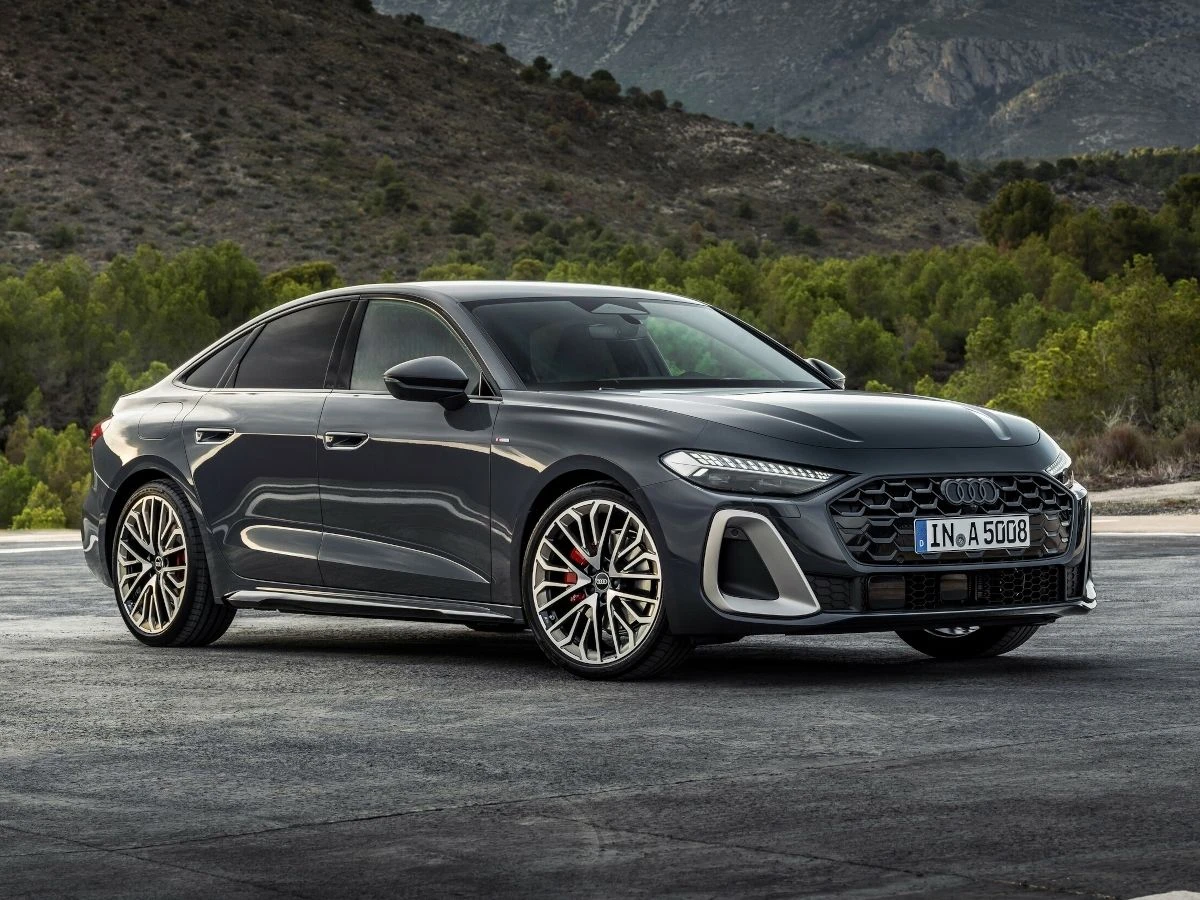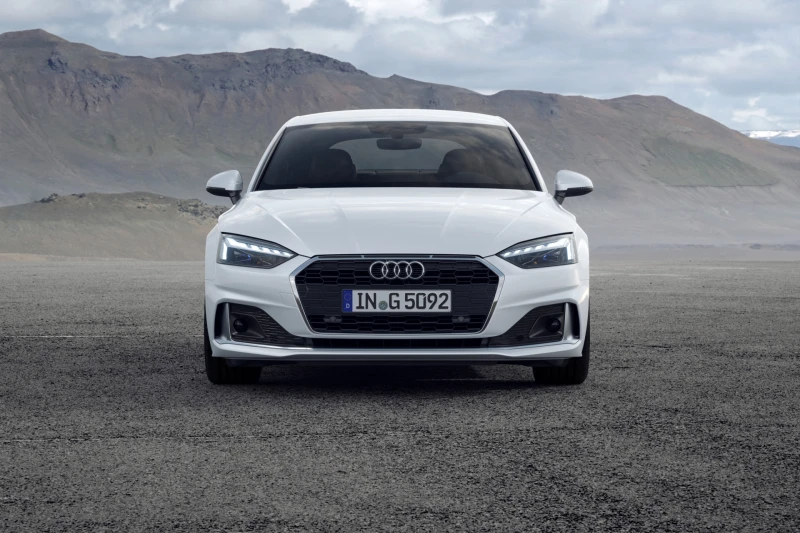
The platform, shared with the B9-generation Audi A4, establishes the A5's longitudinal engine layout, five-link front and rear suspension, and basic weight distribution. For U.S. buyers, the most important distinction is that the official lineup was narrower than the European range: gasoline engines and quattro all-wheel drive dominated, while diesel and front-wheel-drive versions were not part of the regular American offering. Design, cabin technology, and equipment are covered in the other articles in this series.
Powertrains offered in the United States
The second-generation A5 entered the U.S. market for model year 2018 as a Coupe, Cabriolet, and five-door Sportback. Regular A5 models used a turbocharged 2.0-liter TFSI four-cylinder engine. The S5 moved to a turbocharged 3.0-liter V6, while the RS 5 used a 2.9-liter twin-turbo V6. Audi did not officially sell the 2.0 TDI or European-market lower-output gasoline versions in the United States, so those configurations should be treated as gray-market imports rather than normal U.S.-spec cars.
Output changed during the generation. The 2018 A5 was rated at 252 hp, followed by 248 hp for the pre-facelift 2019–2020 specification. For 2021, the A5 45 TFSI increased to 261 hp and gained a 12-volt mild-hybrid system. Audi also introduced a 201-hp A5 Sportback 40 TFSI quattro; this lower-output version was not offered in the Coupe or Cabriolet. The mild-hybrid hardware assists the stop-start and coasting functions but does not propel the car as a conventional hybrid would.
| U.S.-market version | Displacement | Output | Transmission | Drivetrain |
| A5 2.0 TFSI (2018) | 2.0 liters | 252 hp / 273 lb-ft | 7-speed S tronic; 6-speed manual on certain early Coupes | quattro AWD |
| A5 2.0 TFSI (2019–2020) | 2.0 liters | 248 hp / 273 lb-ft | 7-speed S tronic | quattro AWD |
| A5 Sportback 40 TFSI (2021–2024) | 2.0 liters | 201 hp / 236 lb-ft | 7-speed S tronic | quattro AWD |
| A5 45 TFSI (2021–2024) | 2.0 liters | 261 hp / 273 lb-ft | 7-speed S tronic | quattro AWD |
| S5 3.0 TFSI V6 | 3.0 liters | 349–354 hp / 369 lb-ft, depending on model year | 8-speed Tiptronic | quattro AWD |
| RS 5 2.9 TFSI twin-turbo V6 | 2.9 liters | 444 hp / 442–443 lb-ft, depending on model year | 8-speed Tiptronic | quattro AWD |
The seven-speed S tronic dual-clutch transmission was standard with the four-cylinder engine for most of the generation. A six-speed manual was available only on a limited number of early A5 Coupes and disappeared from the U.S. lineup. The S5 and RS 5 used an eight-speed torque-converter Tiptronic. All regular U.S.-spec A5 models were sold with quattro; most automatic A5 versions use the efficiency-focused quattro with ultra technology, while the S5 and RS 5 employ driveline hardware tailored to their higher output.
Exterior dimensions and curb weight
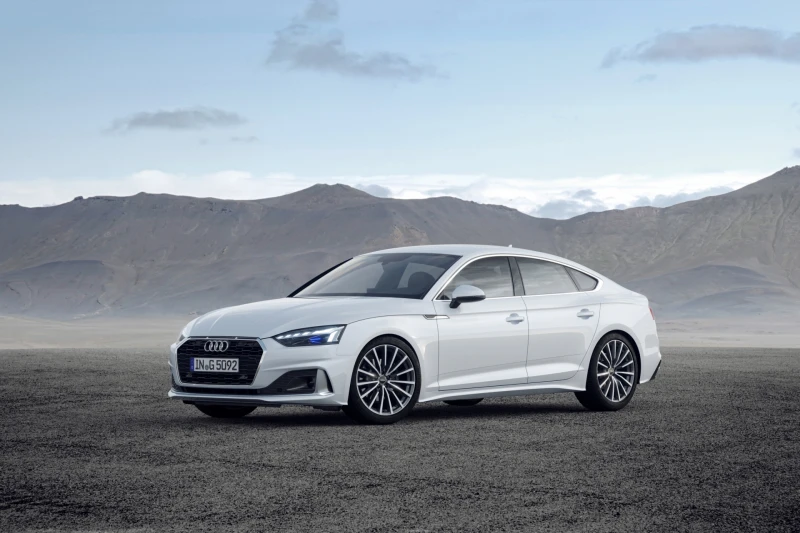
Dimensions vary by body style and model year. The Coupe and Cabriolet share the shorter wheelbase, while the Sportback adds rear-seat space and a large liftback cargo opening. The facelift also changed overall length slightly. S and RS bodywork, larger wheels, convertible-top hardware, and optional equipment can move the final curb weight well beyond the figure for a base A5 Coupe.
| Specification | Typical U.S.-spec value or range | Notes |
| Overall length | About 184.0–188.3 in | A5 Coupe and Cabriolet are shortest; RS 5 Sportback is longest |
| Width | About 72.6–73.5 in | Measured without mirrors; RS 5 has wider bodywork |
| Height | About 54.0–55.1 in | Varies with body style, suspension, and model |
| Wheelbase | 108.8–108.9 in (Coupe/Cabriolet) / 111.2–111.3 in (Sportback) | The Sportback's longer wheelbase benefits rear-seat room |
| Base curb weight | Approximately 3,550–4,080 lb | A5 Coupe is near the low end; Cabriolet and RS 5 Sportback are heavier |
| Seating | Four (Coupe/Cabriolet) / five (Sportback) | Sportback combines four doors with a rear liftgate |
These figures describe the range rather than a single trim. For example, a 2024 A5 Sportback is roughly 187.2 inches long on a 111.2-inch wheelbase, while a same-year Cabriolet is about 184.9 inches long on a 108.8-inch wheelbase. The certification label on the vehicle and the model-year specifications should be used when exact curb weight, payload, wheel, or tire data matter.
Updates within the generation
Globally, the F5 generation began in 2016, but U.S. sales started with model year 2018. The American launch specification paired the 252-hp 2.0 TFSI with quattro and either S tronic or, on some Coupes, a manual transmission. Output was listed at 248 hp for 2019–2020. The refreshed 2020 model brought revised styling and updated infotainment, but the more important mechanical change followed for 2021, when U.S. four-cylinder A5 models received a 12-volt mild-hybrid system and the 45 TFSI rose to 261 hp.
The transmission strategy remained consistent after the early manual Coupe was dropped: seven-speed S tronic for the A5 and eight-speed Tiptronic for the S5 and RS 5. The three mainstream body styles continued through the 2024 model year, while the U.S. 2025 range was reduced primarily to Sportback derivatives before the new-generation A5 arrived. This means the B9/F5 cars covered here now belong mainly to the pre-owned market, even if an occasional leftover vehicle is advertised as new.
Ownership considerations for U.S.-spec cars
EPA fuel-economy ratings vary by body style, output, wheel package, and model year. Four-cylinder A5 versions generally occupy the mid-20s to around 30 mpg combined, with the 40 TFSI Sportback at the efficient end of the range. S5 and RS 5 ratings are lower. Owner-reported consumption is a separate measure and can change substantially with traffic, climate, tires, and driving style, so it should not be presented as an EPA result.
Maintenance requirements should be checked against the factory schedule for the exact model year and VIN. A documented history matters more than a claimed universal service interval: buyers should verify engine-oil changes, transmission and driveline service where specified, brake-fluid service, cooling-system condition, and recall completion. A pre-purchase inspection should also check for fluid leaks, suspension wear, electronic faults, accident repairs, and—in the Cabriolet—the roof mechanism and water drains.
Mechanical parts availability is generally supported by component sharing with the B9 A4 and other MLB Evo models, but body panels, convertible-top components, electronic modules, adaptive suspension parts, and Audi Sport hardware can be substantially more expensive. Diagnostic capability is important because equipment varies widely among Premium, Premium Plus, and Prestige trims and between model years.
Cars.com, Autotrader, and CarGurus carry U.S.-market listings for the generation. Buyers should confirm that an advertised car is genuinely U.S.-spec by checking its VIN and original equipment, especially when the listing mentions a TDI engine, front-wheel drive, a European trim name, or kilometer-based instruments. Mileage alone does not establish condition; service records, accident history, modifications, and a scan of all control modules provide a clearer picture.
Choosing the right U.S.-market configuration
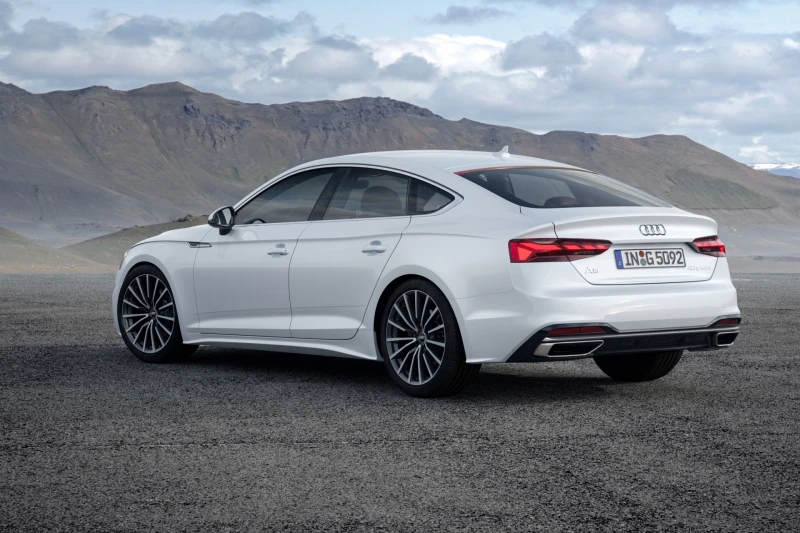
For most buyers, the A5 45 TFSI offers the clearest balance of performance and operating costs, while the 40 TFSI Sportback trades some acceleration for better fuel economy. The Coupe prioritizes style, the Cabriolet adds open-air driving with extra weight and complexity, and the Sportback is the practical choice because of its rear doors, five-passenger layout, and liftgate. Every mainstream U.S.-spec version uses quattro, so there is no need to choose between front- and all-wheel drive as there is in some overseas markets.
The S5 and RS 5 are distinct performance models rather than simple trim upgrades. Their V6 engines, eight-speed transmissions, brakes, suspension hardware, tires, and running costs differ materially from the four-cylinder A5. The best configuration therefore depends on body style, desired performance, fuel use, and the quality of the individual car's history. Regardless of version, a model-year-specific inspection and complete documentation are more useful than broad claims about durability.