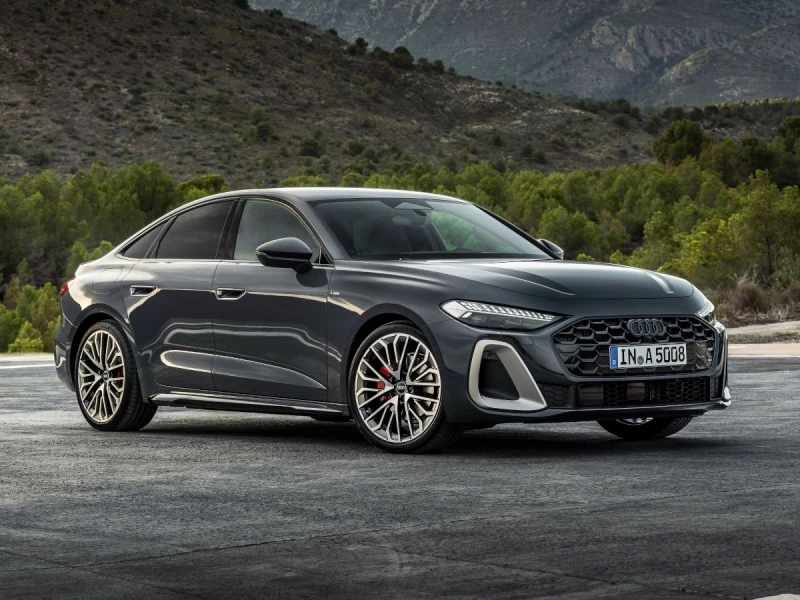
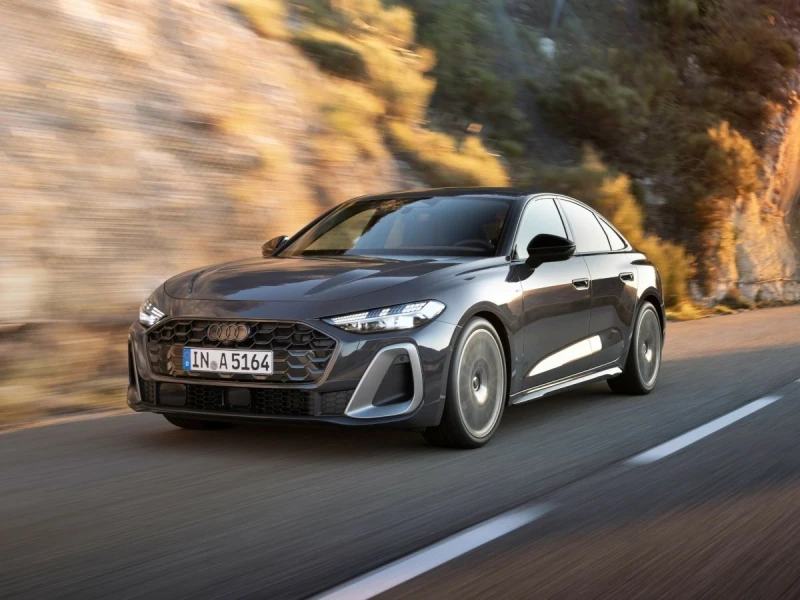
The third-generation Audi A5 uses the PPC (Premium Platform Combustion) architecture and changes the model's role in the United States. The five-door liftback, officially marketed here as the A5 Sedan, effectively succeeds both the previous A4 Sedan and A5 Sportback. For the 2025 and 2026 model years, the U.S. A5 lineup centers on one powertrain: a turbocharged 2.0-liter TFSI four-cylinder, a seven-speed S tronic dual-clutch transmission and standard quattro all-wheel drive. The higher-performance S5 is the only other factory powertrain choice in this body. Design, interior features and option packages are covered separately.
U.S. powertrains: one A5 specification plus the S5
The U.S.-market A5 produces 268 hp and 295 lb-ft of torque. Buyers do not have to choose among several A5 engine outputs: Premium, Premium Plus and Prestige use the same 2.0-liter powertrain. European B10 specifications describing Audi's MHEV plus system should not be applied automatically to the U.S. A5, which Audi of America lists as a turbocharged gasoline model rather than a separate hybrid variant.
Every U.S. A5 uses a seven-speed S tronic dual-clutch transmission and quattro all-wheel drive. The S5 also has a seven-speed S tronic and quattro, but replaces the four-cylinder with a turbocharged 3.0-liter TFSI V6 rated at 362 hp and 406 lb-ft. Front-wheel drive, the 2.0 TDI diesel and the lower-output European gasoline engines are not part of the official U.S. B10 lineup.
| Model or trim | Engine | Output | Transmission | Drive | U.S. position |
| A5 Premium | 2.0-liter turbo I4 | 268 hp / 295 lb-ft | 7-speed S tronic | quattro AWD | Entry trim with the standard U.S. powertrain |
| A5 Premium Plus | 2.0-liter turbo I4 | 268 hp / 295 lb-ft | 7-speed S tronic | quattro AWD | Same mechanical specification with additional equipment |
| A5 Prestige | 2.0-liter turbo I4 | 268 hp / 295 lb-ft | 7-speed S tronic | quattro AWD | Top A5 trim; output is unchanged |
| S5 lineup | 3.0-liter turbo V6 | 362 hp / 406 lb-ft | 7-speed S tronic | quattro AWD | Performance alternative to the A5 |
Audi quotes 0–60 mph in 5.6 seconds for the A5 and 4.3 seconds for the S5. Those figures describe the U.S. models and should not be combined with European-market A5 data. In Europe, the B10 family has also included front-wheel-drive versions, 2.0 TDI diesels and the Avant wagon, none of which is an official U.S. A5 configuration.
Dimensions and weight: one practical liftback body
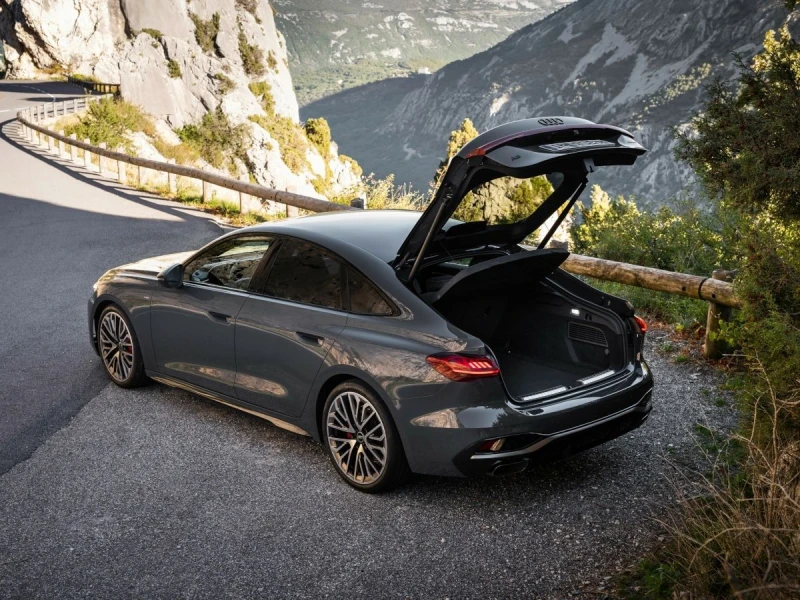
The B10 is longer and has a longer wheelbase than the outgoing U.S. A5 Sportback. Although Audi calls it the A5 Sedan, the rear glass lifts with the cargo hatch, preserving the practicality associated with the previous Sportback. The A5 Avant wagon is produced for other markets but is not included in Audi of America's regular lineup. The figures below describe U.S.-specification 2026 vehicles; curb weight can vary with equipment.
| Measurement | A5 Sedan | S5 Sedan |
| Length | 190.1 in | 190.3 in |
| Width without mirrors | 73.2 in | 73.2 in |
| Height | 57.0 in | 56.5 in |
| Wheelbase | 113.8 in | 114.0 in |
| Base curb weight | About 4,090 lb | About 4,288 lb |
| Gross vehicle weight rating | About 5,269 lb | About 5,423 lb |
Cargo volume is approximately 22.6 cu ft with the rear seat in use. Folding the rear seat expands the available space to roughly 36.6 cu ft in the A5 and 37.5 cu ft in the S5, depending on how the vehicle is measured and equipped. The large hatch opening is the practical advantage of this body style: bulky luggage is easier to load than it would be through a conventional sedan trunk.
U.S. model-year status and changes through 2026
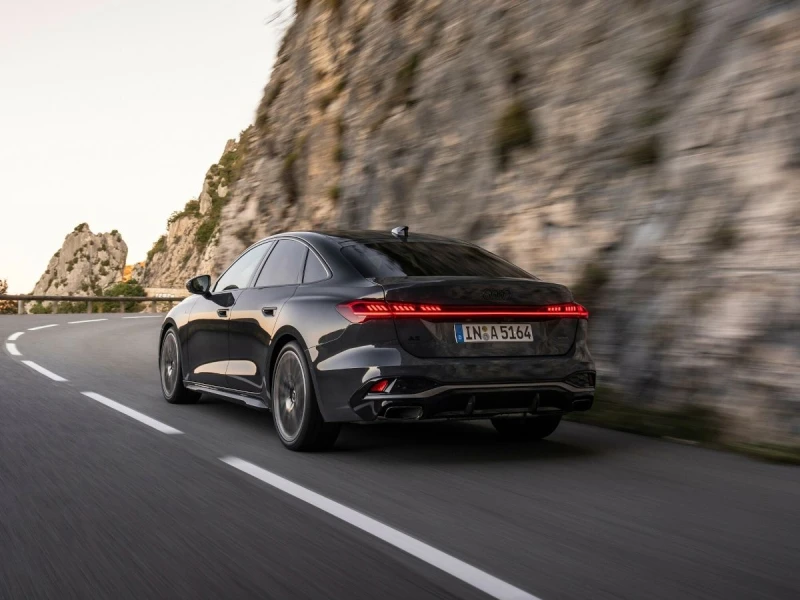
The B10 A5 reached U.S. dealers as an all-new 2025 model. For 2026, the core mechanical specification remains the same: 268 hp, 295 lb-ft, a seven-speed S tronic and standard quattro across Premium, Premium Plus and Prestige. Audi did not add a diesel, front-wheel-drive model or Avant to the U.S. range. The S line designation is tied to appearance and equipment packages rather than a different A5 engine output.
Changes for 2026 focus mainly on software, infotainment functions, driver-assistance features and package content. Equipment can still vary by production date and option combination, so a window sticker or VIN-specific build sheet is more reliable than assuming that every car within a trim has identical hardware. Software additions announced for a later model year should not be treated as guaranteed retrofits for earlier cars.
Ownership considerations and EPA fuel economy
Because the B10 is still a recent design, there is not yet enough high-mileage U.S. history to support firm claims about long-term engine, transmission or electronics life. A pre-owned inspection should therefore focus on documented maintenance, stored fault codes, cooling-system condition, fluid leaks, smooth engagement from the dual-clutch transmission and correct operation of the infotainment and driver-assistance systems. Accident repairs deserve particular attention because the car uses numerous cameras, sensors and electronically controlled modules.
Service should follow the U.S. maintenance schedule for the vehicle's model year rather than a generic mileage rule. Audi states that 2026 models include scheduled maintenance for three years or 30,000 miles, whichever comes first, while the new-vehicle limited warranty runs for four years or 50,000 miles. On a used car, buyers should confirm the original in-service date, remaining coverage and completion of any VIN-specific recalls or service campaigns.
For the 2026 A5, the EPA estimate is 22 mpg city, 32 mpg highway and 26 mpg combined. The S5 is rated at 20 mpg city, 29 mpg highway and 23 mpg combined. These are EPA figures, not results from an independent road test; actual fuel economy depends on speed, traffic, temperature, tires, load and driving style. Premium unleaded is recommended, so fuel-cost comparisons should use premium rather than regular gasoline prices.
Audi's U.S. dealer network can handle warranty work, diagnostics and software updates, while independent European-car specialists may be suitable for routine service after warranty. The PPC platform and its electronics are still relatively new, however, so body, sensor or platform-specific electronic components may be less widely stocked than parts for the outgoing B9 generation. Repair estimates should be compared case by case instead of assuming ownership costs match the older A4 or A5.
Choosing the most suitable U.S. configuration
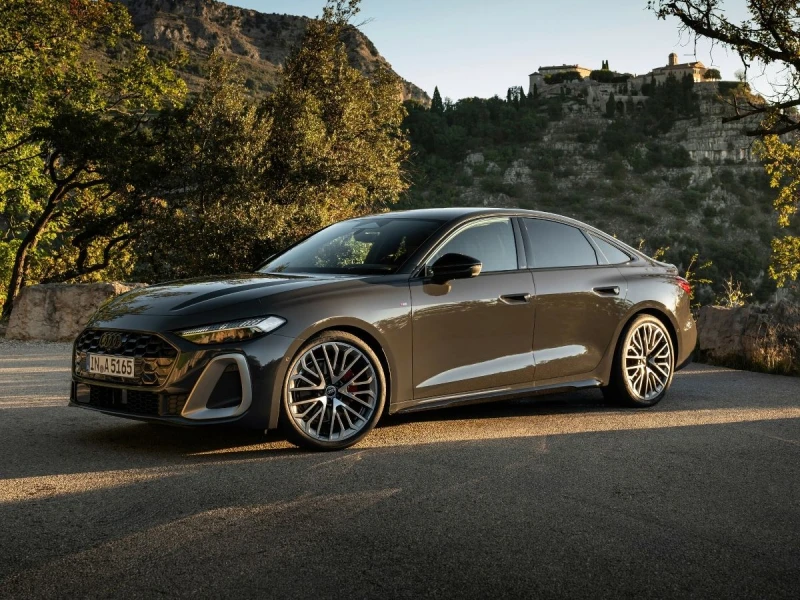
All three A5 trims share the same engine, transmission and standard all-wheel drive, so the practical decision is primarily about equipment, wheel size and price rather than performance. The standard 18-inch wheels provide more tire sidewall than the available 19-inch designs, which can be useful on rough pavement and may reduce replacement-tire cost. Premium Plus and Prestige add convenience and technology content, but package details should be checked on the individual car.
The S5 is the alternative for drivers who place a higher priority on acceleration and chassis performance and accept its higher fuel and running costs. For normal commuting, highway travel and four-season use, the A5's 268-hp powertrain is the more restrained choice. Standard quattro can improve traction, but appropriate seasonal tires remain the more important factor for braking and cornering on snow or ice.
In U.S.-market terms, the B10 A5 is therefore straightforward: one five-door body, one A5 powertrain, three main trim levels and standard all-wheel drive. Keeping those boundaries clear avoids the most common specification error—mixing American cars with European diesels, front-wheel-drive versions or the Avant wagon.