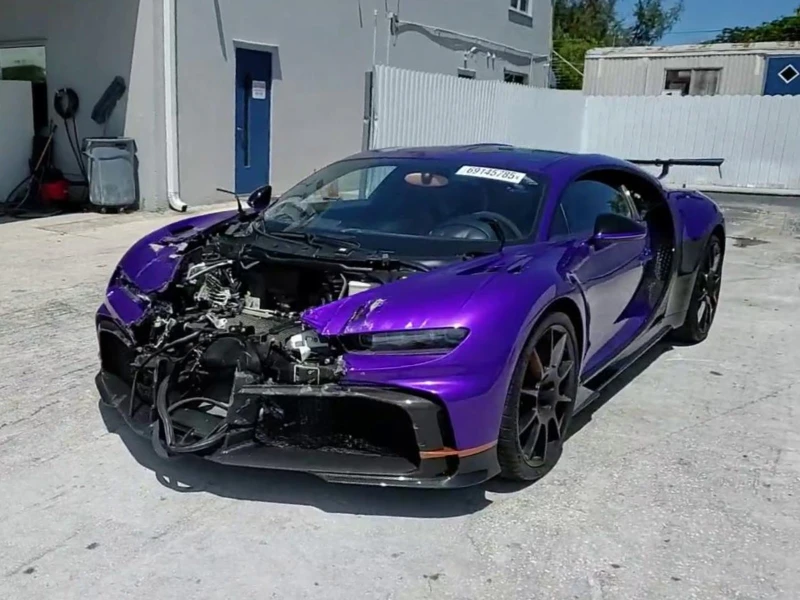
The discussion involves a rare hypercar produced in a limited series and an attempt to bring it back to life using components from far more mass-produced vehicles. This case illustrates how the market for parts for ultra-expensive cars operates and why simple solutions do not always work here.
Rare Variant and Unfortunate End
The Bugatti Chiron Pur Sport was introduced in 2020 as a driver-oriented modification of the base Chiron. The vehicle received a revised transmission, refined chassis, and lightened construction. The maximum RPM of the eight-liter W16 engine was increased to 6,900 rpm, and the overall weight reduction amounted to about 50 kilograms. A total of 60 units were produced.
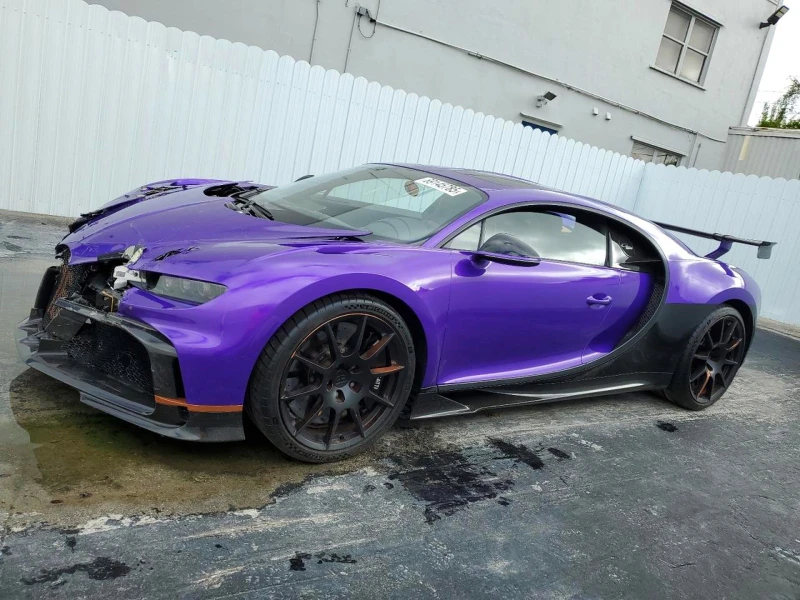
One such vehicle belonged to influencer Alex Gonzalez. Last summer, he reported being involved in a serious accident, after which the car was declared a total loss by the insurance company. The machine ended up at a Copart auction, where it was initially considered as a source of usable remnants.
From Total Loss to Restoration Project
Gonzalez repurchased the crashed vehicle and decided to undertake its restoration in collaboration with mechanic and blogger Mat Armstrong. However, at this stage, a key issue arose: Bugatti supplies original parts exclusively through official service centers. The preliminary repair cost estimate was around 1.7 million dollars, later reduced to a range of 600–700 thousand dollars, which still appeared economically unfeasible.
An additional factor was the requirement to ship the vehicle to the Bugatti factory in Molsheim, France. As a result, the decision was made to explore alternative restoration paths and simultaneously document the process in a video series format.
Identical Parts — Different Requirements
During disassembly, it was discovered that some components, including airbags, are structurally identical to parts from mass models, such as the Audi A3. Formally, it is indeed the same element, which in an ordinary car costs a few dozen dollars. However, when installed in a hypercar, such parts operate in a different environment and require additional adaptation.
Bugatti head Mate Rimac explained that even visually identical components undergo individual calibration. As an example, he cited the influence of cabin temperature and trim materials on the proper deployment of airbags. Without accounting for these factors, intervention may affect the operation of passive safety systems.
Boundaries of Independent Repair
The question of using 3D printing for manufacturing missing parts was addressed separately. Theoretically, this is possible, but without precise data on materials, tolerances, and loads, achieving factory specifications is practically unrealistic. In the case of a vehicle of this level, errors in calculations can have serious consequences.
Conclusion
The restoration project of the crashed Bugatti Chiron Pur Sport remains an open experiment. It demonstrates that external similarity of parts does not imply their full interchangeability, and repairing ultra-expensive vehicles requires not only financial resources but also deep engineering understanding. Even with suitable components available, restoring the car's original characteristics without the manufacturer's involvement is extremely difficult.