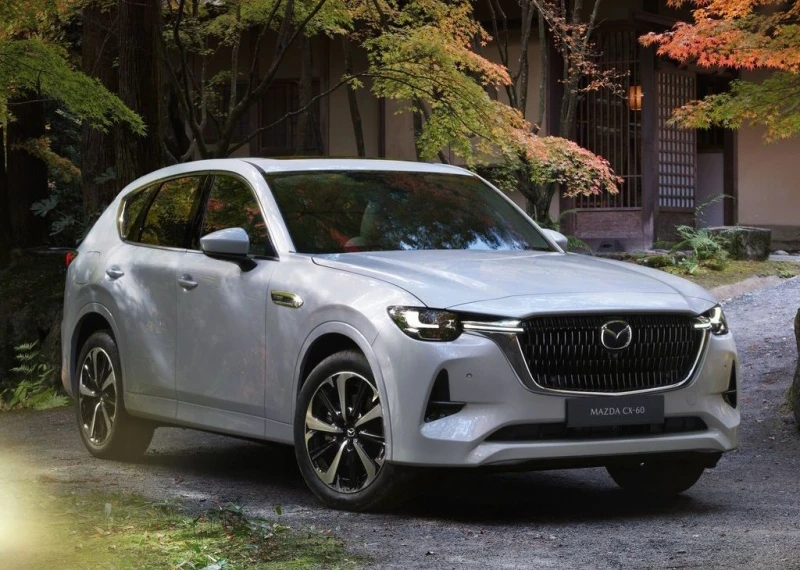
Technical specifications of the Mazda CX-60 I are primarily oriented toward global markets, with availability in the United States through select channels or similar platform siblings as of early 2026. Below are the key details on powertrains, dimensions, and operating features relevant to the US market.
A detailed review of exterior design, interior, trim levels, and potential drawbacks of the generation is covered in separate articles in the series.
Engines and Transmissions
Throughout production, the Mazda CX-60 I (2022–present) has been offered with several powertrain options. In markets similar to the US, emphasis is placed on efficient gasoline engines, mild-hybrid systems, and plug-in hybrid variants. The naturally aspirated 2.5L Skyactiv-G (around 187 hp) appears in select configurations, while the inline-six 3.3L e-Skyactiv G and e-Skyactiv D units feature 48V Mild Hybrid assistance. The plug-in hybrid e-Skyactiv PHEV based on the 2.5L has become one of the most sought-after versions.
All powertrains are paired exclusively with an 8-speed Skyactiv-Drive automatic transmission. Rear-wheel drive is rare (mostly on certain past diesel variants), while i-Activ AWD all-wheel drive is standard on the majority of models available in the US market.
| Engine Type | Displacement, L | Power, hp | Transmission | Drivetrain | Notes / Availability |
| Gasoline Naturally Aspirated | 2.5 (Skyactiv-G) | 187–188 | 8-speed Auto | AWD | Available in select US-friendly configurations, often in mid-to-high trims |
| Gasoline + Mild Hybrid | 3.3 (e-Skyactiv G Turbo) | 280 / 284 | 8-speed Auto | AWD | 284 hp variant most common in premium segments |
| Diesel + Mild Hybrid | 3.3 (e-Skyactiv D Turbo) | 197–254 | 8-speed Auto | AWD (rare RWD) | Higher-output versions support advanced biofuels in updates |
| Plug-in Hybrid | 2.5 + Electric Motor (e-Skyactiv PHEV) | 323 (combined) | 8-speed Auto | AWD | Popular choice, 17.8 kWh battery pack |
Dimensions and Weight
The overall dimensions of the Mazda CX-60 are nearly identical across the generation, with minor variations depending on trim, wheels, and drivetrain. Average figures are listed below. Curb weight varies by powertrain: PHEV and 3.3L models are heavier due to battery packs and added equipment.
| Parameter | Value | Notes |
| Length, in | 186.6–186.8 | Depending on model year and market |
| Width, in | 74.4 | Without mirrors |
| Height, in | 65.7–66.3 | With / without roof rails |
| Wheelbase, in | 112.8 | Consistent across the generation |
| Curb Weight, lbs | 3704–4568 | Lowest — 2.5 gasoline, highest — PHEV / 3.3 |
| Gross Vehicle Weight, lbs | approx. 5291–5732 | Depending on version |
| Ground Clearance, in | 6.8–6.9 | Standard figures |
Updates by Year and Refresh
As of early 2026, the Mazda CX-60 I remains current without a full redesign. However, 2025–2026 model years brought targeted enhancements: revised rear suspension tuning (softer springs, firmer dampers, stabilizer tweaks in some versions for better ride comfort), refined automatic transmission and chassis calibrations, support for advanced fuels in diesels, minor interior material upgrades, and expanded color options. The engine lineup persists: PHEV 323 hp, 3.3L diesel (197/254 hp), 3.3L gasoline MHEV (280/284 hp), and the 2.5L naturally aspirated (187–188 hp) remains available in certain configurations. No major powertrains have been discontinued, though focus has shifted toward PHEV and 3.3L variants in higher trims. The 2025–2026 updates improved the balance of handling and comfort, particularly at the rear axle.
Operating Features and Technical Notes
In the US market context, the Mazda CX-60 is enjoyed mostly in PHEV and 3.3L gasoline/diesel forms. The inline-six 3.3 engines (gas and diesel) show strong early-mileage reliability, though long-term data is still emerging due to the model's relative newness. The PHEV requires attention to high-voltage battery health and charging availability. Most popular powertrains on the used market are the PHEV 323 hp and 3.3L diesel 254 hp variants.
Real-world fuel economy estimates (based on similar models and owner reports): PHEV — 35–50+ MPGe combined with regular charging (electric range up to 35–40 miles); 2.5L gasoline — approx. 25–28 mpg combined; 3.3L gasoline MHEV — 22–26 mpg; 3.3L diesel — 30–35+ mpg depending on driving style.
The 8-speed automatic delivers smooth shifts overall, though early units (2022–2023) had occasional shift quality complaints — largely resolved via software updates in later years. The i-Activ AWD system is reliable and effective on low-traction surfaces. Parts are available through dealer networks and aftermarket channels, with costs above average for the segment but below German luxury brands. Serviceability is good, with many components shared across the Large platform family.
Summary and Optimal Choices for the US Market
From a technical standpoint, well-balanced combinations for US buyers include the PHEV 2.5 (323 hp) + 8-speed Auto + AWD and the 3.3L gasoline MHEV (284 hp) + 8-speed Auto + AWD. The PHEV shines with home charging access (excellent efficiency, strong resale value), while the 3.3L gasoline offers responsive performance. The 2.5L naturally aspirated is simpler to maintain and more affordable on the used market but gives up some power and refinement.
When choosing, factor in maintenance costs (PHEV higher due to battery), fuel/charging availability, and personal driving needs. Overall resale value for the generation remains solid thanks to its unique layout and lack of direct segment rivals.