


Mitsubishi Outlander III, also known as the third-generation Outlander, became a true hit thanks to its excellent balance of value, interior space, and legendary Japanese reliability. In this review, we dive deep into the Mitsubishi Outlander 2013-2021: from its debut to its standing on today's used market. Produced globally from 2012 to 2021, this generation marked Mitsubishi's strong comeback in the midsize SUV segment, going head-to-head with the Toyota RAV4 and Honda CR-V.
Introduction
The third-generation Mitsubishi Outlander (internal code ZJ/ZK) made its world debut at the Los Angeles Auto Show in late 2012, with sales in the US kicking off in early 2013. Production ran through 2021, with significant facelifts in 2015 and 2018 before the fourth generation arrived. Over its run, the Mitsubishi Outlander III sold more than 1.5 million units worldwide. It rides on the GS (Global Shared) platform, co-developed with Renault-Nissan — the same architecture found under the Nissan X-Trail and Rogue — delivering great parts availability, production efficiencies, and a 30% stiffer body structure compared to its predecessor. Dimensions grew noticeably: length reached 4695 mm (+120 mm over the prior model), width 1815 mm, wheelbase 2670 mm, enabling an optional third-row seat for seven passengers. Ground clearance stands at 215 mm (about 8.5 inches), with approach and departure angles of 21°/21°, well-suited for light off-road use and rough roads.
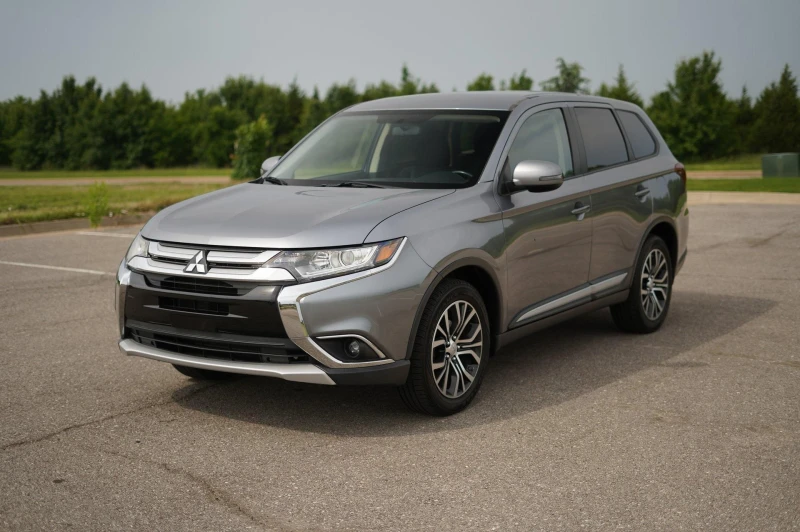
The design of the Mitsubishi Outlander 2013-2021 introduced the signature Dynamic Shield front fascia: a bold chrome-trimmed grille, sharp headlights with LED accents (standard after 2015), muscular wheel arches, and flowing body lines. The rear is clean and functional, featuring horizontal taillights and roof rails. Under the hood are naturally aspirated gasoline engines — a 2.0L (148 hp) and 2.4L (166 hp) — both with chain-driven timing and MIVEC variable valve timing. Transmission choices include the Jatco CVT (paired with the 2.0L) or a 6-speed automatic INVECS-III (with the 2.4L). Super All-Wheel Control (S-AWC) with 2WD, 4WD Auto, and 4WD Lock modes became standard on most trims. Cargo space measures 477–1608 liters (5-seat) or 128–1608 liters (7-seat), with a 60-liter (15.8-gallon) fuel tank. US-market versions featured enhanced rust protection, cold-weather packages (heated steering wheel, washer nozzles), and compliance with EPA Tier 2 Bin 5 / LEV II emissions standards.
This generation fit perfectly into the American market, where demand for versatile, family-friendly crossovers with optional third-row seating continues to grow. The Mitsubishi Outlander III is more than just transportation — it's a practical all-rounder for daily commutes, highway trips, and weekend adventures.
What’s New Compared to the Previous Generation
Compared to the second-generation Outlander (CW, 2006–2012), the third generation represents a major leap from a compact crossover to a true midsize SUV. Styling shifted dramatically: the old model’s conservative look gave way to a bolder, more aggressive European-inspired design. The Dynamic Shield grille replaced the softer front end, headlights became sleeker, and the overall profile grew longer and lower (height dropped to 1680 mm from 1690 mm), improving aerodynamics (Cd 0.33 vs. 0.36). Wheelbase stretched by 70 mm and overall length by 120 mm, adding significant rear legroom (+100 mm) and room for an optional third row.
The GS platform was a breakthrough: far stiffer (+30%), better handling (MacPherson struts front, multi-link rear), and improved NVH (noise reduced by 5–7 dB). The center of gravity is lower, and turning radius is a tight 5.3 meters (17.4 ft) — great for city driving.
Tech took a big step forward. Engines adopted MIVEC with better efficiency (fuel economy improved 10–15%, real-world combined around 25–28 MPG vs. previous 22–24 MPG). The CVT became smoother and more durable (typical lifespan 125,000–155,000 miles), while S-AWC offered smarter torque distribution (up to 50:50) and tailored modes. Infotainment upgraded to a 7-inch touchscreen with navigation, Bluetooth, and USB; post-2015 models added Apple CarPlay and Android Auto on higher trims.
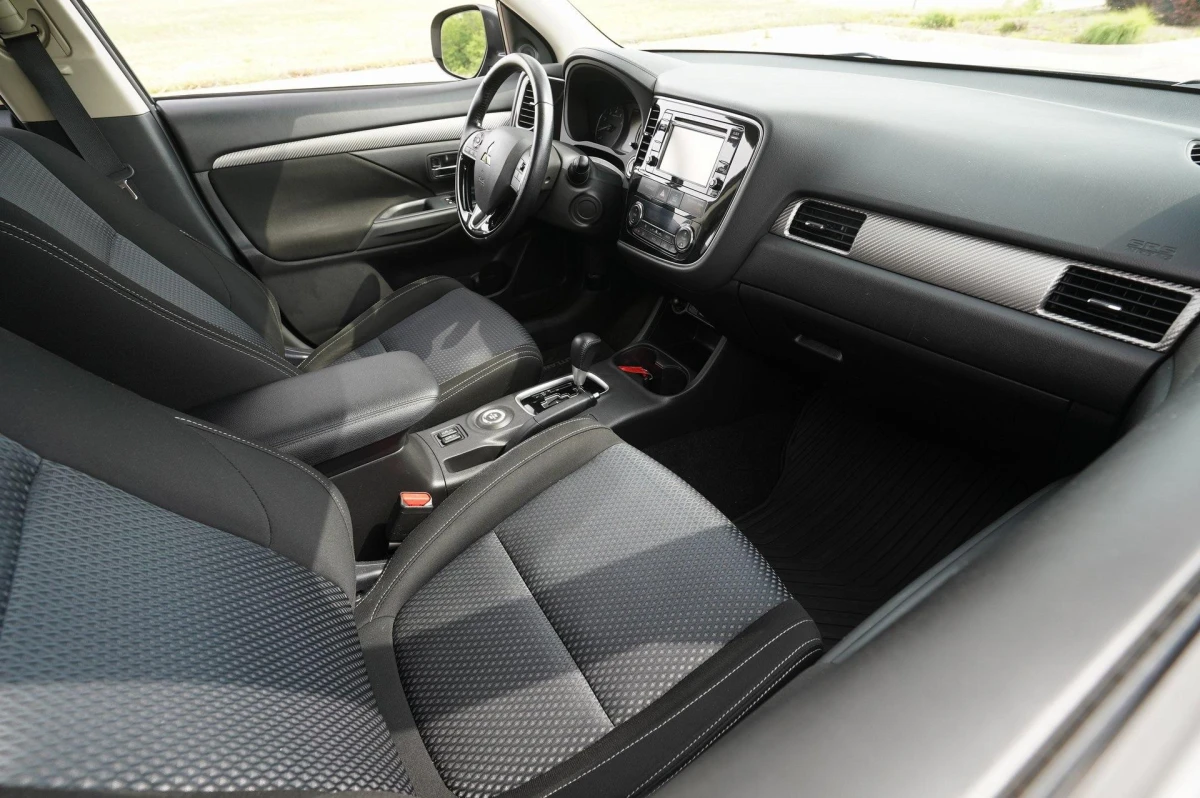
Interior comfort improved with more shoulder room (+50 mm rear), softer materials (leather on Intense+ trims), dual-zone climate control, and an available panoramic roof. The third row folds flat, and power liftgate became available. Safety jumped ahead: standard seven airbags, ABS, EBD, stability control, hill-start assist. After 2015, advanced driver aids included Forward Collision Mitigation, Lane Departure Warning, and adaptive cruise on top trims. Euro NCAP-equivalent US IIHS and NHTSA ratings reached top marks in its class, thanks to a reinforced high-strength steel body (+40% energy absorption).
Overall, the Mitsubishi Outlander 2013-2021 evolved into a spacious, efficient, tech-loaded family hauler that significantly outclassed its predecessor.
US Market Overview
On the American used market, the Mitsubishi Outlander III remains a popular pick among Japanese SUVs. Listings typically range from early models to late facelifts, with steady demand driven by affordable parts (thanks to Nissan compatibility), reasonable maintenance costs, and the rare 7-seat option in this price range.
Approximate market price range (United States, late 2025–early 2026):
- 2013–2015 models, 2.0 CVT, 2WD/AWD — $8,000 – $12,000
- 2015–2018 facelift, 2.0–2.4 CVT/Auto, AWD — $11,000 – $16,000
- 2018–2021, 2.0/2.4, higher trims — $15,000 – $21,000
Most sought-after are 2.0 CVT AWD variants for their blend of performance (0–60 mph in about 10 seconds) and efficiency (around 25–28 MPG combined); post-facelift SEL and GT trims with panoramic roof and premium audio are especially popular. Many examples come from private sellers or regional dealers; well-maintained units with service records move quickly, typically losing 8–12% value per year.
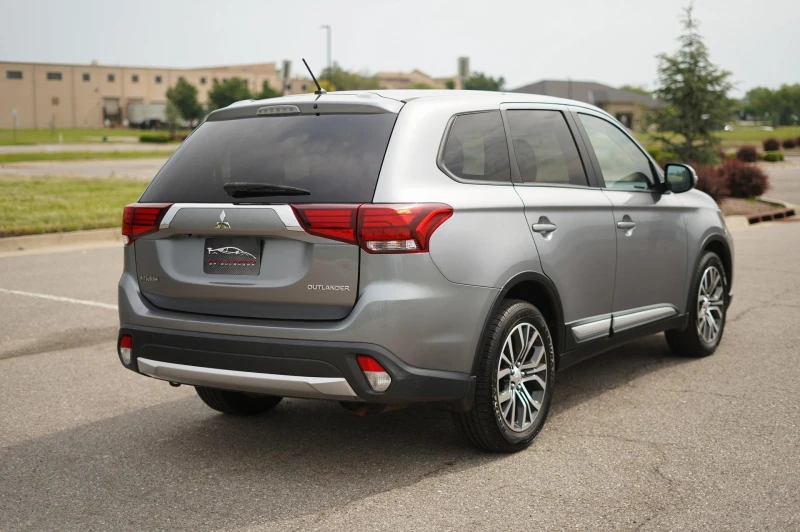
Main Trims and Configurations Available in the US
In the US, the Mitsubishi Outlander generation III was offered in several trims tailored to American preferences: strong emphasis on AWD, advanced safety features, and comfort options. Most used examples are 2.0 or 2.4 with CVT and Super All-Wheel Control.
- ES / Base — entry-level: cloth seats, single-zone AC, 18-inch steel wheels, six airbags, stability control, cruise control, 6.1-inch audio display, USB. Heated front seats available. Used prices typically $8,000–$11,000.
- SE / SEL — best-selling mid-trim: dual-zone climate, rearview camera, parking sensors, 18-inch alloys, leather-wrapped steering wheel, heated steering wheel/wipers area, 7-inch touchscreen. Optional third row. Used $11,000–$15,000.
- GT / SEL Premium — higher-end: leather upholstery, keyless entry/start, power liftgate, panoramic roof, blind-spot monitoring, premium audio (Rockford Fosgate 9-speaker system). Used ~$14,000–$19,000.
- GT / Limited (late models) — top-tier: adaptive cruise, forward collision mitigation, lane keep assist (post-2018), ventilated seats, head-up display option, 19-inch wheels. Full S-AWC standard. Used ~$17,000–$21,000, often with 2.4L engine.
US versions included heated mirrors, enhanced underbody protection, and optional third-row seating. On the used market, SE and SEL trims from 2016–2018 with 2.0 CVT AWD dominate.
Final Thoughts
The Mitsubishi Outlander III (2013–2021) is an excellent fit for American buyers seeking:
- Family-friendly space — optional 7 seats, massive cargo area, roomy cabin;
- Easy daily driving — manageable size, smooth CVT, good fuel economy;
- Light adventure capability — capable AWD for snow, gravel roads, roof rails for bikes/skis.
Standout advantages: shared Nissan parts keep maintenance affordable ($250–$400/year typical), top-tier safety ratings, and strong resale value for the class. In 2025–2026, it offers great value as a reliable Japanese alternative to newer budget crossovers, with many examples easily exceeding 200,000 miles.
Buying tips:
- Have the CVT inspected for shuddering; fluid changes every 30,000 miles recommended;
- Check for rust on wheel arches and underbody (especially northern or salted-road examples);
- Verify mileage with CARFAX or similar (odometer rollback is a known issue);
- Avoid ex-fleet or high-mileage rental cars;
- Third-row seating is best for kids — it reduces cargo space significantly when in use.
If you're hunting for a versatile used SUV in the $12,000–$20,000 range, the Mitsubishi Outlander 2013-2021 — especially post-2016 facelift models in SEL or GT trim — remains one of the smartest picks on the market.