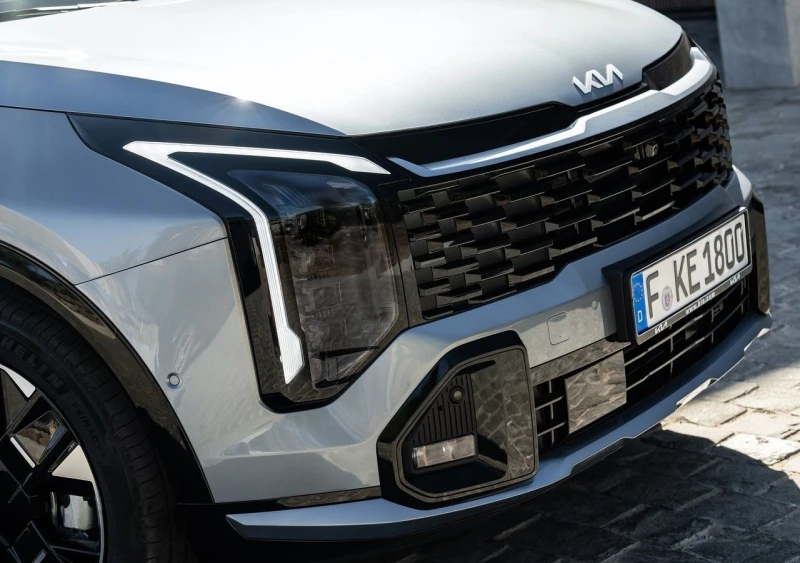
The fifth-generation Kia Sportage sold in the United States arrived for the 2023 model year. Kia service documentation refers to this generation as NQ5/NQ5a, while Kia describes the underlying architecture as the N3 platform. As of September 2026, the 2027 model year is on sale in the U.S. The lineup includes a 2.5-liter gasoline model, a turbocharged hybrid (HEV), and a turbocharged plug-in hybrid (PHEV).
The most important points for U.S. buyers are not the same as on European or Ukrainian versions:
- Gasoline powertrain and fuel economy: U.S.-spec nonhybrid models use a 187-hp 2.5-liter four-cylinder with an 8-speed automatic, not the 1.6 T-GDi/DCT combination found in some other markets. Performance is adequate for everyday driving but independent tests have consistently described acceleration as relaxed. EPA fuel economy also varies by drivetrain and trim; for the 2026 model year, ratings range from 24 mpg combined for the X-Pro Prestige AWD to 28 mpg combined for front-wheel-drive versions.
- Hybrid differences by model year: 2023–2025 Sportage Hybrid models are rated at 227 hp, while the refreshed 2026 model increased combined output to 232 hp. The hybrid uses a 6-speed automatic. Fuel economy depends heavily on drivetrain and model year: for example, the 2025 Hybrid was rated at 43 mpg combined in LX FWD form and 38 mpg combined with AWD, while 2026 ratings are 42 mpg combined for LX FWD and 35 mpg combined for AWD trims.
- PHEV range and complexity: the U.S. Sportage PHEV is AWD-only and uses a 1.6-liter turbo engine with a 6-speed automatic. Output was 261 hp for 2023–2025 and increased to 268 hp for 2026. The 2026 PHEV retains a 13.8-kWh battery and an EPA-rated 34 miles of electric range. Buyers should confirm that the charging equipment works correctly and have the high-voltage system checked if warning messages or charging faults are present.
- Infotainment and controls: 2023–2025 cars with the larger screen use Kia's earlier interface and a shared touch-sensitive climate/audio control panel. The layout can take time to learn because the same knobs change function depending on the selected mode. The 2026 refresh introduced Kia's newer ccNC system and wireless Apple CarPlay and Android Auto across the refreshed lineup.
- Cabin materials and road noise: glossy black trim around frequently touched controls shows fingerprints and light scratches easily. Noise is better treated as a test-drive item than a universal defect: some road tests found the cabin quiet, while others noted more wind noise at highway speeds, particularly in the PHEV.
- Recalls matter more than anecdotal “common problems”: this generation has had several VIN-specific U.S. safety recalls. A used-car inspection should therefore include an NHTSA VIN check rather than relying on forum lists or generalized reliability claims.
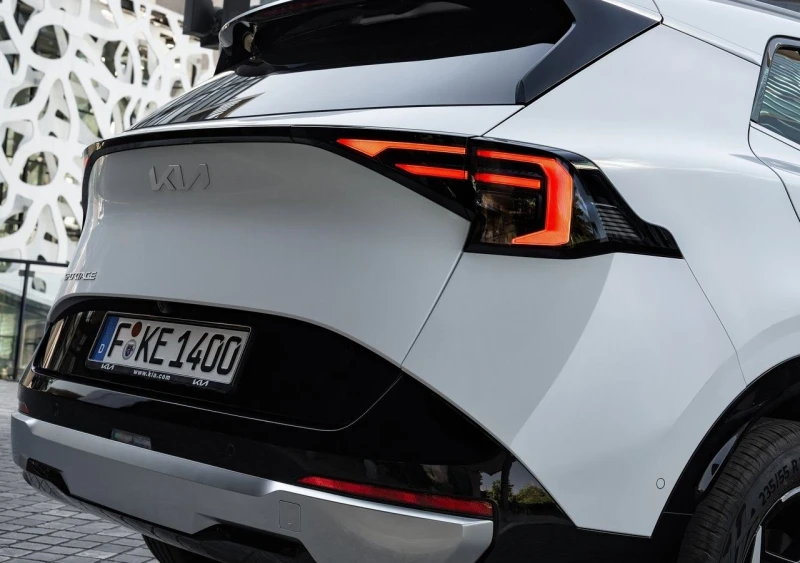
Model years and changes — what to watch
The fifth-generation Sportage began with the 2023 model year in the United States. The main year-by-year differences are:
- 2023: first U.S. model year of the redesigned Sportage. Certain vehicles were recalled under NHTSA campaign 23V298 because the 4.2-inch instrument-cluster display could fail to boot correctly; the remedy was a software update. A separate recall, 23V410, covered certain 2023 Sportage vehicles because a brake-booster diaphragm could cause a loss of power brake assist.
- 2024–2025: the core U.S. powertrains remained the 187-hp 2.5-liter gasoline engine, 227-hp Hybrid, and 261-hp PHEV. Certain 2023–2024 U.S.-built Sportage vehicles without roof rails were recalled under 24V025 because roof molding could loosen or detach. A much smaller 2024 recall, 24V422, covered certain gasoline Sportage vehicles built at Kia Georgia because a defect in the motor-driven power-steering power pack could cause loss of steering assist.
- 2026: major refresh with revised exterior styling and updated cabin technology. Hybrid output rose to 232 hp and PHEV output to 268 hp; the 2.5-liter gasoline model remained at 187 hp. Certain 2026 Sportage, Sportage Hybrid, and Sportage PHEV vehicles were included in NHTSA campaign 26V046 for a software error that could cause the instrument-panel display to fail; the remedy is an over-the-air or dealer software update.
- 2027: current U.S. model year as of September 2026. The gasoline range is largely a carryover from 2026, the PHEV returns unchanged, and the Hybrid lineup expands front-wheel-drive availability to additional S and EX trims.
Recall campaigns do not automatically apply to every vehicle of a given model year. Check the specific VIN with NHTSA and Kia, and verify that all applicable remedies have been completed.
Used Kia Sportage market in the United States
Used fifth-generation Sportage models are widely listed through U.S. marketplaces such as Autotrader, CarGurus, and Cars.com. Because the generation is still in production, the used market overlaps with new 2026 and 2027 inventory. Asking prices vary substantially by powertrain, trim, mileage, region, accident history, and whether the vehicle is certified pre-owned, so a single nationwide price range can be misleading.
What to check before buying:
- VIN and recall status: verify open recalls through NHTSA and confirm completed campaign work in service records.
- Correct U.S. powertrain: gasoline models use the 2.5-liter engine and 8-speed automatic; HEV and PHEV models use a 1.6-liter turbo engine with a 6-speed automatic. The U.S. fifth-generation Sportage does not use the 1.6 T-GDi/DCT setup commonly discussed for some overseas versions.
- Hybrid and PHEV diagnostics: check for stored fault codes, warning lights, charging errors, and abnormal battery behavior. For a used PHEV, a battery-health assessment is more useful than assuming a fixed percentage of degradation based only on mileage.
- Infotainment and updates: test the instrument cluster, touchscreen, cameras, USB ports, phone integration, and wireless charging where equipped. Confirm that recall and infotainment software updates have been performed.
- Tires, alignment, and suspension: inspect tread wear across all four tires, especially on AWD and PHEV versions, and listen for suspension noise over broken pavement. Uneven wear can point to alignment or previous suspension damage rather than a model-wide defect.
- Body and repair history: inspect paintwork, panel gaps, underbody damage, glass, and ADAS sensor areas. On vehicles that have had collision repairs, verify that cameras and radar-based driver-assistance systems were calibrated correctly.
- Trim-specific equipment: panoramic roofs, Harman Kardon audio, surround-view cameras, ventilated seats, and advanced driver-assistance features depend on trim and model year. Do not assume that an LX, EX, X-Line, SX, or SX-Prestige has the same equipment across gasoline, HEV, and PHEV versions.
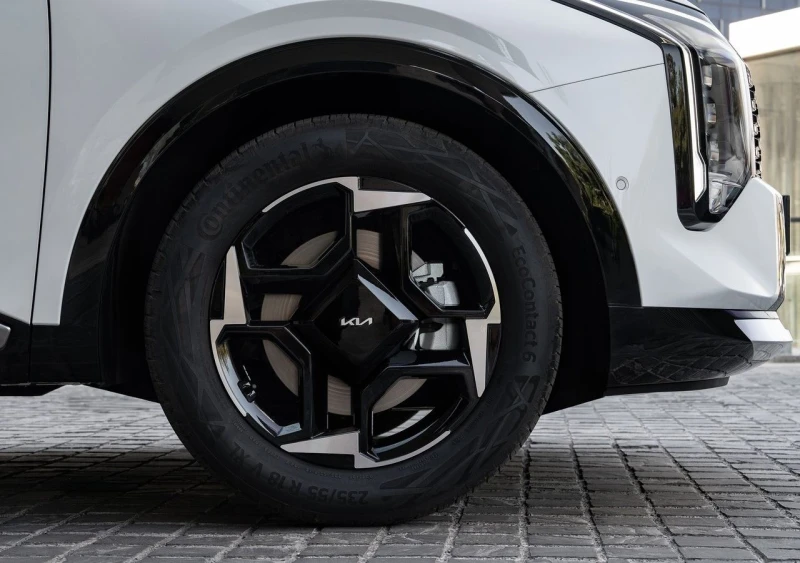
What can be addressed and what to budget for
Most purchase-related concerns fall into three groups: recall work, normal wear, and powertrain-specific diagnostics.
- Open safety recalls should be completed by an authorized Kia dealer. Recall remedies are performed without charge to the owner.
- Software-related issues may be resolved by applicable dealer or over-the-air updates, depending on model year and system.
- Worn tires, alignment issues, brake wear, and cosmetic interior damage are ordinary used-car expenses and should be priced after inspecting the individual vehicle.
- For HEV and PHEV models, budget for a proper pre-purchase scan of the hybrid system rather than relying only on a short test drive.
- For PHEV models, verify the charge port, portable charging equipment if included with the sale, and charging operation on a 240-volt source when practical.
- Do not apply overseas maintenance advice blindly. U.S. gasoline Sportage models use an 8-speed automatic, while HEV and PHEV versions use a 6-speed automatic; this generation's U.S. lineup does not use the DCT referenced in some international guides.
A sensible reserve for a used Sportage depends on mileage, tire condition, trim, service history, and whether any recall or warranty work remains outstanding. A pre-purchase inspection and VIN-specific history check are more useful than applying a fixed percentage of the vehicle's price.
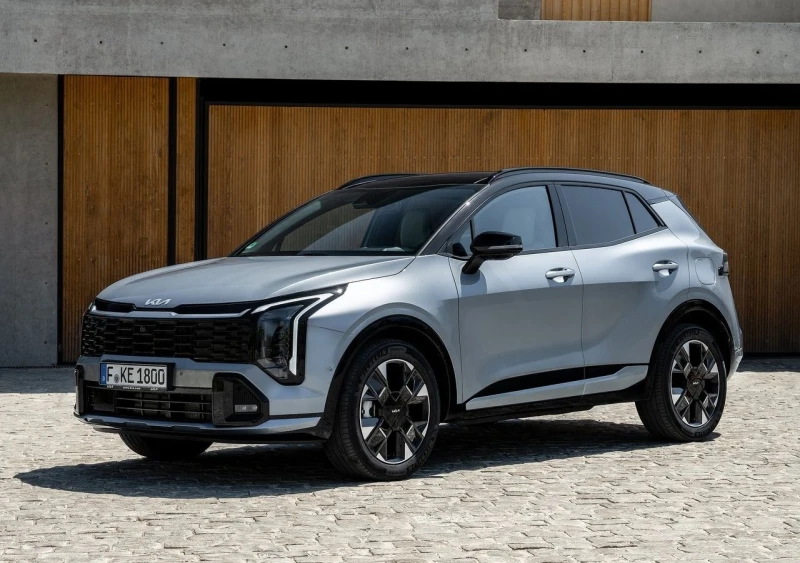
Conclusions and buying checklist
The fifth-generation Kia Sportage is still a current model in the United States, but the U.S. version differs significantly from European and Ukrainian specifications. The 2.5-liter gasoline model is the straightforward nonhybrid choice but gives up some acceleration and fuel economy to the electrified versions. The Hybrid offers stronger performance and lower fuel use, while the PHEV adds 34 miles of EPA-rated electric range but makes the most sense when the buyer can charge regularly.
For early 2023–2024 vehicles, recall completion deserves particular attention. For 2026 models, verify the instrument-panel software recall status. Across all model years, the condition and history of the individual vehicle matter more than generalized claims about battery degradation, suspension durability, or “problem-free” engines.
Before buying a new or used Sportage, check:
- the VIN for open NHTSA and Kia recalls;
- powertrain, trim, and drivetrain against the original U.S. specification;
- instrument cluster, infotainment, cameras, and driver-assistance systems;
- hybrid or PHEV fault codes and charging operation where applicable;
- tires, alignment, brakes, suspension, and underbody condition;
- service, ownership, and collision-repair history.
For an overview of the generation, technical specifications, and interior, see the other articles in this series.