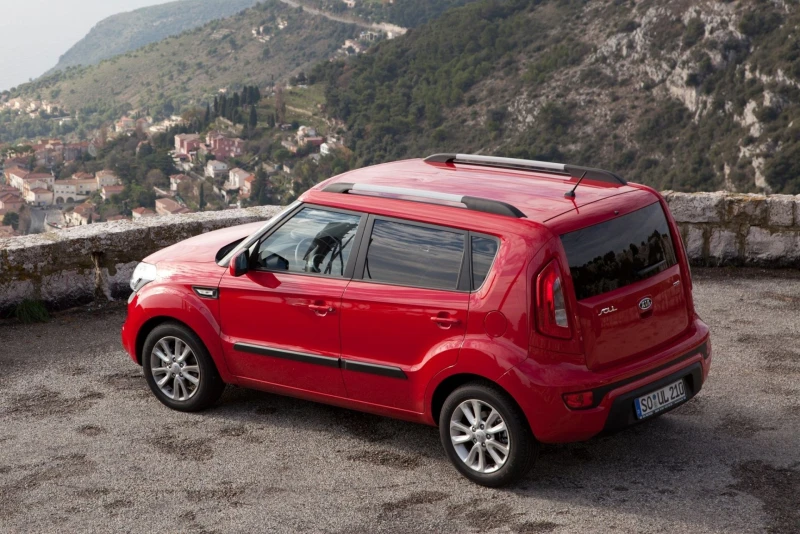
After production ended in 2014, used car lots across the US are dominated by 2011–2013 models with 50,000–93,000 miles on the odometer. The mechanical condition often becomes the deciding factor when shopping for one. Design, interior, and trim details are covered in other articles in this series — here we focus on the engines, transmissions, dimensions, and features that directly impact daily driving and long-term ownership costs.
Powertrains: Simple Construction and Proven Reliability
The engine range for the first-generation Kia Soul was built around naturally aspirated gasoline engines with port fuel injection. All-wheel drive was never offered — every version was front-wheel drive, which suited the urban and suburban needs of most American drivers perfectly. Gasoline models ruled the US market: the 1.6 MPI quickly became the most common powerplant thanks to its simplicity and decent fuel economy. The 2.0-liter engine appeared less frequently, usually in higher trims. Diesel versions were not offered on the official US market and remain very rare.

| Engine Type | Displacement | Power | Transmission | Drivetrain |
| Gasoline Gamma 1.6 MPI | 1.6 L | 124 hp | 5-speed Manual / 4-speed Automatic | Front-wheel |
| Gasoline 2.0 MPI | 2.0 L | 142 hp | 5-speed Manual / 4-speed Automatic | Front-wheel |
| Diesel U 1.6 CRDi (rare) | 1.6 L | 126–128 hp | 5-speed Manual / 4-speed Automatic | Front-wheel |
Both gasoline engines use a timing chain and come from proven families that run reliably on regular unleaded gasoline (87 AKI). They don’t require premium fuel or special care beyond following the recommended service schedule. The 1.6 MPI remains the favorite for US owners: straightforward, thrifty around town, and still going strong at 125,000–155,000 miles. The 2.0 MPI feels more energetic on the highway and works better when you regularly carry passengers or cargo.
Transmissions and How They Perform on American Roads
The four-speed automatic found in early cars and the five-speed manual are both regarded as dependable when fluid and filters are changed on schedule. Six-speed units arrived later and deliver improved efficiency along with smoother operation. No major transmission problems are commonly reported as long as the fluid is refreshed every 37,000–50,000 miles. In real-world use, the automatic with the 1.6-liter engine is often praised as the sweet spot for city driving — it shifts smoothly and asks very little in terms of maintenance.

Dimensions & Weight: Compact Size with Useful Ground Clearance
The Kia Soul I rides on a platform with a 100.4-inch wheelbase that allowed Kia to create a tall, roomy body without making the car overly long. Ground clearance of 6.5 inches remains a practical advantage on US roads: the Soul clears most speed bumps, handles potholes in older cities, and can manage light gravel or fire roads without scraping. Overall dimensions stayed consistent through the entire production run, including the small updates of 2011–2012.
| Parameter | Value | Note |
| Length, in | 161.6 | Hatchback |
| Width, in | 70.3 | Excluding mirrors |
| Height, in | 63.4–65.4 | Depending on trim level |
| Wheelbase, in | 100.4 | Creates a spacious cabin |
| Curb weight, lbs | 2,579–2,965 | Depends on engine and equipment |
| Gross vehicle weight, lbs | 3,307–3,748 | Maximum allowable |
| Ground clearance, in | 6.5 | Helpful on US roads and light trails |
The modest curb weight and balanced proportions help with both handling and fuel economy. The Soul stays easy to maneuver in tight parking lots and feels composed on long highway runs.
Updates During the Generation and Popular Configurations
Over its five-year run, the Soul AM received several small updates: engine mapping was refined, transmissions were improved, and minor electronic changes were introduced. The powertrain selection itself stayed almost unchanged — no new engines or completely different gearboxes appeared. On the US market this means that 2012–2014 examples are mostly distinguished from earlier cars by small gains in refinement and reliability while keeping the same simple, durable mechanical layout.
The most sought-after versions today are still the 1.6 MPI with 124 hp and automatic transmission for around-town duty, along with the 2.0 MPI with 142 hp and either manual or automatic for drivers who log serious highway miles.
Real-World Ownership and What the Numbers Say
US owner forums and used-vehicle data show that Soul I engines routinely reach 125,000–155,000 miles with good care. The most important habits are regular oil changes every 6,000–7,500 miles and using quality fuel. Real-world combined fuel economy for the 1.6 MPI typically lands between 26–34 MPG, while the 2.0 MPI usually returns 22–29 MPG depending on how you drive, how much you carry, and road conditions.
Transmissions earn few complaints when serviced properly. Parts — both OEM and quality aftermarket — are easy to find everywhere in the US. Repairability is excellent: these engines and gearboxes were built to be worked on, not thrown away, which matters a lot when buying used.
All things considered, the mechanical package of the Kia Soul I (AM) delivers a strong balance of purchase price, running costs, fuel efficiency, and resale value for typical American driving. In the 2026 used-car market the model is still relevant precisely because its straightforward engineering provides efficiency and enough performance for daily life without high maintenance bills.