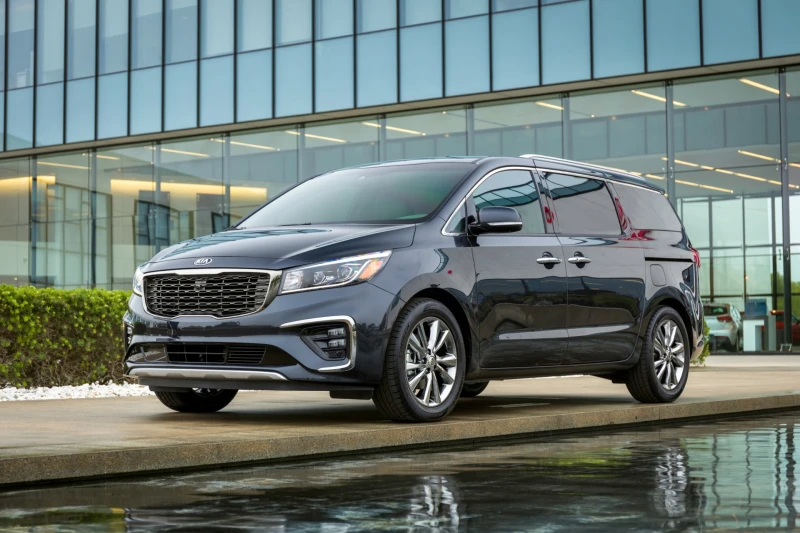
Production of the third-generation model has ended, and the Sedona name itself disappeared from the U.S. lineup after the 2021 model year, when Kia replaced it with the 2022 Carnival. That makes the YP-generation Sedona a straightforward used-vehicle proposition: depreciation has already done much of its work, there is a meaningful supply of owner and dealer listings, and buyers can judge the van on established service history rather than new-model hype. It remains relevant for school runs, commuting, airport trips and long interstate drives, especially for shoppers who want a conventional gasoline minivan without the higher prices attached to many newer alternatives.
What Changed from the Previous Generation
Compared with the second-generation Sedona, the YP model introduced for the 2015 model year moved to a newer platform and adopted a more carlike driving position, a stiffer body structure and a noticeably more polished cabin. It still feels substantial from behind the wheel, but body control, highway stability and interior refinement are better suited to everyday family use. For U.S. buyers, that matters because a minivan of this size often has to cover several roles at once: daily transportation, weekend hauling and long-distance travel with every seat occupied.
The major U.S.-market update arrived for the 2019 model year. Along with revised front and rear styling and updated lighting, Kia paired the existing V6 with an eight-speed automatic transmission in place of the earlier six-speed unit. The change did not transform the Sedona into a sporty vehicle, but it gave later examples a broader spread of ratios and slightly improved the official combined fuel-economy rating. As a result, clean 2019–2021 vans often command more than comparable pre-refresh models.
The 3.3-Liter V6: The Only U.S. Engine
Every third-generation Sedona officially sold new in the United States used a 3.3-liter gasoline direct-injection V6 rated at 276 hp and 248 lb-ft of torque, with front-wheel drive. Model years 2015–2018 used a six-speed automatic, while 2019–2021 models received an eight-speed automatic. The 2.2-liter CRDi diesel found in South Korea, Europe and several other markets was not part of the U.S. new-vehicle lineup, so American buyers should not mix diesel-specific advice with the specifications of a domestic-market Sedona.
EPA figures varied slightly by model year and trim. Many 2015 versions were rated at up to 18 mpg city, 24 mpg highway and 20 mpg combined, while the full 2021 lineup carried 18/24/21 mpg ratings. These are laboratory estimates rather than guarantees: short trips, winter idling, heavy traffic, roof-mounted cargo and a fully loaded cabin can reduce real-world economy. Highway-oriented use is generally the better fit for a large, naturally aspirated minivan like this.
A pre-purchase inspection should focus on evidence of consistent maintenance rather than broad claims that the engine is either flawless or inherently troublesome. Listen for abnormal noise during a cold start, check for fluid leaks and warning lights, confirm smooth acceleration under load, and test the transmission from cold and after it reaches operating temperature. A scan for stored diagnostic codes is worthwhile even when the dashboard is clear. Service records, correct fluid levels and a clean road test are more useful than relying on mileage alone.
Seating, Configuration and Everyday Practicality
Depending on model year and trim, the U.S.-spec Sedona was configured for seven or eight occupants. Many versions used Kia's Slide-N-Stow second-row seats, while certain upscale configurations substituted more comfort-oriented second-row seating. The third row is a 60/40-split bench that folds into the rear floor. Buyers should verify the exact layout of the individual van rather than assuming every LX, EX or SX has the same number of seats or the same folding mechanism.
With the third row folded, the Sedona can handle strollers, luggage, bicycles and bulky household purchases; folding or moving the second row opens considerably more space. Power sliding doors and a power liftgate were standard on some trims and optional or unavailable on others, particularly early base models. During inspection, operate each door repeatedly from the key fob, exterior handle, overhead controls and interior switches, then watch for hesitation, unusual noise or incomplete latching.
Cabin equipment varies widely across the generation. Early vans ranged from fairly basic L and LX models to well-equipped EX, SX and SX Limited versions, while the 2021 lineup consisted of LX, EX and SX trims. Depending on year and equipment, features can include front and rear climate controls, leather upholstery, heated or ventilated seats, a rearview or surround-view camera, driver-assistance systems and upgraded infotainment. Confirm the actual feature list and test every powered function, because trim names and option packages changed over time.
Used Prices in the United States in 2026
Listings on Cars.com, CarGurus and Autotrader show a wide spread because mileage, trim and condition vary sharply. As a practical mid-2026 guide, many 2015–2017 Sedonas fall roughly in the $7,000–$13,000 range, while 2018–2019 examples commonly appear around $11,000–$18,000. Cleaner 2020–2021 vans with lower mileage are often listed near $14,000–$22,000, although unusually high-mileage, damaged, rebuilt-title or very low-mileage vehicles can sit well outside those bands. These are asking-price ranges, not official valuations or guaranteed transaction prices.
Vehicle history has a major effect on value. Private-use vans with documented maintenance, a clean title and fully functioning doors usually justify a premium over former rental, fleet or commercial vehicles. Regional factors matter as well: corrosion exposure in snow-belt states, sun damage in hot climates and prior collision repairs can all change what an apparently similar Sedona is worth. A low listing price is a reason to investigate the title, mileage and repair needs, not proof by itself that the vehicle is a bargain or a problem.
What to Check Before Buying
Start with the powertrain, cooling system, brakes, tires and suspension, then move through every cabin and door function. Pay particular attention to the sliding-door tracks, rollers, latches, wiring and power operation. Some 2015–2018 Sedonas with power sliding doors were included in a safety recall involving the automatic reversal logic, so the VIN should be checked for completed and outstanding recalls through the NHTSA or a Kia dealer. Also inspect the underbody for corrosion, confirm even tire wear and make sure the air conditioning works from both the front and rear controls.

An independent pre-purchase inspection is especially valuable when service records are incomplete. Ask the shop to scan all control modules, inspect for leaks and previous collision repairs, road-test the van at city and highway speeds, and verify that the charging system and battery are healthy. A CARFAX or AutoCheck report can provide useful history, but it does not replace a physical inspection and may not contain every repair or incident.
In the U.S. used-minivan market, the Sedona is commonly cross-shopped with the Honda Odyssey, Toyota Sienna, Chrysler Pacifica and the final-generation Nissan Quest. Kia's main appeal is often value: similarly aged examples may list for less than the best-known Japanese competitors while still offering a strong V6 and flexible seating. Its limitations are equally clear. Every U.S.-market YP Sedona is front-wheel drive, fuel economy is modest by current standards, and the second-row seats are not as easy to remove or stow as the most versatile systems in some rivals.
Overall, the 2015–2021 Kia Sedona remains a sensible used choice for buyers who need genuine minivan space and prefer a conventional gasoline powertrain. The best purchase is not automatically the newest or cheapest listing, but the van with the clearest history, the right seating layout and no unresolved mechanical, electrical or recall issues. A careful inspection can make the difference between an affordable family vehicle and an example that immediately requires expensive deferred maintenance.