


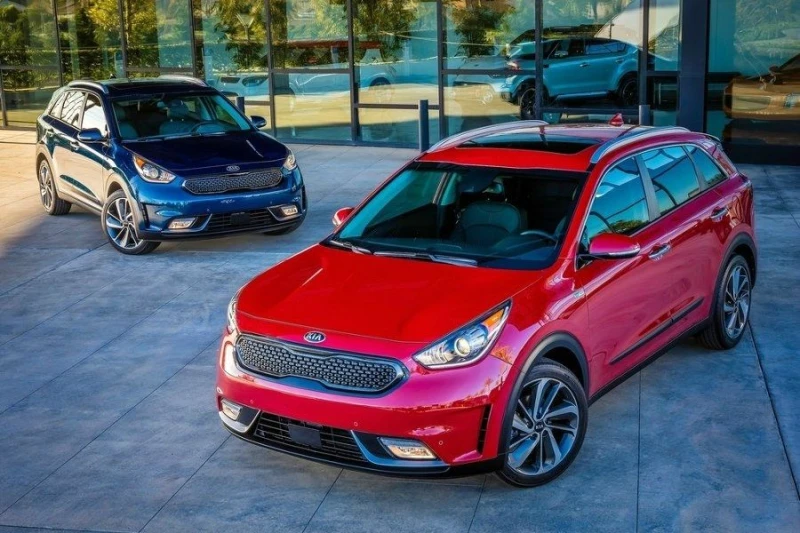
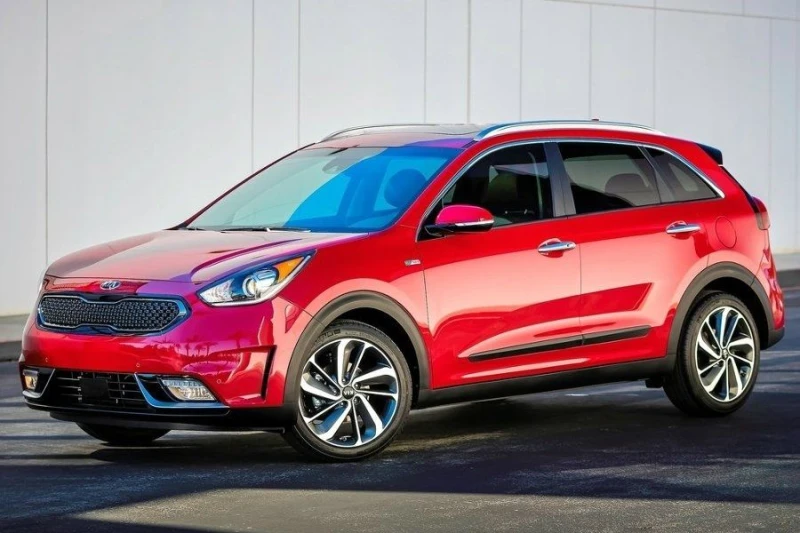
The first-generation Kia Niro (DE) reached U.S. dealerships for the 2017 model year and continued through 2022. In the United States, it was sold only with front-wheel drive: as a conventional hybrid (HEV), a plug-in hybrid (PHEV) beginning with the 2018 model year, and the fully electric Niro EV beginning with the 2019 model year. Each version has different inspection priorities on the used market.
The main points commonly raised by owners and used-car shoppers include:
- Fuel economy and driving range: EPA ratings vary by trim and powertrain. The 2017 hybrid was rated at 43–50 mpg combined depending on trim, while the first-generation PHEV was rated at about 46 mpg combined after its usable electric charge was depleted and offered roughly 26 miles of EPA-rated electric range. The 64-kWh Niro EV carried a 239-mile EPA range rating. Actual results can fall in cold weather, at sustained highway speeds, or with inefficient tires.
- Six-speed dual-clutch transmission behavior: HEV and PHEV models use a six-speed DCT rather than a conventional automatic or CVT. Some low-speed engagement, hesitation, or driveline vibration can be characteristic of this layout, but persistent shuddering, slipping, warning lights, or a burning odor require professional diagnosis.
- Hydraulic clutch actuator recall: certain 2017–2022 Niro Hybrid and 2018–2022 Niro Plug-in Hybrid vehicles were recalled because fluid could contaminate the hydraulic clutch actuator circuit board and increase the risk of an engine-compartment fire. Recall completion should be confirmed by VIN through NHTSA or a Kia dealer.
- Infotainment and connectivity: early cars generally use smaller 7-inch systems, while the 2020 refresh introduced an 8-inch standard touchscreen and an available 10.25-inch navigation display on selected trims. Slow pairing, outdated maps, or intermittent phone integration may be software-related, so installed updates and all USB, Bluetooth, audio, and camera functions should be tested.
- Road noise and interior materials: tire and wheel noise can be noticeable on coarse pavement, particularly on versions with larger wheels. Hard plastics in lower cabin areas also scratch relatively easily. These are refinement concerns rather than automatic signs of mechanical trouble.
- Specialized hybrid and EV service: diagnosis of the high-voltage battery, inverter, charging system, and related electronics requires suitable scan tools and trained technicians. Before purchase, obtain a complete fault-code scan and a documented battery health assessment instead of relying only on the dashboard range estimate.
Versions and model years: what deserves attention
The DE-generation is no longer sold new in the United States. Its U.S. history is best divided by powertrain launch and the 2020 refresh:
- 2017–2019 model years: the hybrid arrived first in FE, LX, EX, and Touring-oriented trims; the PHEV followed for 2018, and the 64-kWh Niro EV for 2019. On early HEV and PHEV cars, verify recall work, DCT operation, software updates, and complete service records. On the EV, check battery condition, charging performance, and whether the supplied charging equipment matches the vehicle.
- 2020 refresh: exterior styling and the dashboard were updated, with an 8-inch touchscreen standard on many versions and a 10.25-inch navigation display available on selected trims. The refresh improves cabin technology, but it should not be treated as proof that an individual vehicle is mechanically better; condition and maintenance history remain more important.
- 2021–2022 model years: these are the final U.S. model years of the first generation. Trim names differed among HEV, PHEV, and EV versions, but all retained their established powertrain layouts. Later cars may have newer driver-assistance and infotainment features, yet buyers still need to verify recalls, charging or hybrid-system operation, and any remaining warranty coverage for the specific VIN.
There is no sound basis for assigning a fixed battery-degradation percentage to a model year. A battery state-of-health test, fault-code scan, charge test, and review of the vehicle’s climate and charging history are more useful than generalized claims.
The U.S. used-car market
First-generation Niro models are widely listed through Autotrader, CarGurus, Cars.com, franchised dealers, and independent retailers. In mid-2026, asking prices for ordinary clean-title examples generally span from the low-$10,000s to the low-$20,000s, with large differences based on model year, mileage, powertrain, trim, location, accident history, and battery condition. Very cheap listings require especially careful title and damage checks.
Key U.S.-market considerations include:
- Body and underbody condition: inspect for collision repairs, uneven panel gaps, overspray, damaged splash shields, and impacts underneath the car. In snow-belt states, also check suspension hardware, brake components, seams, and fasteners for corrosion.
- Recall and campaign history: run the VIN through the NHTSA recall database and ask a Kia dealer to confirm completed campaigns. A seller’s statement that the car is “up to date” is not a substitute for a VIN-specific record.
- Service documentation: favor vehicles with invoices showing correct fluids, cooling-system work, software updates, and hybrid or EV inspections. Missing records do not prove a defect, but they increase uncertainty and should affect the inspection depth and purchase price.
- Charging hardware and ports: U.S.-spec Niro PHEV models use a J1772 inlet for Level 1 and Level 2 charging and do not support DC fast charging. The first-generation U.S. Niro EV uses J1772 for AC charging and CCS Combo 1 for DC fast charging. Test the applicable port and confirm that any portable charging cable is present and undamaged.
- Mileage and title verification: compare the odometer with service records, inspection entries, Carfax or AutoCheck history, and module data where available. Check carefully for salvage, rebuilt, manufacturer buyback, flood, or prior commercial-use disclosures.
- Powertrain-specific inspection: on HEV and PHEV cars, test smooth engagement from a stop, reverse operation, and transitions between gasoline and electric power. On the EV, complete an AC charge test when possible and review battery health, fast-charging history, warning messages, and thermal-management faults.
- Typical U.S. trims: first-generation listings include HEV versions such as FE, LX, EX, Touring, LXS, Touring Special Edition, and EX Premium; PHEV versions such as LX or LXS, EX, and EX Premium; and Niro EV models most commonly advertised as EX or EX Premium. Equipment should always be decoded by VIN because trim names and packages changed by year.
What can be corrected and how to budget
Many age-related items are straightforward, but hybrid, PHEV, and EV faults can become expensive if diagnosis is skipped:
- Replacing worn or mismatched tires and correcting alignment can reduce noise, vibration, and uneven wear.
- Infotainment, navigation, and control-module updates may resolve some software symptoms; recall work should be completed by an authorized dealer at no charge when applicable.
- Scratched trim, worn seat surfaces, and damaged cargo-area panels are usually cosmetic and can be priced separately from mechanical repairs.
- Suspension bushings, wheel bearings, brakes, and the 12-volt battery should be assessed like those on any used compact crossover.
- In rust-prone regions, cleaning and protecting the underbody may be worthwhile after any existing corrosion or damage has been properly evaluated.
- Maintenance intervals and approved fluids vary by model year and powertrain. Follow the U.S. owner’s manual for the exact VIN rather than applying a generic DCT-fluid interval or a schedule from another market.
Set aside money first for a pre-purchase inspection, battery or hybrid-system diagnostics, and overdue routine maintenance. The reserve should be larger for cars with incomplete records, warning lights, accident history, charging faults, or abnormal DCT behavior; a fixed percentage of purchase price is not meaningful across all three powertrains.
Conclusions and recommendations
A first-generation Kia Niro can still be a practical used vehicle in 2026, but the right choice depends on how it will be used. The HEV suits drivers who cannot charge regularly, the PHEV makes the most sense when it can be plugged in consistently, and the Niro EV requires a realistic assessment of local charging access, winter range, and battery condition.
Model years 2020–2022 offer the refreshed cabin and newer infotainment options, but they are not automatically the safest purchase. A well-documented earlier car with completed recalls and a clean inspection may be preferable to a neglected later example.
During the inspection and test drive, pay particular attention to:
- VIN-specific recall completion and warning lights
- high-voltage battery health, fault codes, and charging performance
- DCT engagement and hydraulic clutch actuator history on HEV and PHEV models
- driver-assistance cameras, radar sensors, and calibration after collision repairs
- title history, underbody damage, corrosion, tires, brakes, and suspension noise
Separate articles in this series cover the generation overview, U.S.-market specifications, and interior details.