


However, this is precisely what has occurred. Jaguar has officially discontinued production of all its models. Not just one lineup or a few vehicles — all of them. Currently, the brand has no serial automobiles in production. The next steps remain to be determined.
British Legacy Spanning Decades
Jaguar's history has involved multiple ownership changes, strategic shifts, and evolving priorities, often accompanied by challenges. The brand has undergone repeated reconfigurations, with varying degrees of clarity on its core purpose. The current owners, Tata Motors, have continued this pattern.
This process is officially termed a "transformation." In practice, it resembles a major restructuring with uncertain outcomes. Management describes it as a path to a promising future, though it appears as a venture into uncharted territory.
The Sequence of Events
Jaguar is adhering to a pre-announced plan. The first vehicle of the new era — the conceptual Type 00 — is scheduled to reach the market by the end of 2026. Until then, the company has opted to produce nothing. Dealers have no inventory to sell, leading many to close, while others may transition into luxury outlets for electric vehicles.
Models Now Discontinued
- XE and XF — removed from production
- XJ — long discontinued
- E-Pace — no longer manufactured
- I-Pace — even the electric flagship archived
The F-Pace was the last to remain. Notably, it was the oldest in design among Jaguar's contemporary models. However, it did not survive the overhaul — final orders have been fulfilled, and the assembly line has stopped.
F-Pace Phase-Out and Closure
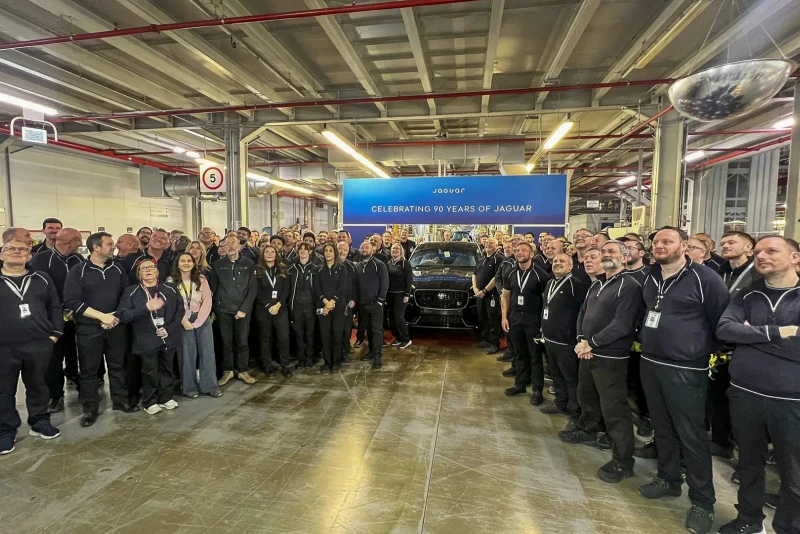
The conclusion was marked at the Solihull plant, commemorating 90 years of Jaguar vehicle production and the 10th anniversary of the F-Pace, followed by the cessation of operations.
The F-Pace achieved notable success. Introduced as Jaguar's first SUV in 2015 — a decision amid the presence of Land Rover in the same group — it gained market acceptance. Over 200,000 units sold positioned the F-Pace as the brand's highest-volume model historically, not a sports car or sedan, but a crossover.
Future Outlook
The current strategy involves significant risks. Jaguar is committing to premium electric models, a refreshed image, and a new customer base. This could result in a strong resurgence or a setback. Historical precedents exist for unconventional approaches yielding unexpected success.
For now, the observation is that the renowned British brand has initiated a pause, marking a notable transition point.