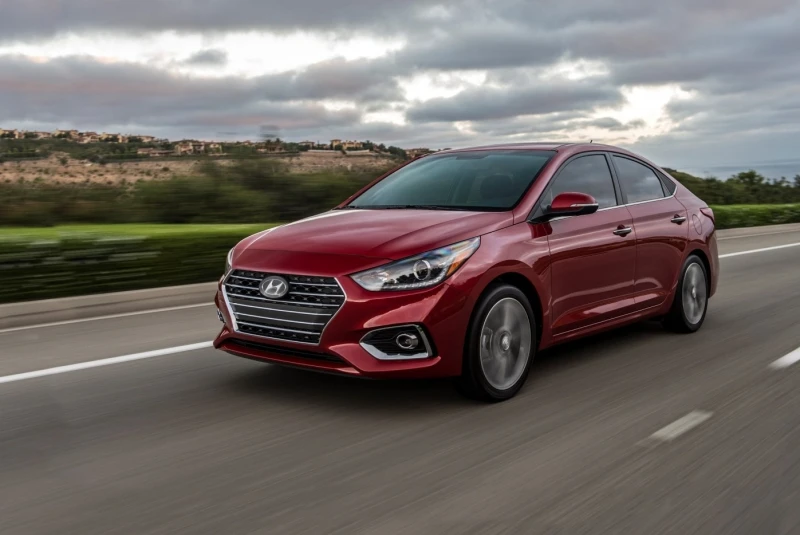
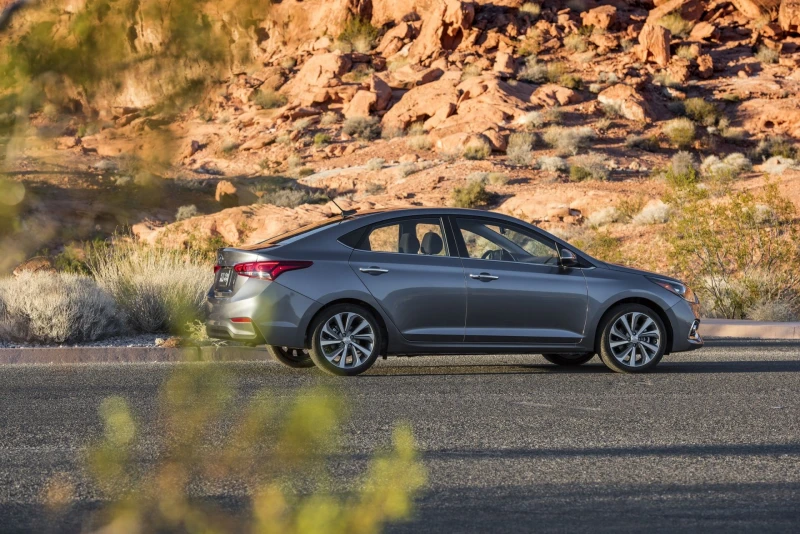
For the United States, the fifth-generation Hyundai Accent arrived for the 2018 model year as an all-new subcompact sedan. Hyundai dropped the hatchback from the U.S. lineup, so every U.S.-market Accent of this generation was a four-door sedan with front-wheel drive. The redesign brought Hyundai's cascading-grille styling, a stiffer body structure with a greater share of advanced high-strength steel, a standard rearview camera and available smartphone integration. In U.S. trim, the Accent competed mainly with cars such as the Kia Rio and Nissan Versa. The generation remained on sale through the 2022 model year; Hyundai discontinued the Accent in the United States for 2023, with the Venue becoming the brand's entry-level model.
What changed from the previous generation
The 2018 redesign was broader than a styling update. Compared with the outgoing U.S. Accent, the sedan became slightly longer and wider, while its wheelbase grew to 101.6 inches. U.S.-spec fifth-generation cars measure about 172.6 inches long, 68.1 inches wide and 57.1 inches tall, with a 13.7-cu-ft trunk. The cabin adopted a more horizontal dashboard layout and, depending on trim, either a 5-inch touchscreen or a 7-inch system with Apple CarPlay and Android Auto. The U.S. car also gained available Forward Collision-Avoidance Assist on upper trims. For 2018 and 2019, the sole engine was a 1.6-liter GDI four-cylinder rated at 130 hp and 119 lb-ft, paired with a six-speed manual or six-speed automatic. The automatic was standard on SEL and Limited, while SE could be ordered with either transmission.
U.S. lifecycle and model-year changes
The most important U.S.-market change came for 2020, and it was a powertrain update rather than the major exterior facelift seen on some overseas versions. Hyundai replaced the 130-hp direct-injected engine and six-speed automatic with a Smartstream 1.6-liter dual-port-injected four-cylinder rated at 120 hp and 113 lb-ft, plus Hyundai's Intelligent Variable Transmission (IVT). A six-speed manual remained available on the base SE through 2021. With the IVT, EPA fuel-economy ratings reached 33 mpg city, 41 mpg highway and 36 mpg combined. For 2022, the manual transmission was dropped, leaving the IVT as the only transmission across SE, SEL and Limited. Hyundai then ended U.S. Accent sales after the 2022 model year.
U.S. used-car market
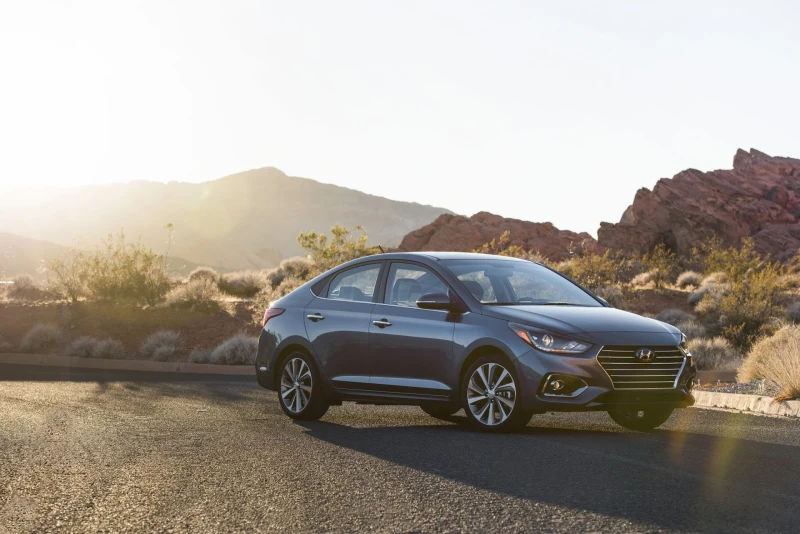
By 2026, the fifth-generation Accent is a used-car-only proposition in the United States. Listings are common on Cars.com, CarGurus and Autotrader, with price depending heavily on model year, mileage, accident history, trim and region. Nationwide CarGurus market data in September 2026 puts the average asking price at roughly $9,800 for a 2018 Accent and about $15,000 for a 2022 model; individual cars can fall well outside those averages. Early 2018–2019 cars are distinguished by the 130-hp GDI engine and conventional six-speed automatic or manual, while 2020–2022 cars use the 120-hp Smartstream engine and IVT, apart from the manual SE that remained through 2021. Buyers should compare the VIN, equipment and model year rather than assuming all fifth-generation Accents share the same powertrain.
Main U.S. trims and versions
The U.S. lineup centered on three trims: SE, SEL and Limited. Equipment changed slightly by model year, but the hierarchy remained consistent. SE served as the entry trim, typically with 15-inch steel wheels, air conditioning, cruise control, Bluetooth, a rearview camera and a 5-inch touchscreen. SEL added features such as 15-inch alloy wheels, a 7-inch touchscreen, Apple CarPlay and Android Auto, automatic headlights, heated outside mirrors and a tilt-and-telescoping steering wheel. Limited added the most comfort and safety equipment, including 17-inch alloy wheels, heated front seats, automatic climate control, a power sunroof, proximity-key access with push-button start, LED lighting on later cars and Forward Collision-Avoidance Assist. U.S. cars did not use the Ukrainian-market Classic, Comfort, Elegance or Premium trim structure, and leather upholstery, a panoramic roof and blind-spot monitoring were not defining factory features of the U.S. fifth-generation Accent lineup.
| U.S. trim | Typical key features |
| SE | 15-inch steel wheels, 5-inch touchscreen, Bluetooth, rearview camera, cruise control |
| SEL | 15-inch alloy wheels, 7-inch touchscreen, Apple CarPlay and Android Auto, automatic headlights |
| Limited | 17-inch alloy wheels, heated front seats, automatic climate control, power sunroof, push-button start, Forward Collision-Avoidance Assist |
Conclusions and current relevance
On the U.S. used market, the fifth-generation Accent offers two clearly different powertrain phases. The 2018–2019 cars combine the 130-hp 1.6 GDI engine with a six-speed manual or conventional six-speed automatic, while 2020–2022 cars use the 120-hp Smartstream 1.6 and, in most cases, the IVT. The later IVT configuration carries the strongest EPA efficiency figures at 33 mpg city, 41 mpg highway and 36 mpg combined. When shopping for a used example, verify service history, accident and title records, tire and brake condition, underbody corrosion in snow-belt regions, and transmission behavior during a road test. On 2020–2022 IVT cars, confirm smooth operation and documented maintenance; on earlier cars, check the six-speed automatic or manual for normal engagement and shift quality.
The Hyundai Accent V remains easy to find in the United States even though new-car sales ended after 2022. Its U.S. story is best understood not as a single 2018–2023 specification, but as a 2018–2022 sedan generation with a significant engine-and-transmission change for 2020 and a simplified IVT-only lineup in its final model year.