


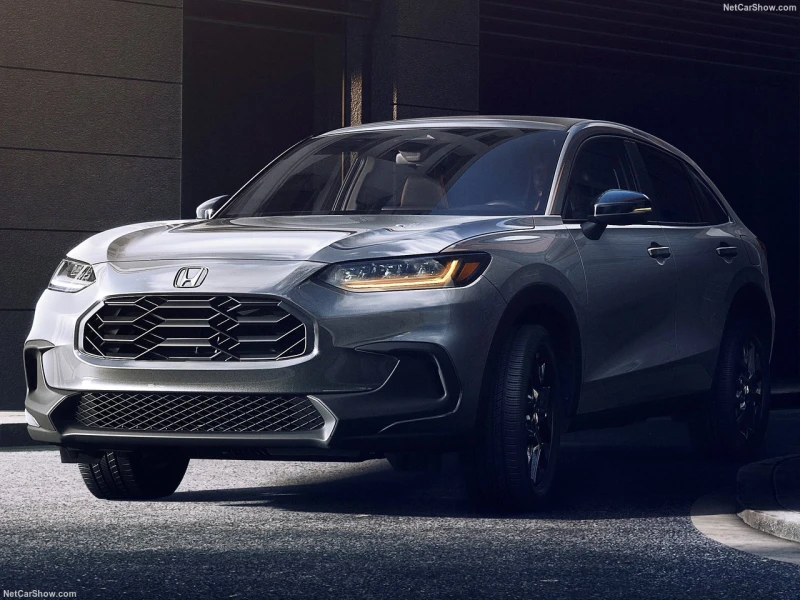
The current U.S.-market Honda HR-V arrived for the 2023 model year and is a different vehicle from the global HR-V sold in markets such as Europe and Japan. In American Honda's own model history, it is the second generation of the HR-V sold in the United States. The U.S. model uses the RZ-series architecture, with RZ1 denoting front-wheel-drive versions and RZ2 used for all-wheel-drive versions.
The American HR-V shares its basic Honda Architecture underpinnings with the 11th-generation Civic. It is a five-seat crossover with a transversely mounted engine, standard front-wheel drive and available Real Time AWD with Intelligent Control System. Unlike the European HR-V e:HEV, the U.S. HR-V is not offered with a hybrid powertrain.
In Honda's U.S. lineup, the HR-V sits below the larger CR-V. The current model is aimed at buyers who want a compact crossover with a conventional gasoline powertrain, a roomy cabin for its footprint and available all-wheel drive. Key features include Honda Sensing driver-assistance technology, a 60/40 split-folding rear seat, available heated seats and a straightforward three-trim lineup.
What changed from the previous U.S. HR-V
The redesign for the 2023 model year was substantial. Overall length increased to 179.8 inches from about 170.4 inches on the 2022 model, while wheelbase grew from 102.8 to 104.5 inches. The wider, longer body moved the HR-V closer to the compact-crossover class and created a more substantial road presence.
The previous 1.8-liter engine rated at 141 hp was replaced by a 2.0-liter DOHC i-VTEC four-cylinder producing 158 hp and 138 lb-ft of torque. A continuously variable transmission remains standard, while buyers can choose front-wheel drive or available Real Time AWD. Chassis changes were equally important: the current model uses MacPherson struts in front and a multi-link rear suspension.
One practical tradeoff is that the current U.S. HR-V no longer uses the second-row Magic Seat system found in the 2022 model. Instead, it has a conventional 60/40 split-folding rear seat. Safety equipment expanded at the redesign as well, with Honda Sensing standard across the range. The 2023 HR-V earned an IIHS Top Safety Pick+ award, and the 2025–2026 HR-V also qualifies for Top Safety Pick+ under the institute's newer criteria.
Current status of the generation
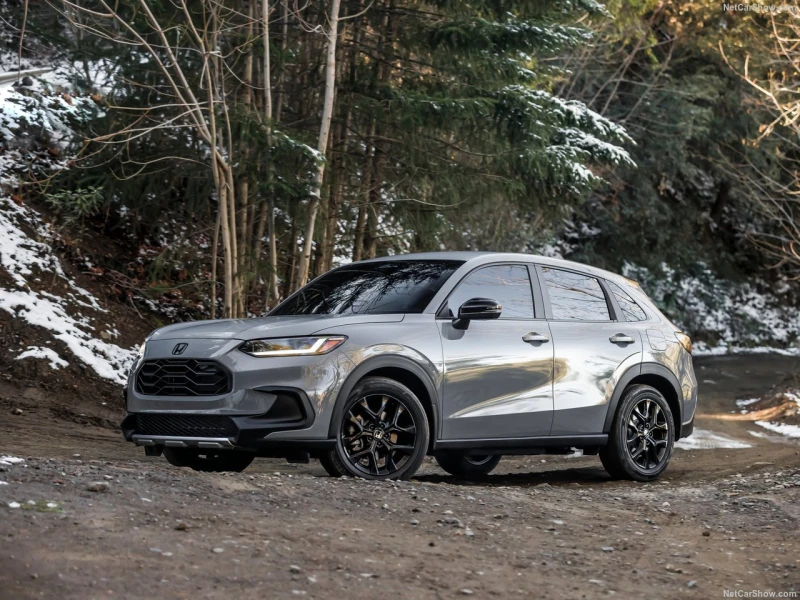
The RZ-series HR-V remains in the U.S. lineup. For the 2026 model year, Honda updated the cabin technology by making a 9-inch touchscreen, wireless Apple CarPlay, wireless Android Auto and a wireless phone charger standard across all trims. The EX-L also moved to 18-inch alloy wheels, while the Sport continues with its own gloss-black 18-inch wheels and styling details.
As of the 2027 model year, the U.S. powertrain lineup remains simple: a naturally aspirated 2.0-liter four-cylinder with 158 hp and 138 lb-ft, paired with a CVT. Front-wheel drive is standard and Real Time AWD is available on LX, Sport and EX-L. For the 2026 model year, Honda lists EPA ratings of 26 mpg city, 32 highway and 28 combined for 2WD versions, and 25/30/27 mpg for AWD versions. Hybrid e:HEV and turbocharged engines offered on related Honda products in other regions are not part of the U.S. HR-V lineup.
U.S. market
The HR-V is an established mainstream model in the United States, with new vehicles sold through Honda dealers and a large supply of used examples on platforms such as Autotrader, CarGurus and Cars.com. Because the current generation began with the 2023 model year, used inventory now spans several model years and all three core trims.
Used asking prices vary significantly with mileage, condition, drivetrain, trim, accident history and location. Nationwide marketplace data in September 2026 puts average asking prices for the current generation roughly in the following range by model year:
| Model year | Typical trims | Approx. nationwide used asking-price level | Notes |
| 2023 | LX / Sport / EX-L | About $24,000 | Largest pool of early current-generation used vehicles |
| 2024 | LX / Sport / EX-L | About $26,000 | Pricing varies notably with mileage and AWD |
| 2025 | LX / Sport / EX-L | About $26,500 | Many examples remain relatively low-mileage |
| 2026 | LX / Sport / EX-L | About $29,000 | Near-new used vehicles often overlap with new-car pricing |
For reference, Honda's current U.S. site lists the 2027 HR-V at starting MSRPs of $26,600 for LX, $28,400 for Sport and $30,450 for EX-L. Transaction prices and dealer fees can differ, so shoppers comparing new and used vehicles should look at total out-the-door cost rather than headline price alone.
Main U.S. trims
The U.S. HR-V lineup consists of LX, Sport and EX-L, all using the same 158-hp 2.0-liter engine and CVT, with AWD available on each trim.
LX is the entry trim. For 2026 and newer models it includes 17-inch alloy wheels, cloth seating, automatic climate control, a 9-inch touchscreen, wireless Apple CarPlay and Android Auto, a wireless phone charger and the core Honda Sensing suite.
Sport adds 18-inch gloss-black alloy wheels, heated front seats, heated side mirrors, remote engine start, Smart Entry with Walk Away Auto Lock, a leather-wrapped steering wheel and shift knob, and blind-spot information with cross-traffic monitoring.
EX-L focuses on comfort and convenience with leather-trimmed seats, an 8-way power driver's seat, dual-zone automatic climate control, a one-touch power moonroof, an 8-speaker audio system, front and rear parking sensors, blind-spot information with cross-traffic monitoring and 18-inch machine-finished alloy wheels on 2026-and-newer models.

Conclusions and current relevance
The current U.S. Honda HR-V is best understood as a straightforward gasoline crossover rather than the hybrid HR-V familiar in Europe. Its main mechanical choices are simple: the same 2.0-liter engine and CVT across the lineup, with the buyer choosing trim level and front- or all-wheel drive.
A new HR-V offers the latest infotainment specification and no prior-use history, while used 2023–2025 examples can reduce the purchase price depending on mileage and condition. Because used-market values overlap across model years and trims, comparing individual vehicles is more useful than relying on a fixed depreciation percentage.
For a used HR-V, the most important checks are:
- service and maintenance history;
- accident and title history;
- CVT operation and evidence of proper maintenance;
- matching tires and proper operation of the AWD system on AWD versions;
- open recalls or service campaigns by VIN;
- trim-specific equipment, especially blind-spot monitoring and parking sensors.
The RZ-series HR-V remains an active part of Honda's U.S. lineup for the 2027 model year, with the same core 2.0-liter/CVT formula introduced for 2023 and updated technology on newer model years.