


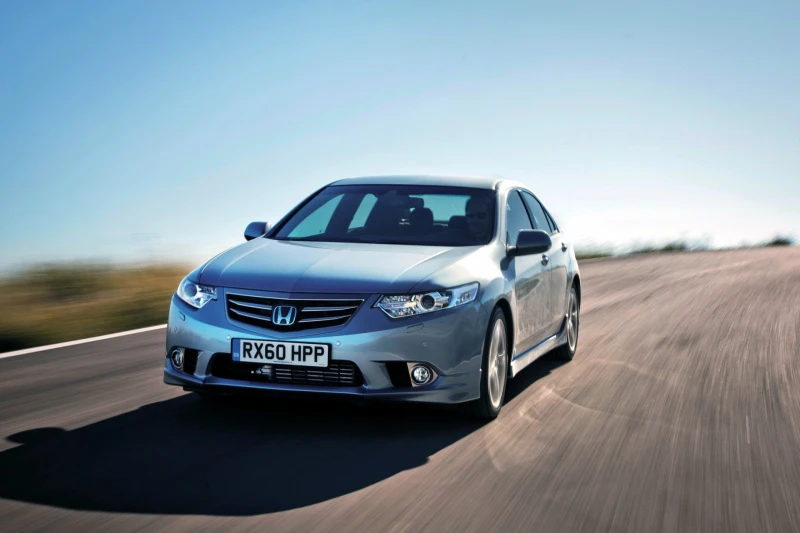
For the United States, the eighth-generation Honda Accord covered the 2008–2012 model years and differed substantially from the European Accord sold during the same period. The U.S. lineup consisted of a four-door sedan and two-door coupe, both front-wheel drive, with 2.4-liter four-cylinder and 3.5-liter V6 gasoline engines. The European 2.0-liter gasoline engine, 2.2-liter i-DTEC diesel and Tourer wagon were not part of the regular U.S. Accord range. Today, these cars are found only on the used market, including major listings on Autotrader, CarGurus and Cars.com.
Separate articles in this series cover exterior design, interior equipment, trim levels and common used-car inspection points.
Engines and transmissions
U.S.-market powertrains were built around two gasoline engine families. The 2.4-liter DOHC i-VTEC four-cylinder was offered in two output levels: 177 hp in lower sedan trims and 190 hp in higher sedan trims and the coupe. The 3.5-liter V6 produced 268 hp at launch and 271 hp in later model years. Four-cylinder versions used a 5-speed manual or 5-speed automatic transmission, depending on trim. V6 sedans used a 5-speed automatic, while the V6 coupe could also be ordered with a 6-speed manual. All U.S. versions were front-wheel drive.
| Engine | Displacement | Output | Transmission | Drive | U.S. application |
| Gasoline inline-four | 2.4L i-VTEC | 177 hp, 161 lb-ft | 5-speed manual / 5-speed automatic | FWD | LX, LX-P and later SE sedan trims |
| Gasoline inline-four | 2.4L i-VTEC | 190 hp, 162 lb-ft | 5-speed manual / 5-speed automatic | FWD | EX and EX-L sedans; LX-S, EX and EX-L coupes |
| Gasoline V6 | 3.5L i-VTEC / VTEC | 268–271 hp, up to 254 lb-ft | 5-speed automatic; 6-speed manual on V6 coupe | FWD | EX / EX-L V6 sedan and EX-L V6 coupe, depending on model year |
Dimensions and weight
The U.S. Accord sedan and coupe shared their basic engineering but used different wheelbases and body dimensions. The sedan was longer and taller, while the coupe had a shorter wheelbase and lower roofline. Minor exterior dimensions changed with the 2011 refresh, so the figures below show representative values for the generation rather than treating every model year as identical.
| Parameter | Sedan | Coupe | Notes |
| Length | about 194.1–194.9 in | about 190.9 in | Sedan length changed slightly after the 2011 update |
| Width | 72.7 in | 72.8 in | Excluding mirrors |
| Height | 58.1 in | 56.4 in | Representative factory dimensions |
| Wheelbase | 110.2 in | 107.9 in | The coupe used the shorter wheelbase |
| Curb weight | roughly 3,200–3,600 lb | roughly 3,200–3,550 lb | Varies by engine, transmission and equipment |
| Trunk capacity | about 14.7 cu ft | about 11.9 cu ft on many versions | Equipment can affect published capacity |
| Fuel tank | about 18.5 gal | about 18.5 gal | Regular unleaded gasoline was specified for the U.S. lineup |
Model-year updates
The generation launched for the 2008 model year with 177- and 190-hp versions of the 2.4-liter four-cylinder and a 268-hp 3.5-liter V6. The four-cylinder came with a 5-speed manual or optional 5-speed automatic, while V6 sedans used the automatic and the V6 coupe offered an available 6-speed manual.
For 2011, Honda refreshed the Accord lineup with revised exterior styling, interior changes and improved EPA fuel-economy ratings on several automatic-transmission models. The sedan also gained an SE trim. The 3.5-liter V6 was rated at 271 hp, while the two 2.4-liter four-cylinder outputs remained 177 and 190 hp. The basic transmission strategy remained unchanged through the end of the generation.
The 2012 model year was the final year of this Accord generation in the United States. It was replaced for 2013 by the ninth-generation Accord, which introduced a new direct-injected 2.4-liter engine, a CVT and a new 6-speed automatic for the V6.
Fuel economy and technical considerations
EPA fuel-economy ratings varied by model year, body style, engine and transmission. At launch, Honda listed the 2008 four-cylinder automatic sedan at an estimated 21 mpg city / 31 mpg highway, while the V6 sedan was rated at 19 / 29 mpg. By the 2011 model year, the four-cylinder automatic sedan had improved to 23 / 34 mpg, and the V6 sedan to 20 / 30 mpg. Coupe ratings differ from the sedan, especially for the V6 with the 6-speed manual, so buyers should check the exact model-year EPA rating rather than applying one figure to every Accord.
When inspecting a used 2008–2012 Accord, maintenance history matters more than broad reliability claims. On four-cylinder cars, check for consistent oil-service records, smooth transmission operation, suspension wear, brake condition and evidence of fluid leaks. On V6 cars, the 3.5-liter engine uses a timing belt, so documentation of scheduled timing-belt service is especially relevant on higher-mileage examples. Automatic-transmission behavior should be evaluated both cold and fully warmed up, and any warning lights should be scanned rather than cleared before purchase.
The U.S. generation used regular unleaded gasoline. There was no diesel or Tourer wagon in the regular U.S. lineup, and there was no Accord Hybrid version for these model years. Those variants belong to other regional Accord families or different model generations and should not be mixed with U.S.-market specifications.
Which version fits different U.S. buyers?
The 2.4-liter four-cylinder paired with the 5-speed automatic is the most straightforward configuration for buyers focused on everyday commuting and lower fuel use. The 190-hp version found in EX and EX-L trims adds more output without changing the basic engine size. Drivers who prioritize stronger acceleration can look at the 3.5-liter V6, while the V6 coupe with the 6-speed manual is the most performance-oriented factory combination in the range.
For any used Accord from this generation, trim level and engine choice should be considered together with accident history, maintenance documentation and the condition of the transmission, suspension and braking system. Because all 2008–2012 U.S. Accords are now used vehicles, the condition of a specific car is more important than its original trim hierarchy.