


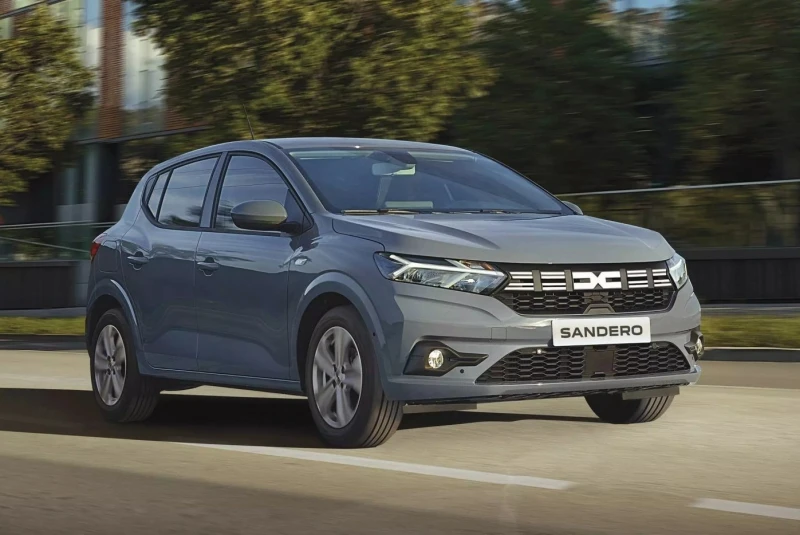
Dacia revealed the third-generation Sandero in September 2020, with European sales beginning later that year. Unlike the European market, the United States has no official Dacia Sandero sales program, U.S.-spec model-year lineup, or factory-backed dealer offering.
The Sandero is built on the Renault-Nissan-Mitsubishi Alliance CMF-B modular platform, also used by models such as the Renault Clio and Captur. It is a front-wheel-drive subcompact with a transverse engine layout.
Within Dacia's range, the Sandero is positioned as an affordable subcompact hatchback, while the Sandero Stepway adds a crossover-inspired appearance, extra ground clearance, body cladding, and modular roof bars. The third generation also introduced Dacia's Y-shaped lighting signature and a more modern cabin and electronics architecture.
What changed from the previous generation
The second-generation Sandero was sold from 2012 to 2020, while the third generation brought a major redesign. The regular Sandero measures about 160.9 inches (4,088 mm) long, compared with roughly 160.2 inches (4,069 mm) for its predecessor, while the styling became lower and wider in appearance with a more pronounced shoulder line and the new light signature.
The move to CMF-B was the biggest technical change. At the European launch, the lineup included the naturally aspirated 1.0-liter SCe 65, the turbocharged 1.0-liter TCe 90, and the gasoline/LPG 1.0-liter ECO-G 100. Depending on the engine and market, Dacia paired them with a five- or six-speed manual transmission or a CVT. The suspension retained a MacPherson-strut front layout and a torsion-beam rear axle.
The cabin and safety package were also updated. Dacia specified six airbags and automatic emergency braking for the new generation. Euro NCAP awarded the Sandero Stepway two stars in its 2021 assessment; that result should be read in the context of the test protocol used at the time rather than compared directly with older star ratings from earlier test standards.
Current status of the generation
The third-generation Sandero remains in production in 2026. A major update announced in late 2025 brought revised exterior lighting and trim, a new steering wheel, updated driver displays and multimedia availability, additional safety systems, and revised powertrains. In 2026, Dacia also expanded the range with the Eco-G 120 gasoline/LPG engine, including a six-speed dual-clutch automatic option, and introduced the full-hybrid 155 powertrain on Sandero and Sandero Stepway in parts of Europe.
For 2026 European-market cars, the regular Sandero can be found with engines such as the SCe 65, TCe 100, Eco-G 120, Eco-G 120 automatic, and hybrid 155, depending on country and trim. Sandero Stepway offerings include the TCe 110, Eco-G 120, Eco-G 120 automatic, and hybrid 155 in selected markets. These are European-market specifications; there is no equivalent U.S.-certified Sandero engine, transmission, or trim lineup.

United States market
Dacia does not officially sell the Sandero in the United States, so there is no U.S. MSRP, factory warranty program, EPA fuel-economy rating, U.S.-specific trim structure, or normal dealer inventory for this generation. The model is primarily a European-market vehicle, with availability also extending to selected markets outside Europe.
Because the Sandero III is a recent non-U.S.-market vehicle, there is no representative American used-car price range comparable with a normally distributed domestic model. Any individual car offered in the United States would need to be evaluated separately for its import status, federal compliance, title and registration history. The 25-year NHTSA age exemption does not yet apply to any third-generation Sandero.
| Model year | U.S. retail status | U.S.-spec trim / powertrain | U.S. pricing guidance |
| 2021–2022 | Not officially sold | None | No official U.S. MSRP or established market range |
| 2023–2024 | Not officially sold | None | No official U.S. MSRP or established market range |
| 2025 | Not officially sold | None | Any private-import asking price is case-specific |
| 2026 | Not officially sold | None | No factory-backed U.S. new-car pricing |
Autotrader, CarGurus, and Cars.com therefore should not be treated as sources for a normal Sandero III market value in the United States. If an individual listing appears, its legal import status and documentation matter more than comparisons with European asking prices.
Main versions and trims for U.S. readers
There are no official U.S. Sandero III trim levels. Names such as Essential, Expression, Journey, and Extreme belong to European or other regional Dacia lineups and can vary by country and model year.
Essential is used in European markets as an entry-level specification. Equipment varies by country and year, so a European Essential should not be assumed to match any U.S. equipment standard or safety package.
Expression sits above the entry specification in several European markets and can add infotainment, convenience, and exterior equipment. The exact feature set depends on the country and production year.
Journey is used on the regular Sandero in some European markets as a higher equipment level, while current Sandero Stepway ranges in markets such as France use names including Essential, Expression, and Extreme. None of these names represents a U.S.-market trim.
Sandero Stepway is the crossover-styled derivative, with raised ground clearance, protective body cladding, and roof bars. Its European engine range has included TCe gasoline, Eco-G gasoline/LPG, and, in 2026, hybrid 155 versions. Those configurations are not official U.S.-market specifications.

Conclusions and relevance of the generation
For a U.S. audience, the Sandero III is best understood as a current overseas-market subcompact rather than a conventional new- or used-car choice available through American dealers. Its appeal in Europe centers on simple packaging, compact dimensions, and a broad range of lower-cost powertrains.
There is no new U.S.-dealer version to compare directly with a used example, and a privately imported car should not be valued by simply converting a European asking price into dollars. Import eligibility, compliance work, documentation, parts access, and registration can materially affect the real cost of ownership.
The generation remains current in 2026, with updated gasoline, LPG, automatic, and hybrid offerings in Europe. For any Sandero III located in the United States, the most important checks are:
- documented service and ownership history;
- federal import and compliance documentation;
- title and state-registration eligibility;
- availability of parts, diagnostics, and qualified service support.
The Dacia Sandero III continues to evolve in its core overseas markets in 2026, but it remains outside Dacia's official U.S. retail lineup.