


This has proven particularly challenging for sports models, where preserving not only power but also the character of the vehicle is crucial. Many manufacturers are addressing the challenge with hybrid systems, but BMW has opted for a different approach for its M-series sports models.
The German manufacturer has unveiled a new technology for its inline-six engines that will enable compliance with Euro 7 standards without full hybridization. The solution will be implemented in the updated versions of the BMW M2, M3 and M4.
Why Euro 7 Has Become a Challenge for Sports Cars
The new Euro 7 environmental standard does not introduce radically stricter emission limits, but it significantly expands the operating conditions under which vehicles must comply. This covers not only normal driving but also cold starts, high loads, rapid accelerations and engine operation across a wide range of climatic conditions.
For sports cars, this presents a particularly difficult challenge. During enthusiastic driving, the engine operates under higher loads, where fuel consumption and emissions traditionally increase.
Many manufacturers have chosen to compensate for this by adding hybrid systems. The electric motor helps reduce fuel consumption and temporarily assumes part of the load, but it also makes the vehicles heavier and more complex in construction.
BMW's New Solution
BMW has developed its own gasoline engine upgrade system, named M Ignite. It is based on pre-chamber ignition technology.
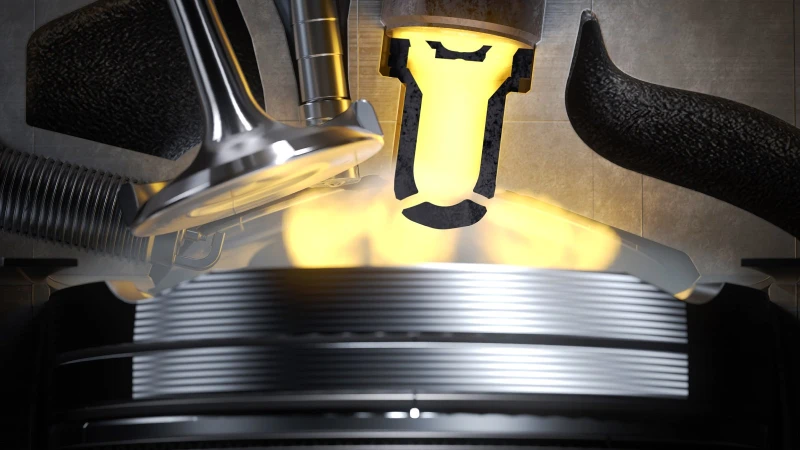
The key feature of the system is an additional small combustion chamber located above the main cylinder. In normal operation, the engine functions in the conventional manner, but under high load an additional ignition process for the fuel mixture is activated.
Part of the mixture is first ignited in the separate chamber, after which the flame propagates through special channels into the main combustion chamber. This approach ensures faster and more uniform fuel combustion.
Advantages of the New Technology
Pre-chamber ignition improves engine efficiency in demanding operating conditions. This is particularly important for sports cars that frequently run at high revs.
The main advantages of the technology are:
- reduced fuel consumption under high load;
- lower emissions of harmful substances;
- preservation of engine power;
- elimination of the need for a heavy hybrid system;
- retention of the traditional character of the sports car.
BMW states that the maximum power output of the M2, M3 and M4 models will remain unchanged. The modernization focuses solely on optimizing engine operation from an environmental and efficiency perspective.
Why BMW Avoided Full Hybridization
In recent years, many sports cars have adopted substantial hybrid setups that have noticeably increased vehicle weight. For models prioritizing handling and dynamics, this represents a significant compromise.
BMW has chosen to preserve the classic concept of a gasoline-powered sports car and use less radical modernization methods. While the company may consider mild hybrid systems in the future, it currently prioritizes traditional powertrains.
For fans of the M series, this means retaining the familiar vehicle dynamics, engine sound and handling characteristics that have long been central to BMW sports models.
Summary
BMW has introduced a new inline-six engine upgrade system that allows its sports models to meet Euro 7 requirements without a full shift to hybrid technology.
The company is focusing on enhancing the efficiency of the engine itself while maintaining the traditional design and performance of its M-series vehicles. The first updated models are expected to enter production in the coming months.