Over the past four decades, the plant has evolved from a relatively compact facility dedicated to a single model into one of BMW’s most technologically advanced and productive plants in Europe. Its history clearly reflects the broader transformation of automotive manufacturing, labor organization, and digital technologies.
Launch and Early Years
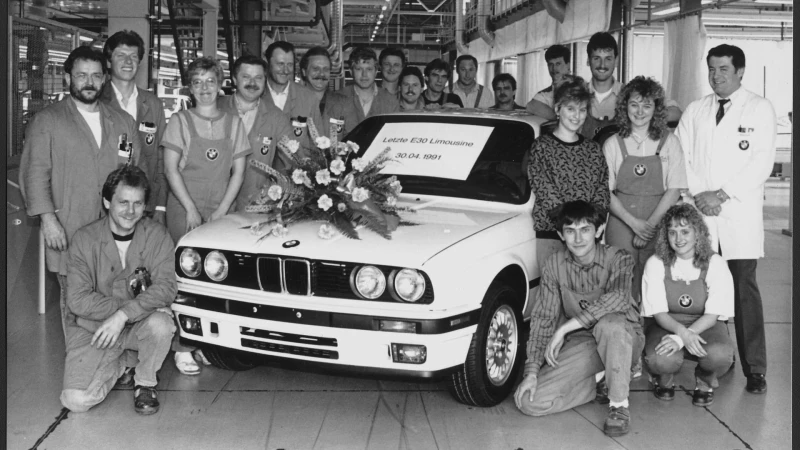
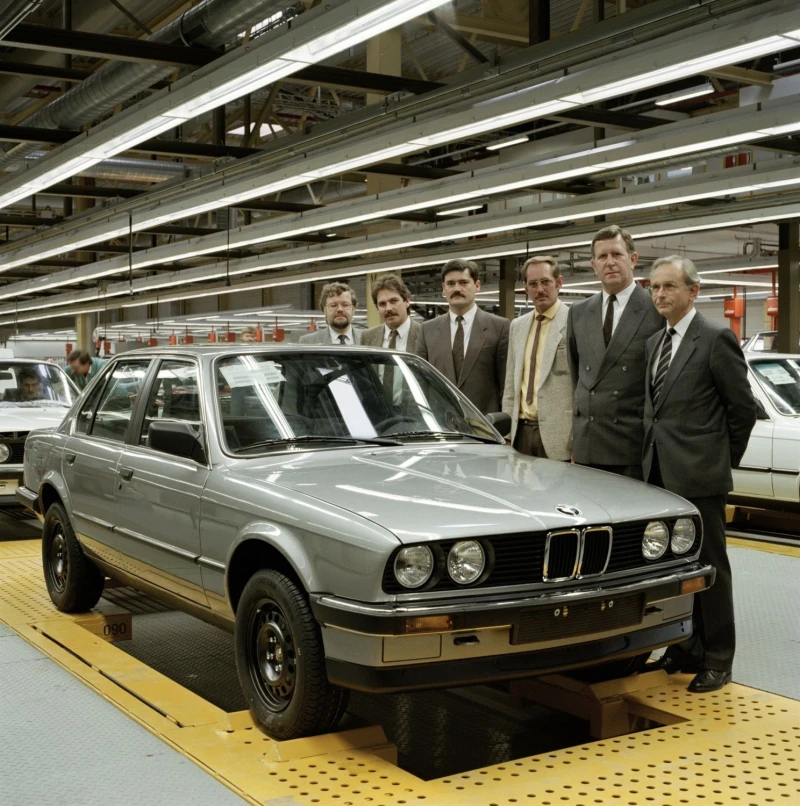
The decision to build the factory in Regensburg was made in 1983, and series production began in the mid-1980s. The first vehicle produced was the BMW 3 Series E30. Initially, the plant employed around 1,300 people and had a planned daily capacity of approximately 400 cars.
In its early years, the factory grew rapidly. In 1987, it commissioned its own paint shop and introduced the first interconnected computer systems in assembly areas, laying the foundation for future automation.
Growth in Volume and Capacity Expansion
In the early 1990s, a body-in-white production line was launched, and the workforce expanded to more than 7,000 employees. Annual production reached about 128,000 vehicles. By 1995, the plant had produced its one millionth car, and by the end of the decade, yearly output exceeded 200,000 units.
By 2005, annual production surpassed 300,000 vehicles. Significant investments were made in stamping, logistics, and quality control to support an expanding model range.
Digitalization and Automation
In recent years, digitalization has been the main focus of development. The plant extensively uses artificial intelligence for paint inspection and quality control on assembly lines. Component logistics are managed through cloud platforms that enable real-time optimization of deliveries.
Since 2025, autonomous vehicle movement has been implemented: after final assembly, cars drive themselves without a driver to the dispatch area. A new vehicle leaves the production line every 57 seconds.
Production Results and Key Models
Last year, the Regensburg plant achieved a record output of approximately 357,000 vehicles, making it BMW’s highest-volume production site in Europe. More than 150,000 of these were electrified models. The BMW X1 accounted for the largest share of production.
Since its launch, the factory has manufactured over 8.7 million vehicles in total. The BMW 3 Series remains the most produced model here, with more than 4 million units. Other models produced over the years include the 1, 2 and 4 Series, as well as the X2 and Z4.
Conclusion
The 40-year history of BMW’s Regensburg plant mirrors the evolution of modern automotive manufacturing — from traditional assembly to highly automated, intelligent, and digital production systems. Continuous technological advancement has allowed the factory to maintain high efficiency and a central role in BMW’s global manufacturing network.