


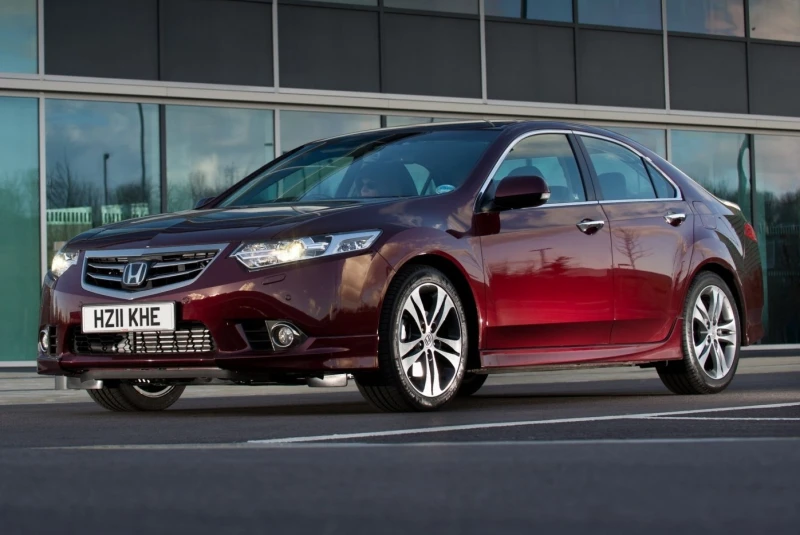
Honda introduced the all-new 2008 Accord for the United States on August 21, 2007, with sales scheduled to begin in mid-September. For the U.S. market, this eighth-generation Accord was sold as a four-door sedan and a two-door coupe. The European-market Accord of the same era was a different model and included a Tourer wagon, so its engines, trims and body styles should not be mixed with U.S. specifications.
The U.S. Accord used a front-engine, front-wheel-drive layout with a double-wishbone front suspension and a multi-link rear suspension. Production was centered in North America, and Honda reported that by the 2011 model year more than 95% of U.S.-market Accords were built at its plants in Marysville, Ohio, or Lincoln, Alabama.
Within Honda's American lineup, the Accord remained the brand's core family car, positioned above the Civic. The generation emphasized a roomier cabin, stronger body structure, more powerful gasoline engines and a broader range of comfort and safety equipment. There was no factory diesel Accord in the U.S. lineup for these model years.
What changed from the previous generation
The 2008 redesign made the Accord noticeably larger. The sedan stretched to 194.1 inches in length, 72.7 inches in width and 58.1 inches in height, with a 110.2-inch wheelbase. Honda said the sedan was 3.0 inches longer than the 2007 model, while the larger passenger compartment moved it into the EPA's large-car class by interior volume.
The engine lineup was also revised. LX and LX-P sedans used a 2.4-liter i-VTEC four-cylinder rated at 177 hp and 161 lb-ft, while EX and EX-L four-cylinder models produced 190 hp and 162 lb-ft. The 3.5-liter V6 debuted for 2008 at 268 hp and 248 lb-ft; for 2009 Honda revised the rating to 271 hp, with 254 lb-ft for automatic-equipped versions. Four-cylinder cars could be paired with a 5-speed manual or 5-speed automatic, while the V6 sedan used a 5-speed automatic. The V6 coupe could also be ordered with a 6-speed manual.
Honda also increased body rigidity and expanded standard safety equipment. Vehicle Stability Assist, ABS, side-curtain airbags, front side airbags and active front head restraints were standard across the 2008 lineup. The 2008 Accord sedan earned an IIHS Top Safety Pick designation, and the updated 2011 sedan later received a five-star Overall Vehicle Score under the then-newer NHTSA testing program.
Where the generation stands today
By 2012, the U.S. lineup still centered on the same two gasoline engine families: the 177-hp or 190-hp 2.4-liter four-cylinder and the 271-hp 3.5-liter V6. Sedan trims included LX, LX-P, SE, EX, EX-L, EX V6 and EX-L V6, while the coupe lineup included LX-S, EX, EX-L and EX-L V6. All versions were front-wheel drive.
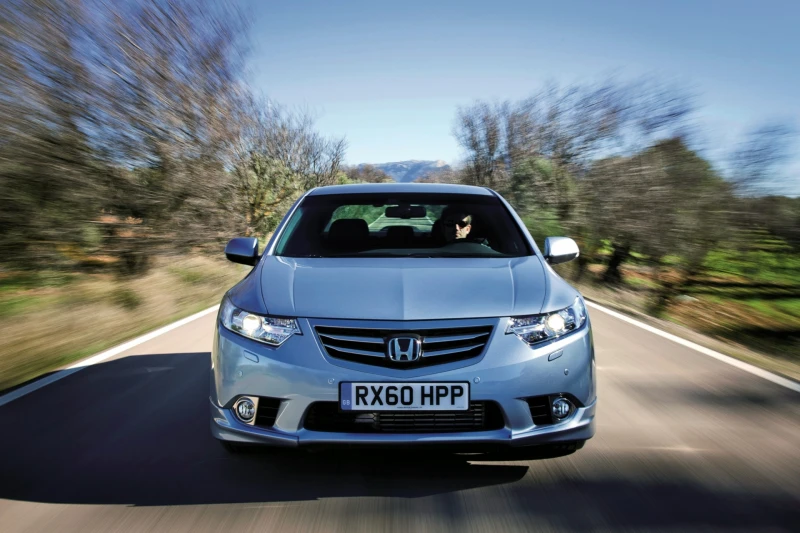
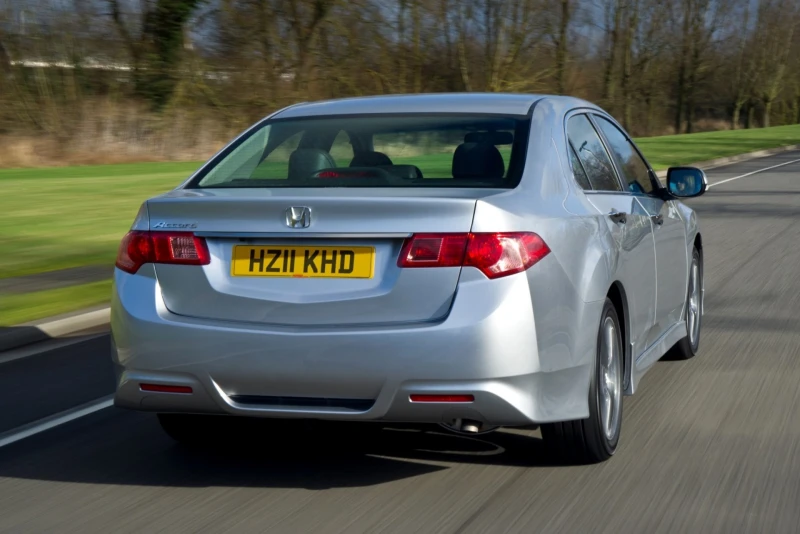
The key mid-cycle update arrived for 2011. Honda revised the grille, bumpers, rear styling and interior details, added the SE sedan trim, and improved fuel economy on several automatic-transmission versions. For example, the 2011 four-cylinder automatic sedan was rated at 23 mpg city, 34 mpg highway and 27 mpg combined by the EPA. The eighth-generation U.S. Accord ended after the 2012 model year, with the ninth-generation 2013 Accord going on sale in fall 2012.
On the used market, the main configurations to distinguish are the lower-output 2.4-liter LX/LX-P sedans, the 190-hp EX/EX-L four-cylinder cars, and the 3.5-liter V6 models. Buyers interested in a manual transmission should note that the 6-speed manual was reserved for the V6 coupe, while four-cylinder versions used a 5-speed manual when so equipped.
U.S. used-car market
In 2026, the 2008–2012 Accord remains widely represented on major U.S. used-car platforms such as Cars.com, CarGurus and Autotrader. Asking prices vary sharply with mileage, condition, accident history, region, body style and trim, so a single narrow price range is not representative of the market.
Current nationwide listing pages show model-year averages generally in the upper-8,000tomid-9,000 range for 2009–2012 cars, while lower-priced examples can appear well below those averages. These figures are listing-market references rather than official valuations and should be treated as a snapshot rather than a fixed price guide.
| Model year | Typical U.S. configuration | 2026 nationwide asking-price reference | Market context |
| 2008 | LX/LX-P 2.4 sedan or EX/EX-L | About $8,000 average | Early cars show the widest spread by mileage and condition |
| 2009 | 2.4 sedan/coupe or 3.5 V6 | About $8,600 average | V6 and lower-mileage examples can sit above the overall average |
| 2010–2011 | 2.4 four-cylinder or 3.5 V6 | Roughly 8,500–9,000 average by model year | The 2011 model brings the mid-cycle styling and efficiency updates |
| 2012 | Sedan or coupe, four-cylinder or V6 | About $9,500 average | Final model year of the generation; unusually clean cars may ask more |
Condition matters more than trim alone at this age. A well-documented four-cylinder car can be a better purchase than a more expensive V6 or leather-equipped model with deferred maintenance, accident repairs or corrosion. Regional pricing can also differ significantly across the United States.
Main U.S. trims and versions
Common sedan trims were LX, LX-P, EX and EX-L, with V6 power available on upper trims; the SE sedan joined the lineup for 2011. Coupe buyers typically encountered LX-S, EX and EX-L, with the V6 concentrated in EX-L models.
LX and LX-P sedans used the 177-hp 2.4-liter four-cylinder. LX-P added convenience equipment over the base LX, including alloy wheels and additional power-seat content depending on model year. These trims generally represent the simpler end of the range.
EX and EX-L four-cylinder cars used the 190-hp version of the 2.4-liter engine. EX models added equipment such as a moonroof and upgraded audio, while EX-L brought leather seating and additional comfort features; navigation was available on selected EX-L models. Equipment details changed slightly by year, so the original window sticker or VIN-specific build information is useful when evaluating a used car.
The 2011 SE sedan added leather-trimmed seating, heated front seats, driver power lumbar support and a leather-wrapped steering wheel to equipment derived from the LX-P. V6 sedans paired the 3.5-liter engine with a 5-speed automatic, while the EX-L V6 coupe was the enthusiast-oriented configuration because it could be ordered with a 6-speed manual. Honda's Variable Cylinder Management system was used on automatic V6 versions to improve cruising efficiency.
Conclusions and relevance as a used car
For U.S. shoppers, the eighth-generation Accord remains a straightforward used-car proposition: a roomy sedan or coupe with widely available gasoline powertrains and conventional front-wheel drive. The most important distinction is not between European-style trims or diesel options, but between the 2.4-liter four-cylinder cars and the more powerful 3.5-liter V6 models.
Its age means condition and maintenance history now matter more than broad reputation. Current listings show that the generation still has an active U.S. market, but prices overlap heavily across years and trims. A pre-purchase inspection and vehicle-history check are more useful than assuming that a particular badge automatically guarantees a better example.
Four-cylinder LX, LX-P, EX and EX-L cars suit buyers prioritizing simpler running costs and fuel economy, while the V6 sedan and especially the 6-speed-manual V6 coupe offer more performance. The 2011–2012 cars add the refreshed styling and several equipment and efficiency updates.
When inspecting a used Accord from this generation, pay particular attention to:
- service history, including timing-belt service on the 3.5-liter V6 when due under Honda's Maintenance Minder;
- automatic-transmission operation, fluid-maintenance history and any signs of leaks or delayed shifts;
- suspension wear, tire condition and brake condition;
- rust or underbody corrosion, especially on cars that spent years in road-salt regions;
- accident history, warning lights, electronics and a cold-start/test-drive inspection.
In the United States, a 2008–2012 Honda Accord should therefore be evaluated as the North American eighth-generation sedan or coupe, with U.S.-specific engines, trims, safety equipment and market pricing rather than specifications from the European Accord sold during the same period.