Low temperatures affect battery efficiency, energy consumption, and charging speed. To evaluate the real capabilities of modern models, a comparative test was conducted, examining range, energy consumption, and the ability to quickly recharge in winter conditions.
Test Methodology and Conditions
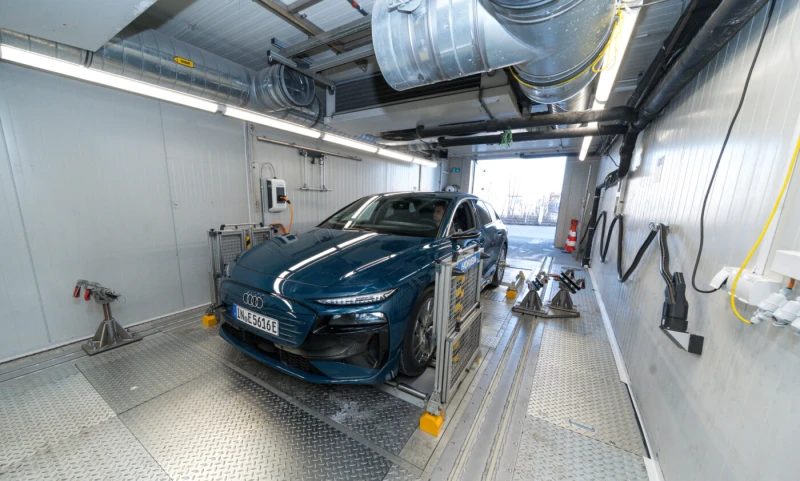
The study involved 14 electric vehicles from various manufacturers, each officially capable of traveling at least 500 kilometers without recharging. The tests were conducted in near-winter conditions at around 0 degrees Celsius. A test route of approximately 580 kilometers was simulated on a test bench, with variable speeds, inclines, and varying loads on the powertrain.
The evaluation focused on three key parameters:
- actual range on a single charge;
- distance that can be covered after a 20-minute fast charge;
- average energy consumption.
This combination of factors determines how suitable an electric vehicle is for long-distance travel in cold weather.
Test Results and Model Differences
The best result was achieved by the Audi A6 Avant e-tron performance, which covered about 441 kilometers on a single charge. It required only one stop for recharging to complete the entire test distance. This was made possible by an efficient powertrain and a well-designed energy management system.
Some models showed considerably lower results. For example, the Volvo EX90 Twin Motor AWD ranked at the bottom, while the BYD Sealion 7 Excellence AWD demonstrated a range of less than 300 kilometers. This means such vehicles would require more charging stops under similar conditions.
Efficiency Matters More Than Battery Size
The test results confirmed that the key factor is not just battery capacity but also its efficient use. For instance, the Tesla Model Y exhibited one of the best energy consumption rates — about 22.2 kWh per 100 kilometers. The Audi A6 Avant e-tron performance also showed high efficiency at around 23.2 kWh per 100 kilometers.
In contrast, vehicles with higher energy consumption, such as the Volvo EX90 and BYD Sealion 7, used significantly more — over 31 kWh and 35 kWh per 100 kilometers, respectively. This directly impacts range and makes these models less convenient for long winter trips.
Advantages of Modern Fast Charging Systems
Another important factor was the speed of recharging. Vehicles equipped with an 800-volt electrical architecture can restore energy faster. Such a system reduces losses during charging and allows for higher charging power compared to traditional 400-volt solutions.
Nevertheless, some vehicles with classic architecture also achieved high results, confirming the importance of overall powertrain efficiency and software-managed charging.
Conclusions
The tests showed that the range of electric vehicles in winter can significantly differ from official figures. Efficiency in energy use plays a crucial role, rather than just battery capacity. Modern models with well-thought-out energy management systems and fast charging capabilities maintain high practicality even in cold conditions, whereas less efficient vehicles require more frequent stops for recharging.