


The CR-V has long been praised for its bulletproof reliability and versatility, while the Tucson turns heads with bold design and cutting-edge tech. In this comparison, we break them down across key categories—design, performance, comfort, technology, light off-road capability, and pricing—to help you decide which one deserves a spot in your garage.
Design and Exterior Styling
These crossovers showcase distinctly different personalities through their looks.
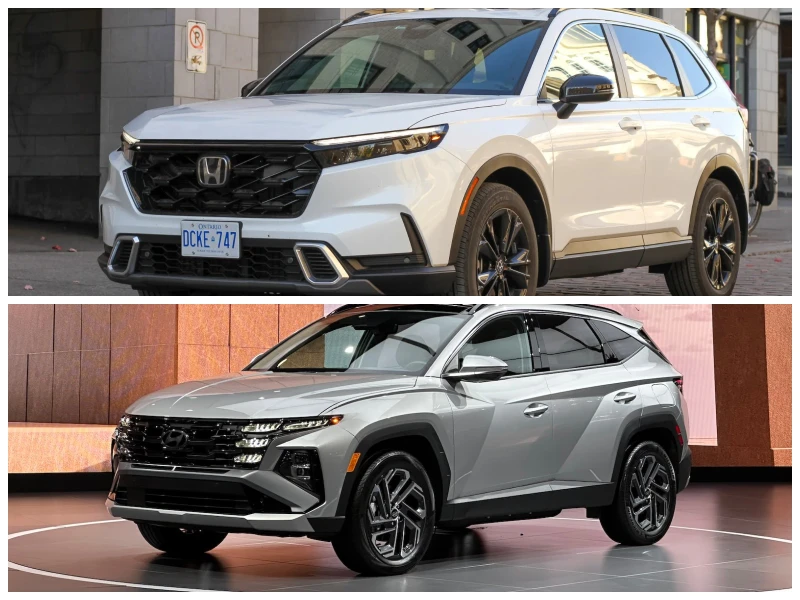
- Honda CR-V: The 2025 model evolves Honda’s timeless design language. A wide grille, slim LED headlights, and smooth body lines deliver a clean, upscale appearance. It looks substantial and practical—perfect for buyers who want an understated yet modern SUV.
- Hyundai Tucson: The Tucson takes a daring approach with futuristic hidden lighting, sharp creases, and an aggressive front fascia that makes it one of the boldest in the segment. It’s built to stand out on the road.
Extra note: The CR-V is slightly longer (184.8 inches vs 182.3 inches for the Tucson), giving it a more imposing stance, while the Tucson edges ahead in height for a sportier profile.
Verdict: CR-V offers refined classic styling; Tucson delivers bold, contemporary flair.
Performance and Specs
Both SUVs offer gasoline and hybrid powertrains, but with different priorities.
| Model | Horsepower | Fuel Economy (mpg combined) | 0-60 mph (sec) | Drivetrain |
|---|---|---|---|---|
| Honda CR-V (hybrid) | 204 | 40 | 8.0 | AWD available |
| Hyundai Tucson (hybrid) | 231 | 38 | 7.8 | Standard AWD |
- Honda CR-V: The hybrid pairs a 2.0-liter engine with electric motors for smooth, quiet operation. The gas version uses a 1.5-liter turbo (190 hp). All-wheel drive is optional.
- Hyundai Tucson: Its hybrid combines a 1.6-liter turbo with an electric motor for more punch. The base gas engine is a 2.5-liter (187 hp). AWD comes standard on hybrids.
Extra note: The CR-V’s e-CVT delivers seamless acceleration, while the Tucson’s 6-speed automatic feels more responsive.
Verdict: Tucson takes the lead in power and acceleration; CR-V shines with refinement and slightly better hybrid efficiency.
Comfort and Interior Space
For family SUVs, cabin room and ride quality are make-or-break.
- Honda CR-V: Maximum cargo space reaches 75.8 cu ft with seats folded (36.5 cu ft behind rear seats). Rear legroom is generous, the suspension is plush, and noise isolation is top-tier.
- Hyundai Tucson: Cargo maxes out at 80.3 cu ft (41.2 cu ft standard). The cabin is spacious, though seats are firmer and the ride a bit stiffer.
Extra note: CR-V offers more rear legroom (41.0 inches vs 39.0 inches), while Tucson provides greater cargo volume with seats up.
Verdict: CR-V is the comfort champion for passengers; Tucson wins for cargo flexibility.
Technology and Safety
Both are loaded with modern driver aids and infotainment, but approach them differently.
- Honda CR-V: 9-inch touchscreen, standard Honda Sensing suite (adaptive cruise, lane keeping, automatic emergency braking), wireless Apple CarPlay/Android Auto. Interface is intuitive and dependable.
- Hyundai Tucson: Standard 12.3-inch display with available dual 12.3-inch panoramic screens. Features Blind-Spot View Monitor, Remote Smart Parking Assist, and Highway Driving Assist II.
Extra note: Tucson packs more wow-factor gadgets like digital key via smartphone, while CR-V prioritizes proven, hassle-free systems. Both earn 5-star NHTSA and IIHS Top Safety Pick ratings.
Verdict: Tucson leads in tech innovation; CR-V excels in simplicity and reliability.
Light Off-Road Capability
Neither is a hardcore off-roader, but they handle snow and gravel with ease.
- Honda CR-V: Ground clearance of 7.9 inches, available Real Time AWD with intelligent torque distribution. Great for winter roads and light trails.
- Hyundai Tucson: 8.3 inches of clearance and HTRAC AWD with terrain modes. Slightly better suited for rougher surfaces.
Extra note: Tucson has a small edge thanks to higher clearance and drive-mode tuning, but both stay firmly in the soft-roader category.
Verdict: Tucson is marginally better for occasional dirt roads; CR-V is perfectly fine for urban and suburban use.
Pricing and Ownership Costs
Value and long-term costs often seal the deal.
- Honda CR-V: Starts around $32,000; hybrid models from approximately $38,000. Strong resale value, low maintenance costs, and widespread dealer network.
- Hyundai Tucson: Base price from about $30,000; hybrids start around $35,000, with top trims reaching $42,000. Industry-leading 10-year/100,000-mile powertrain warranty.
Extra note: Approximate market pricing for the United States (MSRP before taxes and fees). CR-V holds value better over time; Tucson offers more features for the money upfront and a longer warranty.
Verdict: Tucson wins on initial affordability and warranty; CR-V shines in long-term ownership value.
Final Verdict: Which One Should You Choose?
The 2025 Honda CR-V is the go-to pick for buyers prioritizing reliability, passenger comfort, and a smooth daily drive. The 2025 Hyundai Tucson appeals to those craving standout styling, advanced tech, and spirited performance. Both rank among the best compact SUVs on the market—your choice comes down to priorities. Get behind the wheel of each and let the test drive decide!