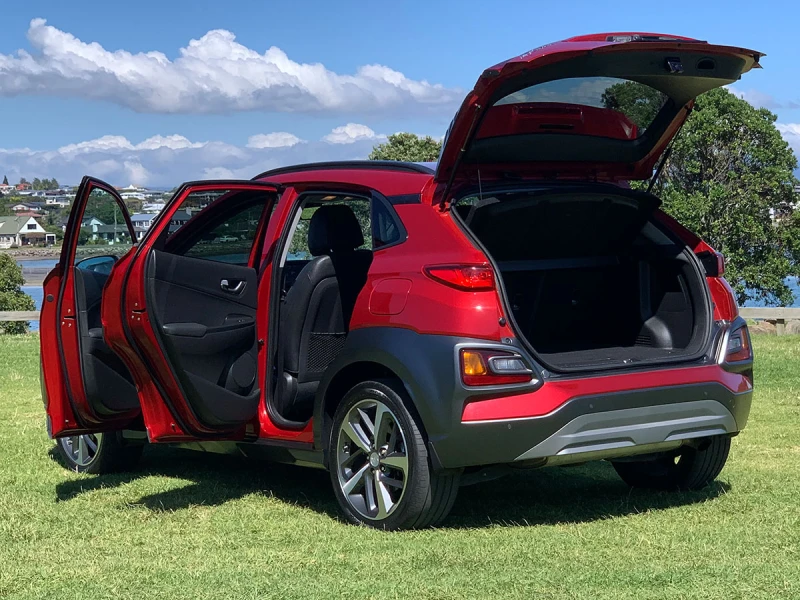
In the US market, the model was officially offered starting from 2018, mainly with gasoline powertrains. Technical specifications of the Hyundai Kona I (OS) varied depending on the model year, trim level, and configuration. Below are the key details on engines, transmissions, dimensions, and operating features relevant to the American market.
A detailed review of the exterior, interior, trim levels, and common issues of this generation is covered in separate articles in the series.
Engines and Transmissions
In the US, the Hyundai Kona I (OS) was predominantly equipped with gasoline engines. Diesel versions were not offered officially, and hybrids appeared later in the model's lifecycle but were less common in the first generation. All-wheel drive (HTRAC) was available primarily with the more powerful turbo engine.
Main powertrains available in the US market:
| Engine Type | Displacement, cu in | Power, hp | Transmission Type | Drivetrain | Notes |
| Gasoline, naturally aspirated MPI | 2.0L | 147 | CVT (IVT) | FWD | Most common base variant throughout the generation |
| Gasoline, turbo T-GDI | 1.6L | 175–195 | 7-speed DCT | FWD / AWD (HTRAC) | Offered on higher trims; power varied by year and facelift |
After the 2020 facelift, the 1.6-liter turbo engine received updates (Smartstream family), and minor-hybrid systems were introduced in some markets but remained rare in the US for this generation.
Dimensions and Weight
The exterior dimensions of the Hyundai Kona I (OS) stayed largely consistent throughout production, with minor adjustments after the 2020 facelift mainly to bumpers and lighting. Typical values for gasoline versions in the US:
| Parameter | Value | Notes |
| Length, in | 164–165 | Pre-facelift ≈164 in, post-facelift ≈165 in (with updated bumpers) |
| Width, in | 70.9 | Excluding mirrors |
| Height, in | 61.0–61.6 | Depending on wheels and trim |
| Wheelbase, in | 102.4 | Consistent across all versions |
| Curb Weight, lbs | 2,855–3,300 | Lowest for base 2.0 FWD, highest for 1.6 turbo AWD DCT |
| Gross Vehicle Weight, lbs | 3,900–4,200 | Depending on drivetrain and engine |
| Ground Clearance, in | 6.7–8.3 | Varies by drivetrain (lower on FWD, higher on AWD) |
Weight and dimension specs varied slightly between front-wheel-drive and all-wheel-drive versions, as well as pre- and post-facelift models.
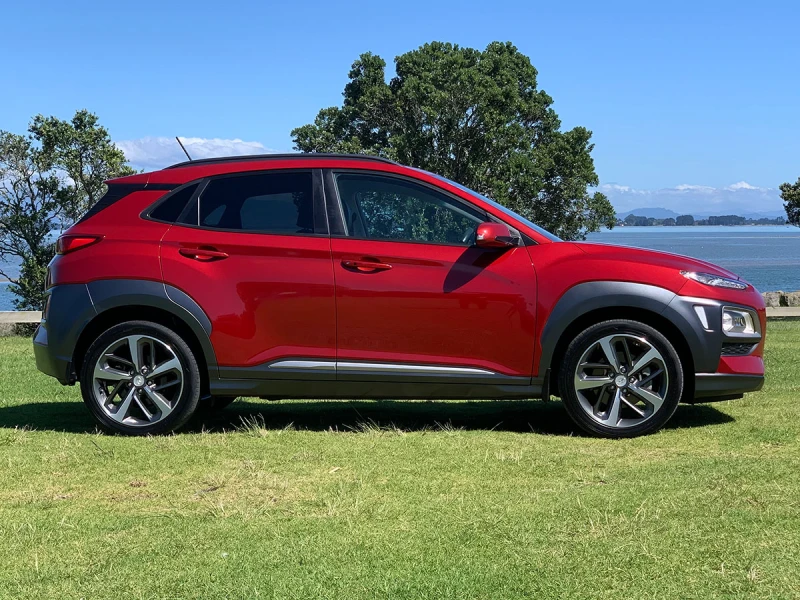
Updates by Year and Facelift
Production of the Hyundai Kona I (OS) continued through 2023. Key changes:
- 2018–2019 — launch in the US, main engines: 2.0 MPI (147 hp) and 1.6 T-GDI (175 hp). Transmissions: CVT (IVT) for 2.0, 7-DCT for 1.6 turbo.
- 2019 — introduction of N Line trim with sportier suspension and styling (mostly paired with 1.6 turbo).
- 2020 facelift — refreshed front and rear design, updated interior materials, expanded driver-assist features. 1.6 turbo bumped to around 195 hp in later models. 2.0 MPI remained the base option.
- 2021–2023 — main offerings in the US: 2.0 MPI and 1.6 turbo with CVT/DCT, including AWD variants. N Line and higher trims gained popularity.
On the US used market in 2026, post-facelift models from 2020–2023 with 2.0 MPI and 1.6 turbo engines dominate.
Operating Features and Technical Notes
In the US, the most popular versions are the 2.0 MPI (everyday economical choice) and 1.6 turbo (more dynamic, especially with AWD). The naturally aspirated 2.0 is reliable and widely available on the used market.
Engine reliability is generally good to above average when maintenance schedules are followed. The turbo 1.6 T-GDI is sensitive to fuel quality and requires timely oil changes; carbon buildup on intake valves (direct injection) may occur, so preventive cleaning every 50,000–60,000 miles is recommended. The 2.0 MPI is more forgiving but less spirited.
According to US sources (EPA ratings, owner forums), approximate real-world fuel economy:
- 2.0 MPI — 28–32 mpg combined;
- 1.6 turbo (175–195 hp) — 25–29 mpg combined (FWD), 23–27 mpg with AWD, higher in city driving.
The 7-speed DCT requires fluid changes every 40,000 miles or so; aggressive driving can lead to overheating and clutch wear. HTRAC AWD is reliable but increases weight and fuel consumption slightly.
Parts availability is excellent (OEM and aftermarket), and maintenance costs are average for the class. Repairability is strong, with many components shared with other Hyundai/Kia models like the Elantra or Veloster.
Summary and Best Choice for the US Market
On the US used market in 2026, the most balanced option appears to be the 2.0 MPI with CVT (IVT) and front-wheel drive: decent performance, good fuel economy, low ownership costs, and strong resale value. The 1.6 turbo (195 hp) with DCT and AWD suits those wanting more power and better traction, but it comes with higher fuel and maintenance expenses.
When shopping, prioritize post-facelift 2020+ models with documented service history, especially for the DCT transmission and turbo components. Naturally aspirated versions are ideal for relaxed driving with minimal extra costs.
Approximate market price range for well-maintained used examples in the US (2026): $12,000–$22,000 depending on year, mileage, trim, and condition. Approximate market price for the United States.