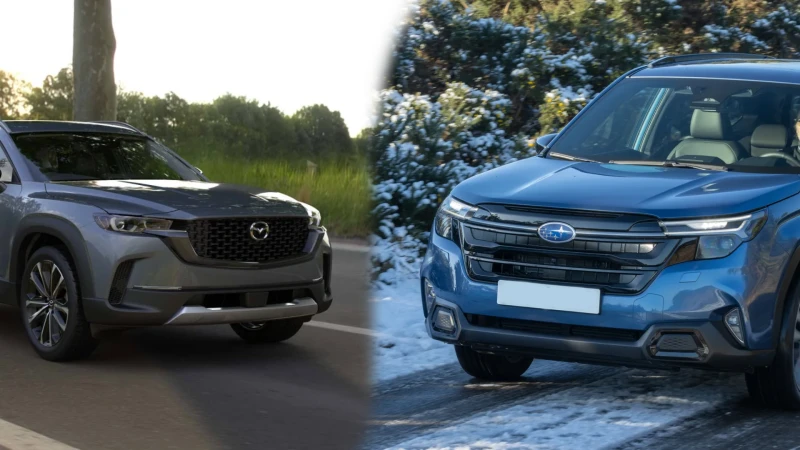
The CX-50 emphasizes sporty dynamics and a premium cabin, while the Forester prioritizes utility and family comfort. Let’s break down the key differences to help you decide which compact SUV is right for you.
Design Overview: Sportiness vs Practicality
The exterior styling and design philosophy of these SUVs reflect their intended use and target buyers.
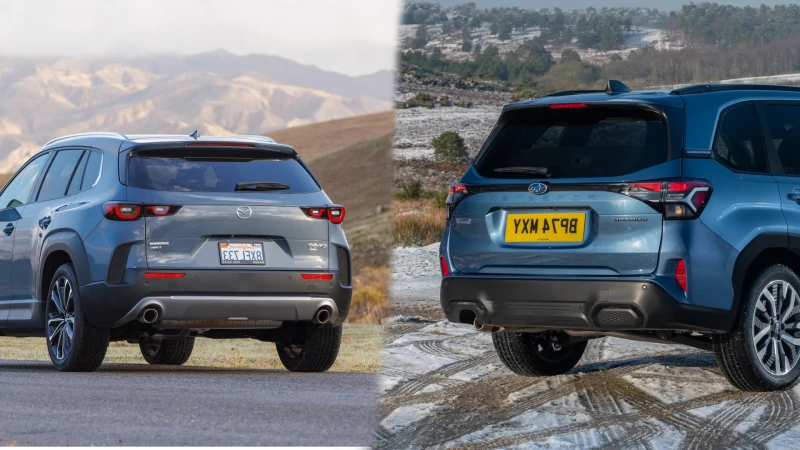
- Mazda CX-50: The 2025 CX-50 stands out with elegant, athletic lines, black cladding, and LED lighting. It measures around 185 inches long, offers up to 8.6 inches of ground clearance (Meridian edition), and new colors like Polymetal Gray add personality. The overall look feels more upscale than typical family crossovers.
- Subaru Forester: The sixth-generation 2025 Forester adopts a bolder, boxier design focused on function. It’s about 183 inches long, with 8.7 inches of ground clearance and tall roof rails that signal adventure readiness — especially in the Wilderness trim.
Who it’s for? The Mazda CX-50 appeals to drivers who want style and refinement for daily commutes and light weekend getaways. The Subaru Forester is ideal for families and outdoor enthusiasts seeking a rugged, dependable companion.
Performance Specs: Power and Efficiency
Both come standard with all-wheel drive and offer hybrid options, but their powertrain philosophies differ.
| Specification | Mazda CX-50 2025 | Subaru Forester 2025 |
|---|---|---|
| Engine | 2.5L 4-cyl (187 hp); 2.5L turbo (up to 256 hp); hybrid (219 hp) | 2.5L 4-cyl (180 hp); hybrid (194 hp) |
| Torque | 186–320 lb-ft | 178 lb-ft |
| 0–60 mph | 8.5 sec (base); 6.6 sec (turbo) | ~8.3 sec |
| Fuel Economy (city/hwy) | 24/30 mpg (base); 39/37 mpg (hybrid) | 26/33 mpg (base); ~35 mpg (hybrid) |
| Drivetrain | All-wheel drive (i-Activ AWD) | All-wheel drive (Symmetrical AWD) |
| Transmission | 6-speed auto; CVT (hybrid) | CVT |
Performance: The CX-50 offers more engine choices, including a punchy turbo that delivers sharper acceleration. The Forester focuses on smooth, predictable delivery but has less power in its base setup.
Efficiency: The CX-50 hybrid leads with up to 39 mpg highway, while the Forester hybrid is close behind at around 35 mpg. Non-hybrid Forester models edge out the base CX-50 for everyday fuel economy.
Verdict: Choose the CX-50 for driving excitement and hybrid efficiency; go with the Forester for proven reliability and solid fuel savings.
Interior and Tech: Premium Feel vs Utility
Both cabins are modern and tech-rich, but they cater to different priorities.
- Mazda CX-50: The near-luxury interior features high-quality materials, available leather, and a 10.3-inch display with Amazon Alexa, wireless Apple CarPlay, and Android Auto. Rear legroom is 39.7 inches; cargo space is 31.4 cu ft (up to 56.3 cu ft with seats folded). The rotary controller for infotainment takes some getting used to.
- Subaru Forester: Spacious and functional, with an 8- or 11.6-inch vertical touchscreen and wireless smartphone integration. Rear legroom measures 39.3 inches; cargo volume is 29.6 cu ft (up to 74.4 cu ft). Durable StarTex upholstery in certain trims resists dirt and wear.
Bottom line: The CX-50 wins on upscale ambiance and materials, while the Forester offers more maximum cargo room and family-friendly practicality.
Off-Road Ability and Safety: Versatility vs Ruggedness
Standard AWD and advanced safety suites come on both, but off-road prowess varies.
- Mazda CX-50: i-Activ AWD with Off-Road mode and up to 8.6 inches of clearance handle light trails well. The Meridian edition adds all-terrain tires. Safety tech includes adaptive cruise, automatic emergency braking with nighttime pedestrian detection, and IIHS Top Safety Pick status.
- Subaru Forester: Symmetrical AWD plus X-Mode (with snow/dirt settings) gives it an edge on tougher terrain — especially the Wilderness trim. 8.7-inch clearance and robust roof rails boost capability. EyeSight driver assists earn equally strong IIHS ratings.
Verdict: The Forester is the better choice for serious off-road adventures; the CX-50 strikes a great balance for mostly on-road use with occasional dirt-road escapes. Both excel in safety.
Pricing and Warranty: Value Comparison
Cost and coverage are major decision factors.
- Mazda CX-50: Starts at $31,720 (Select) and tops out around $44,720 (Turbo Premium Plus); hybrid models begin at approximately $35,840. Warranty: 3 years/36,000 miles basic, 5 years/60,000 miles powertrain.
- Subaru Forester: Base price $31,415, up to $47,995 (Wilderness). Warranty: 3 years/36,000 miles basic, 5 years/60,000 miles powertrain.
Orientative market price range for the United States (MSRP including destination, late 2025):
• Mazda CX-50: $32,000–$45,000
• Subaru Forester: $31,500–$48,500
Analysis: The Forester offers a slightly lower entry price and competitive top-end value. The CX-50 provides more powertrain variety, including an efficient hybrid option.
Which SUV Should You Choose?
It comes down to your priorities. The Mazda CX-50 2025 is the stylish, engaging driver’s crossover — perfect for those who want premium feel, spirited handling, and occasional light adventures. The Subaru Forester 2025 is the rugged, spacious family hauler built for reliability, cargo flexibility, and real off-road capability. A test drive will reveal which one feels right for your lifestyle!